In the last two weeks of September in Serbia, SD (34) killed his wife SS (27), RV (58) killed his ex-wife Lj. V. (54), and Đ. M. (26) mother DM (61). A video showing MD (57) beating a female person VI (48) on the street (who later turns out to be his longtime friend), as well as photos of SH (19) who was beaten by her husband DH (23), injuring her and their two-month-old baby. At least two of the perpetrators emphasized their religious affiliation and appealed to God on social networks.
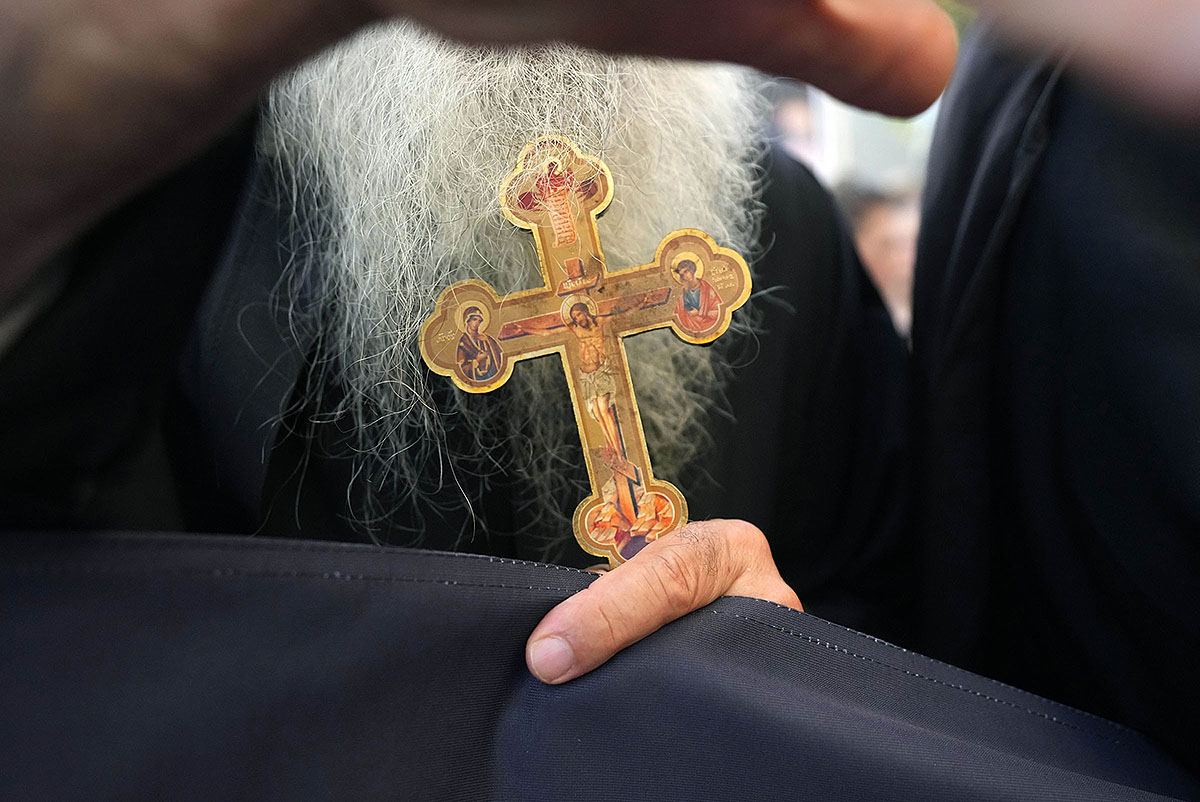
Domestic violence knows no borders - both the abusers and the victims are members of all classes, illiterate and PhDs, atheists and believers of all religions... The role of religious communities in a society, especially dominant ones, can be roughly two-fold - on the one hand, they can provide victims with spiritual and practical support, create horizon of normal i accepted which condemns violence, and dismantles the patriarchal narrative about what a woman can and should do, and on the other hand, it can actually encourage it - make the victim feel even more guilty, provide the abuser with justification to continue with his behavior, and thus play an important role in all denser sacred silence.
REVOCATION PERMITS FOR VIOLENCE
"It is not excluded that I missed it, but I did not notice that there was a public condemnation of domestic violence by church dignitaries. The exception is bishop Grigorije, who normally talks about topics that are rarely discussed in church circles," psychologist Danka Spasovski told Vreme. He emphasizes that such messages are very important because they do not deepen the gap between the secular and the church, but on the contrary, they unite them and bring people closer to those values that should be universal.
It is not certain that the bullies would behave differently if they heard from a priest or bishop that what they are doing is wrong. However, according to the interviewee of "Vremena", this would contribute to the establishment of norms that consider domestic violence unacceptable: "If the community reacted differently, it would be a form of condemnation and penalties for the bullies themselves”.
Namely, with this, the tacit permission to commit violence that he received from society - that he has the right to control the woman, to treat her as if she were his property - would be withdrawn, at least in part.
"CONSPIRACY OF SILENCE"
In Belgrade in 2006, domestic violence was for the first time a topic of joint discussion among high-ranking religious representatives. Unfortunately - and the last one.
Then, at the round table organized by the Society of Serbian-Jewish Friendship, then Bishop Jegarski and now Patriarch Porfirije of the SPC, Belgrade Archbishop Stanislav Hočevar, Chief Rabbi of Serbia Isak Asiel and Academician Prof. Dr. Ljubomir Tadić, then president of the Society of Serbian-Jewish Friendship.
How did it even come about?
Rabbi Isaac Asiel explains that at that time, 16 years ago, he was watching a television program and a bystander, grinning, said that he told his wife that he must not disturb him during sports Wednesday, she was saying something in front of the television, and he he slapped her at that. And that was the moment when the rabbi began to deal with the topic of domestic violence by collaborating with the non-governmental organization Astra, giving lectures and participating in debates.
His presentation in 2006 was titled "Conspiracy of Silence". He said that religious leaders should speak about problems of general social importance, especially domestic violence: this is in accordance with the biblical principle that one should not stand aside while the blood of one's neighbors is shed. And the Talmud, as the rabbi explains, expands the meaning of this commandment - "anyone who is able to improve or correct the situation, but does nothing, is responsible for the transgression and the consequences".
In the Jewish communities, he pointed out what all types of violence exist - what all this entails is physical and psychological, economic and sexual violence - the risk factors, as well as the warning signs when it comes to violent behavior, that men and women are different but that this difference does not implies superiority or inferiority unless one wants to interpret it that way, and the Torah does not consider the husband's position as the head of the family to be a position of power.
"I was in Sarajevo at a gathering and commenting on my presentation, they said - what feminism - and I spoke from the viewpoint of classic Jewish texts", says the rabbi for "Vreme". "Let's say, many centuries ago, Judaism held the position that marital rape is forbidden. Australian legislation, when it comes to this, was precisely inspired by Jewish religious law". He adds that the problem of domestic violence is also present in Israel, but that legal and ethical writings in Judaism are unequivocal regarding the prohibition of physical violence against women.
By the way, marital rape became a criminal offense in Serbia for the first time in 2002, and it has only been prosecuted ex officio since 2017. Before that, the procedure was entered on the basis of the injured party's proposal, which was signed by the prosecutor's office.
Although none of the religious representatives later dedicated themselves to the topic and the education of believers, the rabbi believes that the topic of domestic violence must never be left off the agenda. And the reality, according to his description, is more than bleak - the media generally "sells blood", violence is encouraged in reality shows, and the entire value system suffers from a lack of self-control.
"We cultivate a culture of violence - verbal, physical, sexual... Everything starts with jokes, young people get messages that such jokes are a desirable model of behavior, it causes laughter, they are more accepted. And one thing leads to another... That's how the devil threw the longline," says the rabbi.
SINGLE EXAMPLES
The term "almost diabolical" was used recently by Pope Francis when he spoke about violence against women. Namely, he paid attention to that problem several times. Last year, on December 19, in the show "Francis and the Invisibles", designed to draw public attention to vulnerable categories of the population, he spoke with an Italian woman, a victim of domestic violence, an unemployed mother of four.
"The number of women abused by their husbands in their own homes is very, very large. For me, there is something almost diabolical about taking advantage of one's (physical) strength”. In February of the same year, Pope Francis spoke about the types of violence against women, calling psychological, physical and sexual violence an act of cowardice and degradation of all humanity. In his sermons, he called on major Christian holidays to help women who are victims of domestic violence, which especially intensified during the pandemic due to even greater isolation.
Just in the days when Italian television viewers could follow the conversation between Pope Francis and the victim of domestic violence, and his condemnation of the same, an avalanche was launched in Serbia under the hashtag I didn't report. Namely, thousands and thousands of women wrote on Twitter why they didn't report their abusers - there were terrifying testimonies about a system that, more or less consciously, makes a decision every day to victimize women. The institutions remained silent.
From the Serbian Orthodox Church, which certainly, according to its influence, bears greater responsibility for speech and silence in public space compared to other religious communities, only Bishop Grigorije of Dusseldorf and Germany spoke out. Among other things, he wrote on his Instagram account that violence and cruelty are not a necessity and an inevitability, and that is why we must never turn a blind eye to such an act:
"We can only imagine the mental suffering, internal fractures, humiliation and sense of lost dignity of a woman who has suffered violence, but the ambitions to which that suffering reaches remain incomprehensible".
He also pointed out the importance of unreserved support for the victim, both through the unconditional acceptance and understanding of her relatives and the support of professionals.
"The ultimate outcome of the suffering the victim goes through usually depends on that support. After all, even Christ was not alone when he was going through suffering", wrote Bishop Grigorije. He dedicated the end of the text to the perniciousness of the feeling of guilt and the importance of getting rid of it: "A woman whose being has been assaulted in a rude and ferocious manner often attributes the guilt and responsibility for what has been done to her to herself, which is more pernicious than anything else."
ANSWER FROM THE PATRIARCHATE
A considerable number of criticisms have been heard in recent days against Patriarch Porfirio of the Serbian Orthodox Church - why is he silent about domestic violence, and uses very harsh words when it comes to the LGBT population.
Apparently, the answer to public pressure appeared in "Večernji Novosti". It is an interview with Vicar Bishop Justin, coordinator of humanitarian activities of the Archdiocese of Belgrade and Karlovac. In that conversation, the bishop said everything that should have been heard earlier and louder - that marriage with a violent person is not God's will, that economic dependence is one of the key factors in the passivation of victims, as well as that the Church, together with other parts of society, should take a greater role in preventing violence.
"The wrong idea of preserving a marriage through violence against a living person is a sin in itself. We in the Church have a big task to highlight this paradigm in the foreground, which will change other outcomes in our observations of life and Christianity", said Bishop Justin. He announced training for priests and emphasized the importance of establishing a family service as well as finding work for women who have experienced severe trauma, and finally, he reiterated that the Church must fight against violence. It seems that, in reflection on these issues, experts were also consulted, which is good.
FAMILY STAYING IN PLACE
The SPC - although it is not alone in the world in this respect - for now shows, to say the least, a lack of sensitivity to the contemporary problems of women.
Mostly, we don't talk about violence against women, the difficulty of harmonizing family life and work, a worse position on the labor market, dismissals from employers when women get pregnant, or the famous job interview question - "Do you have children and/or do you plan to have them?" Also, there is not a word about lower wages for women for the same work or work of equal value, greater vulnerability of women intensified in times of crisis, gender discrimination, less presence of women in public life and in high positions, nor about the need for their greater involvement in life itself Churches... And all that has to do with a healthy family and birth rate.
There is talk, occasionally, about the traditional family, and there, I guess, the traditional roles of man and woman are assumed to be good. If abortion is condemned, all responsibility is placed on the woman.
At this moment, a prayer for the family is read in all the churches of the Serbian Orthodox Church. How powerful and important would the message be if the defense of the family, i.e. its most vulnerable members, were also discussed there? Wouldn't that be the fight for a healthy family? Because it is from there that models of behavior - violence and suffering - are built. It would also be an important walk through the streets of the capital - to protect the victims.
Sociologist Nancy Nason Clark is a professor emeritus at the University of New Brunswick and has been researching the relationship between violence, religion, gender and culture in various parts of the world for years. In his text "When Terror Strikes at Home: The Interface Between Religion and Domestic Violence", he states, among other things, that there is no evidence that violence is more frequent or serious in religious families, but that religious women are more vulnerable when violence occurs. Namely, those patterns that exist in mainstream culture are reinforced in that case: fear, isolation, vulnerability, a promise before God to remain a spouse until death separates them. Therefore, they are more inclined to believe the abuser's promise that they will change their behavior, and the guilt that they will let God and the family down because they did not last in the marriage is very present. Of course, a huge role is played by financial dependence, as well as fear for one's own life or the life of children, but often also, as Professor Nason Clark calls it, religious ideology that insists on "a happy family that builds a happy nation" and insists on the role of women as homemakers. and mother is very important for her sense of self-worth and belief that every divorce is wrong.
Nevertheless, the role of religion can be to support but also to influence the violent behavior of an individual. The most important thing in this is the issue of accepting responsibility. For men who are believers, Nancy Nason Clark points out, it is important that the condemnation of violence comes not only from contemporary, secular culture but also from the religious community. She also points out that it is important to combine these dimensions in rehabilitation programs for violent offenders.
The decisive role in individual cases is played by religious representatives, but also by the community itself. "Sacred texts and the religious authorities who interpret them play a decisive role in how violence is interpreted," writes Nancy Nason Clark. "When it is talked about in services - through sermons or various materials available to the faithful - the victims feel safe to come forward, and when it is absent from the religious discourse, the victims continue to remain silent, seeing it as their personal struggle".
What is also important, when it comes to this topic, is, as some other authors point out, the misinterpretation or misuse of religious texts, which reinforces the guilt of the victims, and rationalizes and justifies violence.
Finally, the question can be raised as to how well, for example, priests are educated to answer such a question, how well they are prepared to provide support in cases of such trauma.
A case from Bosnia and Herzegovina can serve as a good example. Namely, there more than 60 religious representatives - Orthodox and Catholic priests, imams, religious teachers - from all three religious communities went through training for the prevention of violence against women, as well as violence in general. The program is jointly managed by several local organizations in cooperation with UN Women in Bosnia and Herzegovina.
In a statement for Free Europe, the imam from Sanski Most, Selmir Hurić, said that through training he learned how to recognize a person who suffers violence and the mechanisms that can help him: "Religious leaders often say that they find themselves in situations where women ask for help, because they they see it as a safe point they can turn to, and they may not yet be sufficiently aware of what women can do in such a situation, where to turn," he said. One of the reasons for religious leaders to get involved is the fact that more than 90 percent of citizens in Bosnia and Herzegovina declare themselves to be believers. The representative of UN Women for Bosnia and Herzegovina added in the same text - why not use this opportunity for good?
This text was created within the project "Improving the safety of women in Serbia", which is implemented by the United Nations Agency for Gender Equality and Empowerment of Women in Serbia (UN Women), with the support of the Norwegian Embassy in Belgrade. The views in this text belong exclusively to the authors, and do not necessarily represent the views of UN Women and the Norwegian Embassy.