In the place that probably most clearly radiates the media's and every other ruin in Serbia, in the "Kurir" tabloid, a headline appeared whose poetics speaks far more convincingly about the said theories than I will do in the rest of the text. Or is it just me who thinks that the sentence "Nine of us saw the third bullet" should be the crown evidence and I rest my case on court, in the first round, by knockout.
The story of the third bullet is not the only topic on which all interested parties created fog around the most important court process in Serbia, but it has become its most recognizable expression. The ambitions of its creators changed over time, from the desire to abolish the special court, to overturn the indictment according to which the assassins were tried and to write a new one, according to which they would probably be acquitted and beatified, and finally, to listening to public opinion, and suffocating this topic in a bunch of meaningless theories.
ZOMBIE THEORIES: Nikola Vrzić gained his dark journalistic fame precisely by inventing a conspiratorial fiction that came out of the need of all users on March 12 to talk about this terrible event that changed Serbia for the worse forever, never getting a final, judicial, social and historical epilogue. Some of his theories, in the meantime, have become so bizarre that even Vrzić would have renounced them. Some still roam among people, like soulless zombies. Basically, Đinđić's entourage, which is a colloquial name for several people who spent days with him, and could be reduced to Čed, Beba, Milić and Janjušević, was fabricated for some of his own criminal reasons, in order to hide his connections with the assassination some indictment, which will fall by itself, as soon as brilliant minds say what it is about. Well, in order. Photo-robot with the help of which he proved that Zvezdan did not shoot. It was not a problem for him that the photo-robot was released immediately after the assassination, when it was not known, as it is known now, that Aleksandar Simović and Ninoslav Konstatinović were wearing glasses and wigs on that day, fleeing the scene of the crime, so that in the possible photo - you wouldn't look like yourself to a robot. Then the ice bullet, stolen from Robert Redford from Three Days of the Condor. Well, the second rifle, the Kalashnikov that Vrzic enthusiastically wrote about as the assassin's real weapon, and Miloš Vasić, in this very newspaper, explained to every normal person that this Kalashnikov was found in the same bag with the heckler and sent for expert examination in Wiesbaden to determine that was it used in one of the unsolved murders. And so endlessly.
If people didn't hate reading the indictment or the verdict, these theories would seem silly at first glance. Namely, this reading is clear and precise, like a collection of tasks for the first elementary, in which facts simply agree with other facts. The fact that Zvezdan Jovanović fired two shots, one of which killed Zoran Đinđić, has been hammered in from a hundred sides and absolutely nothing can change it. Apart from the confession he gave, which also fits the material evidence and other testimonies, there is a bullet, which was proven to have been fired from the rifle from which Jovanovic fired, there is a grain with gunpowder particles that match the gunpowder particles on the gun and the gunshot wound, there are on the rifle there are fibers from the blanket draped over the window from which he fired, there is Jovanovic's DNA on the cigarette butts and there is so much more material that would make this text more boring than the verdict that on 446 page of the PDF file explains this case in minute detail.
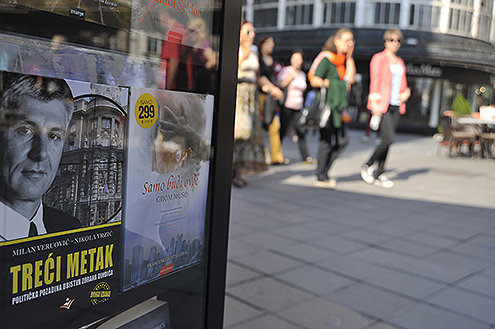
RETURN TO GEPRATOV: A decade later, when Vrzić's fiction seemed to have been chewed long ago, it began its afterlife in the book Third bullet. The thesis about the third bullet first appeared on the big stage in October 2003, with the guest appearance of Milan Veruović in "Zažiprst B92". When he testified on this topic a few days after March 12, he told the people he spoke to that he had heard nothing. Zoran's moan and then nothing. The statements of the other bodyguards did not reveal the later monolithic story about the third bullet that everyone heard and now may have seen. Anyone who remembers October 2003, remembers that it was the time of the collapse of the Živković government, the stamping of spectacular affairs, and the craziest one of all, according to which the real assassin shot from Birčaninova Street and not from Gepratova, Veruović's story about the third bullet was dismissed as fools helmet.
When it turned out that due to the entrance angle of the wound, the building in Birčaninova Street would have lacked six floors in height for the bullet to reach it, Veruović, as well as the entire entourage of the third bullet, lawyer Boža Prelević, and Homer of this epic, Nikola Vrzić, return the assassin to Gepratova . Fortunately for them, no one reads the texts, so the content under the title "The Third Bullet" was easily changed. At that time, it was not enough even for President Tadić to whisper about the third bullet in intimate circles, but for the first time he went to the Special Court to express his support for Veruović. And maybe some kind of pathology according to Đinđić. After this testimony, the Veruović brothers received appointments in foreign embassies, Milan in Strasbourg, and Miladin (famous for the fact that, after the first assassination attempt at the Limes hall, he cold-bloodedly returned the mobile phones, which contained all the evidence of the connection with the assassins) to Bagzi in Lisbon , which is an adventure about which then ambassador Dušan Kovačević could write a sequel Hilarious tragedies. The theory of the third bullet suffered a slightly worse fate at the main trial than it did in the media. When they were forced to place the third bullet, the shot that all nine saw and heard, at the exact time in relation to the other events from the precise and complicated reconstruction, it turned out that the bullet wandered left and right for several tens of seconds until it settled. in their ears. Because of this, as well as the fact that they changed their statements several times, the court rejected their testimonies as incorrect and illogical, leaving them to shame themselves and everyone who messed with them.
NOBODY NEEDS EVIDENCE: Or let's try to turn things upside down. After the assassination, some people conducted an investigation. They knocked on the doors of people who don't know each other, questioned everyone, arrested, interrogated and made up some kind of story. If it is a conspiracy, about a hundred people should have participated in it. And all the years of Kostunica's reign, who with his entire entourage rushed to this case like a speaker on a lectern, threatening, bribing, deposing, forcing false testimony, doing all that, without managing to make a serious crack in this case. No more serious than the story of the third bullet.
And we had the opportunity to see what it looks like when the conspirators meet with investigations and facts. It looks just like when Veruović changes his expression with each season. It looks like Vrzic's tabloid theories. He looks like Velja Ilić and Čović when they lie about Legija's letter. I saw the letter. I never saw the letter. What letter? And then the frog turned into a fourteen-year-old girl, and that's the truth, Mr. Judge, not what her mother is saying. It looks like when Aco Tomić and Rade Bulatović lie about the meetings with Legija and Šiptar. It looks like when Legija lies about 600 kilos of heroin on his back and in his nose. It looks like when Koštunica has been sabotaging the passing of the law on protected witnesses for months. It looks like when Jočić minimizes the significance of the murder of the witness Kuja Kriještorac. It looks like when the whole gang, which no one has ever had the opportunity to question before the court, gets so entangled in their lies and actions that during the trial of Djindjic's killers, all the people leading this process are replaced.
Therefore, if there was a conspiracy by which Đinđić's entourage tried to hide something, there would have been much thicker and more visible traces than Vrzić's theories, even thicker than those left behind by those whose rise to power was a direct consequence of the assassination.
And well, who really wanted Djindjic dead? Experts Vrzić and Veruović will perhaps show that the assassination of Đinđić was the result of an unexpected turn after which he became a pro-European politician without any provocation. new born nationalist, and because of that he was eliminated by the foreign services. Perhaps the argument that those services did not eliminate Slobodan Milosevic by assassination even after much worse manifestations of nationalism would mean something to someone. Perhaps it would mean the argument that Đinđić tried to take the initiative with a couple of benign letters, to save the Kosovo issue from Kostunica's manipulation and while there was time to extract as much as possible from it, certainly more than will be obtained after independence. It is interesting that the refusal of the great powers to deal with the subject was as cold-blooded as Đinđić's initiative expressed in several letters. The only passionate rejection of Đinđić's involvement in Kosovo came, of course, from Kostunica.
The litmus test to know how normal or happy our country is will always be easy to do when you see how far it has progressed in the investigation of the political background of the assassination of Zoran Djindjic. I would like to be wrong, but I am afraid that the commission formed by Vučić's government will find itself among those who will solve the problem of Đinđić's murder by not solving it. In the hope that Seselj could die appropriately, and that he or someone like him could easily become a monopolist of the political background. And everyone happy. And nobody happy.
Although I think that no one needs evidence about the kind of country we live in, even though 60 percent of its adult citizens are currently satisfied with their misfortune.
The author is an artist from Belgrade.