This year's Nobel Prize in Physics was awarded for an unusual record that physicists managed to set. Man normally sets various records - he conquers the highest peaks, jumps from the highest heights, sends robotic probes to the greatest (space) depths, reaches the lowest possible temperatures (close to absolute zero) and in general, sometimes demands the most or the least from himself and the world in which he lives . Imagine the next goal - to produce something that lasts the shortest time. How short can something be?
The current world record in this twisty discipline is much shorter than what we traditionally think of as going fast. The metaphorical "blink of an eye" lasts infinitely long, one third of a second, the swing of a fly's wings lasts much shorter, about one thousandth of a second, i.e. a millisecond, but it is still a very slow thing, and when we try to find things that last for millions or billionth of a second, we will find ourselves in a world of short radio signals, microprocessor cycles, rapid radioactive decay and pulses of laser light. These last, the laser pulses, it turns out, can be made to last very short indeed. Physicists do it too.
The world record for the shortness of a laser pulse is 43 attoseconds, which was achieved in 2017 in a laboratory at the prestigious ETH in Zurich. When we talk about the so-called attosecond, we are talking about a duration that is a billion billion times shorter than one second. This "duration" is actually shorter than one second, approximately as much as one second is shorter than the age of the Universe (15 billion years). The prefix ato, borrowed from the Danish language where it means eighteen, is used in physics for a duration that is 18 orders of magnitude less than a second (10-18).
In order to achieve such "shortness", it was necessary to exceptionally develop the physics of lasers, which today have enormous applications in telecommunications and other modern fields. Physicists in highly developed laboratories today use lasers that produce so-called femtosecond pulses and which have great applications in recording very fast processes in nature, but they are even a thousand times slower than the fastest ones, attoseconds. This year, the Nobel Committee therefore, somewhat unexpectedly, illuminated a small community of dedicated enthusiasts who deal with precisely the fastest possible, attosecond physics.
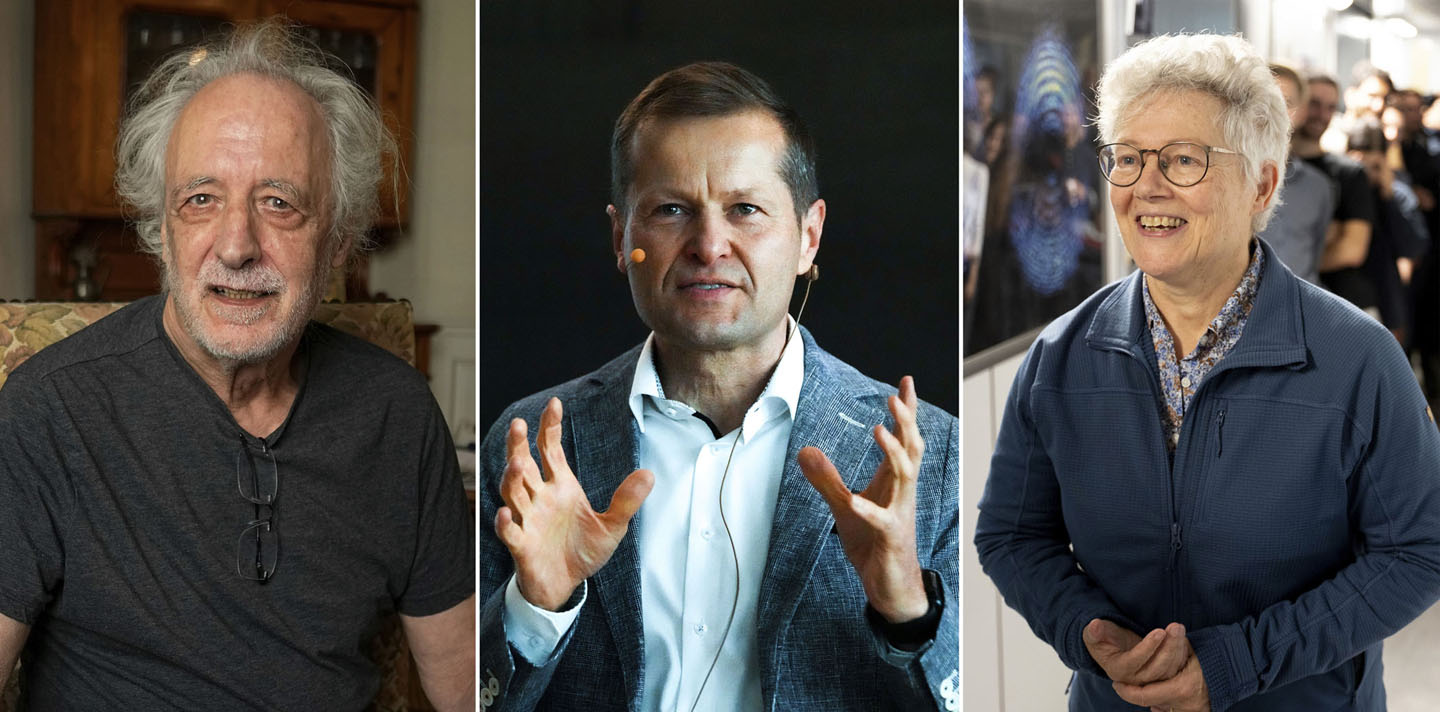
The Royal Swedish Academy of Sciences awarded the 2023 Nobel Prize in Physics on Tuesday to Pier Agostini, Ferenc Kraus and Anna L'Ullier, for experiments that generate attosecond pulses. Agostini is a physicist from Ohio University in the USA, Kraus works at the Max Planck Institute for Quantum Optics in Germany, while L'Ullier is a professor at Lund University in Sweden. By the way, she is only the fifth woman to receive the Nobel Prize in Physics, a fact that has been hailed in the media around the world.
The works of this year's Nobel laureates enabled the development of fast laser pulses, and the Nobel committee paid special attention to the question you probably already asked yourself - what is the purpose of such a discovery and such a record, too fast to be understood at all?
The answer is very simple and actually obvious - just as in the world of insects things happen faster than in the world of humans, if we go into the world of the really very small, into the world of electrons, we will realize that they are moving so fast that they could be recorded by any known microscopic devices because they are too slow for that. In fact, their "movements" last an attosecond and in order to record them, it is necessary to use attosecond pulses that have become possible thanks to the works of this year's Nobel laureates. Their discovery actually opened the door to the life of electrons. Once we watch it on film, the world as we know it will not be the same again, and it will be thanks to a twisted record achieved by laser physicists.
Read daily news, analysis, commentary and interviews at www.vreme.com