Evropa Nostra Serbia nominated the General Staff complex for this year's program "7 Most Endangered" facilities and entities in Europe.
Europe's leading civil society network for heritage, which covers more than 40 countries and works closely with the European Union, the Council of Europe and UNESCO, expresses deep concern over continued reports of plans by the Serbian authorities to sign a contract with an American company to allow the demolition of a historically significant of the General Staff and Ministry of Defense complex in Belgrade, due to the construction of a hotel.
What threatens the General Staff
Namely, this May, the Serbian government signed a contract with the company of Dazed Kushner, the son-in-law of former US President Donald Trump, under the radar of the public and without explanation, for the construction of a luxury hotel on the site of the former General Staff complex in Belgrade.
It was only necessary to find a way to remove the status of cultural property from the General Staff.
The conservators of two institutes for the protection of cultural monuments - the republican and the city - publicly opposed the cancellation of the status of immovable cultural property for the complex of buildings of the old General Staff in the city center. They believe that cultural heritage is a "non-renewable resource" whose loss, as they pointed out in the statement, "disappears the permanent universal values of the overall heritage on a national and wider level."
Directors of both institutes - Olivera Vučković and Dubravka Đukanović resigned, refusing to remove protection from the General Staff.
The Serbian Academy of Sciences and Arts announced that it is expressly against the demolition.
Architects and the professional public have published a Declaration against the demolition of the General Staff and the Belgrade Fair.

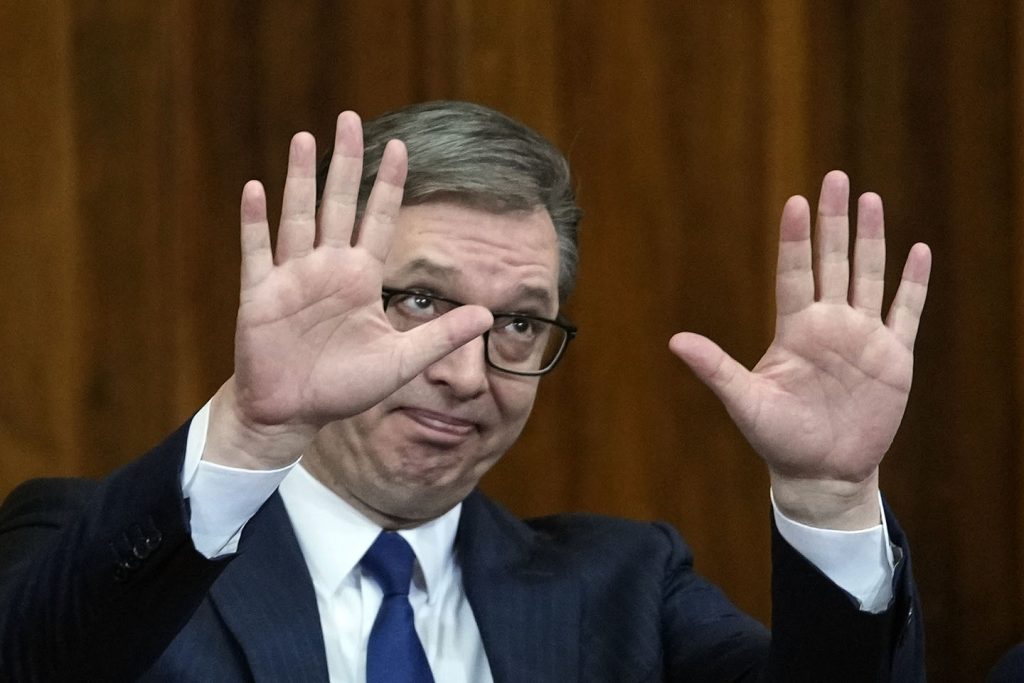
Photo: InstagramPresident Vucic and Jared Kushner
And yet, Kushner's meeting with Vučić this summer, this project was made official.
Since it was announced that the finance committee of the US Senate launched an investigation against Kushner, President Vučić and other representatives of the government have mentioned the General Staff less often, which of course does not mean that they have given up on its overthrow.
Thus, in the last "Hit Tweet" TV Pink show, the head of the Radical Party, Vojislav Šešelj, said that now "smart people have appeared, some from the academy (SANU) even, that it should be preserved like a cultural monument, of what kind of culture?" A certain architect Dobrović, known for the construction of those communist buildings, built the General Staff here to resemble the Sutjeska canyon where the partisans allegedly broke through, and where Tito sacrificed the wounded to save his head. Is it some cultural value? And if Trump's son-in-law is ready to invest a billion dollars and build an elite hotel there, why not give it? A clear gain for Serbia, plus the problems in the city center would be solved."
The General Staff is a masterpiece
Because of all this, Evropa Nostra believes that the cultural property of the General Staff complex is endangered and that, as a cultural property, it should be protected.
The nomination entitled "Modernist complex of the General Staff" was submitted on October 15.10.2024, XNUMX.
In the explanation, they stated that "the General Staff is a masterpiece of Yugoslav, Serbian and European modernist architecture. Designed according to the project of the famous architect Nikola Dobrović, completed in the sixties of the last century, this building complex represents one of the most significant and valuable symbols of the urban landscape of Belgrade. Its potential demolition would not only destroy a unique part of cultural history, but would also set a dangerous precedent for the future protection of heritage monuments in Serbia."
The decision of the Serbian branch of Europe Nostra to nominate the General Staff for the "7 Most Threatened" this year is, according to "Vreme", primarily "the result of the expressed responsibility of numerous associations and institutions, as a reaction to the news of the intention to demolish and radically change the purpose of protected architectural masterpieces".
Support from other countries
This refers primarily to the aforementioned Declaration of Architects, which has been supported by 50 institutions and associations from Serbia, Slovenia, Montenegro, the Czech Republic, Bulgaria to date in the form of open letters - starting with the Serbian Academy of Sciences and Arts, through faculties and key professional associations, to ICOMOS, DOCOMOMO International - international organization for the documentation and conservation of buildings, places and units of the modern movement in architecture, and the International Union of Architects - General Secretariat.
Who is protected by the "7 Most Vulnerable"
The "7 Most Endangered" program has been implemented by Evropa Nostra since 2013 with the aim of saving European cultural heritage. During the selection of candidates, their cultural and historical significance, as well as the degree of danger they face, are first of all taken into account. The Institute of the European Investment Bank (EIB) joined the program three years ago.
Each of the seven selected projects is entitled to financial support from the EIB in the amount of up to 10.000 euros, as an initial investment.
So far, fifty-six endangered monuments and sites from thirty-one countries have been selected for the list of the "7 Most Endangered" program. About twenty percent of those projects have been successfully completed, another fifty percent are making good or medium progress, and only three projects can be considered failures.
From Serbia, the Subotica Synagogue, Belgrade Fortress and its surroundings, Dečani Monastery, Vodenice Bistrice, Petrovac na Mlava have been included in the Program so far.
and the House of the JNA in Šabac.
Whether the General Staff will join them will be decided by the Management Board of Europe Nostra.