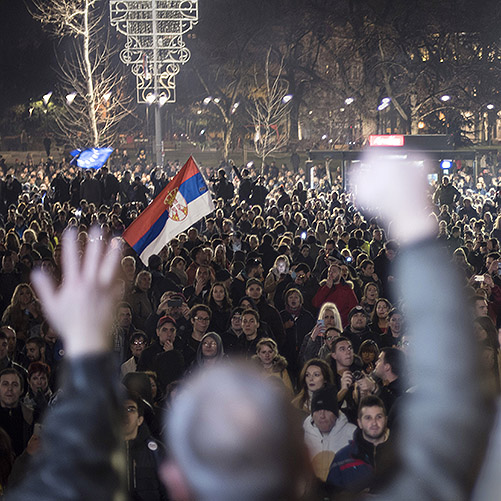
Both the government and the opposition accuse each other of planning to cause violence on the streets, only the government's accusations against the opposition are louder. The government is sucking the blood of the opposition 1) due to the raid on RTS on March 16 and 2) the following day due to the siege of Aleksandar Vučić in the Presidency of Serbia, which are realistically the two biggest (mostly the only) stupidities of the citizen-opposition protests that have been spreading since the beginning of December across Serbia. Quite enough for the regime to make maximum use of them for its propaganda and pay for it with interest. In that package, a protest walk to TV Pink was announced this Saturday, which is still being discussed as to whether it will take place. The opposition, on the other hand, accuses the government of planning violence since the presidential counter-rally campaign "The Future of Serbia" began, which is Aleksandar Vučić's direct response to civil protests. It was, in fact, only a matter of time when two opposing columns would find themselves on the street at the same time, one opposite the other.
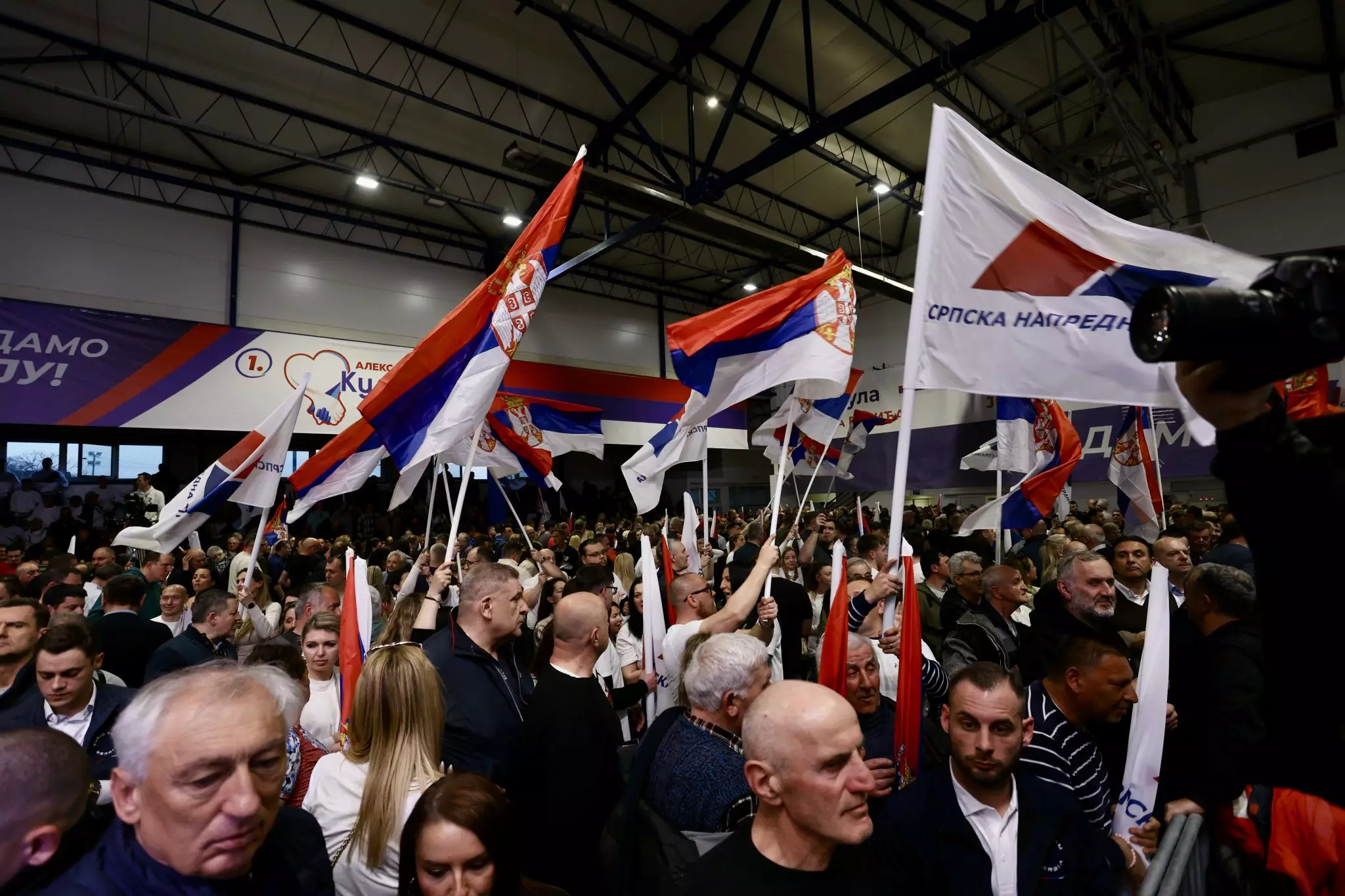
Aleksandar Vučić announced a large gathering in Novi Sad on Friday, April 12, at a time when a protest has been taking place in that city for weeks.
#1 out of 5 million. This puts pressure on the opposition and the citizens to withdraw, otherwise they will be accused of inciting violence, because they are attacking the RTS "with chainsaws" and they are carrying "gallows".
Dragan Đilas, one of the leaders of the Alliance for Serbia, says: "They (organizers of the protests in Novi Sad, ed.) have a meeting today to decide what they will do on April 12 because the man who usurped the office of the president of Serbia thought that at the same time 100 meters away organizes his protest. It speaks of one's mental state" (Danas, April 1).
The day after, on April 13, the opposition is preparing a large protest in Belgrade, which will be attended by protests from all over Serbia, and as a counter to that, Vučić announces "the largest gathering of decent Serbia in history" in Belgrade on April 19, belittles the opposition and threatens it with numbers : "They are telling us to get ready for violence on April 13, and we don't want violence, we will just come to talk about our program and ideas on April 19." And people will be able to see what 10-15.000 and hundreds of thousands of people look like. Because decent Serbia will no longer be silent."
TO SEND 10.000 PEOPLE ON TVN1
We know that Vučić likes to spin and replace theses, no one ever called for violence on April 13 in Belgrade, but Vučić now has a unique opportunity that was given to him by Boško Obradović, recently the chairman of SzS. After the main role that the leader Dveri assigned to himself by running through the corridors of RTS and wrestling with the police the next day when he led the citizens, together with other SzS leaders, to surround the Presidency during Vučić's press conference, how much weight do his words have when assures that he does not want conflicts and violence? Immediately after the incident on RTS, he announced his departure to TV Pink with the words: "Let PINK get ready!"
That is why the first big test for both Boško Obradović and the entire opposition will be the announced departure in front of TV Pink on April 6. Are they organized and capable enough to prevent any incident, or is it wiser to give up? Dragan Đilas assures the brave citizens that there is nothing to expect from the protest this Saturday because people will come, gather in front of the building of that television, and that there will be no other steps on their part: "We had no plan to enter Radio-Television of Serbia, now we will do our best to prevent any similar things from happening." ("Danas", April 1) Željko Mitrović, the owner of TV Pink, always eager for reality shows, on his Twitter account, after hearing that the decision to walk to Pinka questions, provokes Boško Obradović: "Boškić, I'm not the only one who thinks you're a degenerate and a country scumbag, but if you're a cunt again and give up parties in front of Pinko, on Saturday, I'll call you for life both privately and publicly LJUBIČICA MILA!" Sergei counts too!”
Even the provocations of Aleksandar Vučić, inappropriate for the president of a country, even if it was Serbia, are nothing less fan and street incitement and incitement of violence, all in defense of Željko Mitrović and TV Pink: "But who are you to invade and threaten someone ? It's okay to say you disagree. Do you know that I can easily send 10.000 people in front of the N1 and they will stay there until they promise that there will be no anti-twitch TV, and then we will invade a little. You would say that we are savages, crazy people - and rightly so. That must not be done," said the country's president on TV Happy ("Cirilica", March 27).
In short, it is clear that only Vučić and possibly Boško Obradović could benefit from any possible violence, street conflicts and riots. Here it is - Željko Mitrović. Everyone else would be a loser. That is why the opposition is on a serious task to make a strategy of what they want from April 6, what from April 13 and what after? How to fine-tune the so-called civil disobedience and above all and in spite of everything obvious civil discontent and rebellion, but so as not to allow and more importantly not to initiate that disobedience turn into riots, violence and conflicts with SNS supporters, the police or the law? In the event that the government does not want to accept any of the basic and quite easy demands of the opposition for fair elections and free media and brings civil protests to a dead end on the one hand with counter rallies, and on the other hand with the reconstruction of the city center - that is the only possible way.
Until then, what did the protests from 1991 to the present day bring us, and what did they take away?

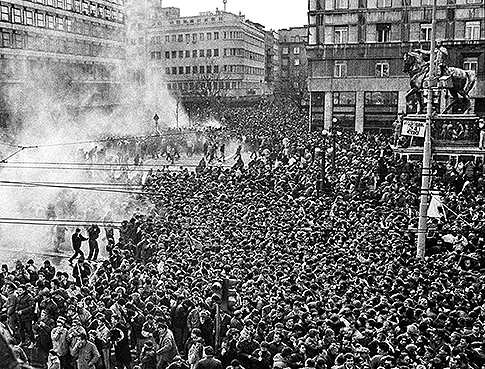
photo: Goranka MatićMARK OF THE NINETES: Demonstrations on March 9, 1991;…
9. MART 1991.
The March demonstrations were initiated by Vuk Drašković, the president of the SPO. The reason: demanding the resignation of the general director of Television Belgrade, Dusan Mitević, and the Minister of Police, Radmil Bogdanović. In the end, the demonstrations turned into a rebellion against the regime of Slobodan Milošević. Drašković demanded the resignation of Mitević, who did not allow him to publish his denials on "TV Bastille". The protest was held on Republic Square. It was ordered to shoot at the demonstrators, two people lost their lives (high school student Branivoj Milanović and police officer Nedeljko Kosović), and many were injured and beaten. The water cannons that the police fired at the demonstrators were also remembered, and there were tanks on the streets. Vuk Drašković was arrested. Radio B92 and NTV Studio B were banned. According to independent media reports, there were about 50.000 demonstrators on the streets at the time, while TV Belgrade estimated several thousand. Milošević addressed the nation on television the same evening, March 9. Then he said that the events of that day "were driven by the forces of chaos and madness, which Serbia must oppose with all constitutional means."
The next day, March 10, around 5000 students left Student City to join the protesters, which was a response to the beatings, water cannons and tanks in downtown Belgrade the previous day. A police cordon awaited them at Brankovo Most. They threw tear gas at them, several students were beaten. After Zoran Đinđić's negotiations with the police, the students were allowed to pass and join the demonstrators in the city center. The "plush revolution" has begun. That day was remembered for the speech of the actor Branislav Lečić, and other speakers took turns on the improvised stage, among them Patriarch Pavle.
The demonstrations lasted for several days, the demonstrators' demands were expanded, so in addition to the resignations of Dušan Mitević and Radmil Bogdanović, they demanded the resignation of four editors of TV Belgrade, enabling the work of Radio B92 and NTV Studio B.
In Usce on March 11, 1991, the regime organized a counter rally "For the defense of the Republic, for constitutionality, freedom and democracy". They chanted: "Freedom, Freedom", "Judge the Wolf", "Ustasha, Ustasha", "We will not give Kosovo", the students were called hooligans. The counter-rally had a counter-effect. Mitević and Bogdanović were replaced, Vuk Drašković was released from prison and the others were arrested on March 9. Demonstrations lasted for several days, until the demands were met. All requirements are met.
photo: Goranka Matić…1992;…
STUDENT PROTEST 1992.
Participants of the student protest in 1992 will say today that two events initiated the students to revolt: the beginning of the war in Bosnia and Herzegovina and the introduction of economic sanctions against FR Yugoslavia.
The students' demands were: the resignation of Slobodan Milošević, the dissolution of the Serbian Parliament, the calling of elections and the formation of a coalition government. By the way, that was the first protest where the resignation of Slobodan Milošević was demanded. The first 15 days of June 1992 were spent in student agreements, organization, protests, but on June 15, 1992, a strike was announced. More than 10.000 students gathered that day on Student Square and occupied the Rectorate and the surrounding faculties - Faculty of Arts, Philology, Philosophy. They prevented the holding of classes at those faculties. They demanded that the Scientific and Teaching Council of BU, which was in session that day, accept the students' request and suspend the work of Belgrade University. That happened four days later. Slobodan Milošević also contributed to the unity of professors and students, who used the meeting with professors and students on June 17 to tell them that for him the University of Belgrade is just as important as any agricultural cooperative.
Although this student protest, which lasted several weeks, did not lead to the fall of the regime, it will be remembered for the released energy, slogans, actions, forums and lectures, all in an independent student organization and walks around Belgrade as a way of protest.
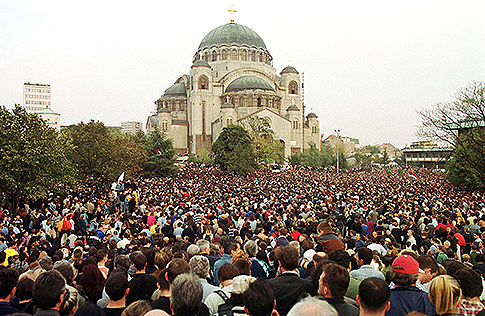
VIDOVDAN COUNCIL
Just at the time of the student protest, that same year, a large opposition rally was organized on Vidovdan, June 28, 1992, in front of the Federal Assembly building in Belgrade. SPO was the organizer, and it was joined by a part of the Democratic Party (later, from that part DSS emerged) and the Serbian Liberal Party. The parliament lasted until July 5, and the purpose of organizing it was to change the regime due to extremely difficult political and economic conditions (wars and sanctions) in which the then Federal Republic of Yugoslavia found itself, proclaimed a few months before April 27, 1992. Wars broke out in three of the former republic of the SFRY, so the sequence of events led Milošević to the adoption of the Žabljak Constitution and the proclamation of the FRY. That year, DEPOS was formed - the Democratic Movement of Serbia, led by SPO (in 1992, DSS and Nova Srbija were part of DEPOS, and in 1993, DSS left and the Civil Union of Serbia joined). Since the opposition boycotted the federal elections, as well as due to international sanctions, Milosevic agreed to a compromise and sat down with the opposition at the round table. He made a concession to them. He agreed that instead of the majority election, the elections should be conducted according to the proportional system. And won again in December 1992.
photo: miroslav petrović...1996/97
STUDENT PROTESTS IN 1996-1997.
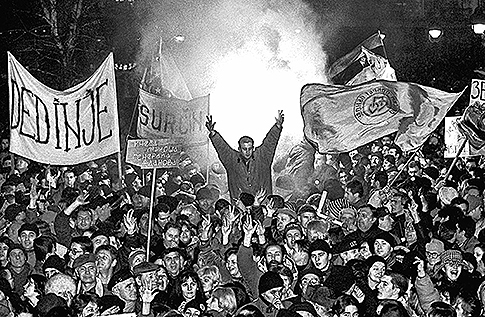
On March 9, the DS, SPO and GSS commemorate the anniversary of the demonstrations with the joint rally "Za promene - Zajedno", and thus the founding of the Zajedno Coalition begins. DSS also joined the coalition. It was formed before the federal elections on November 3, 1996, where the SPS-JUL-ND coalition won 1.848.669 votes or 64 seats in the Assembly, the Together Coalition 969.296 votes or 22 seats, the SRS 764.430 votes or 16 seats. Citizens voted differently in local elections. The candidates of the Coalition Together in the second round, which was held on November 17, 1996, won the elections for the City Assembly of Belgrade, Kragujevac, Niš and Novi Sad, in most Belgrade municipalities and more than 40 municipalities in Serbia. It was Slobodan Milošević's first major defeat in Serbia, which he wanted to cover up with a major electoral theft. The direct cause of the demonstrations was the theft of the local elections in 1996, a kind of trigger, but side by side with the theft of the elections stood the difficult socio-political and economic situation in which the country was, the isolation of the country, the need for changes.
The Zajedno coalition organized daily protests by citizens in the larger cities of Serbia, and student protests also began alongside the civic protests. Civil protests organized by the Together Coalition lasted 88 days, and student protests lasted 117 days. In the end, Milošević was forced to recognize the results of the February 1997 elections, after the arrival of Felipe González, the OSCE's special envoy.
Remembering the protests of 1996/97. it would not be complete without the episode about the counter rally on December 24, 1996 in Terazije. The counter rally "For Serbia" was organized by the SPS and JUL at three in the afternoon, in the same place where supporters of the Together Coalition had been gathering for weeks. For the 4000 buses that brought socialist supporters to Belgrade that day, 800.000 liters of diesel fuel were consumed. A total of 1 German marks were spent on the counter rally.
It ended with the death of Predrag Starčević, a participant in the Coalition Zajedno protest, and that was the most expensive thing left on Slobodan Milošević's account that day. Ivica Lazović was seriously wounded. There were dozens of injured on both sides. The body of Predrag Starčević was found on the Gazela Bridge, and he died as a result of the beating, according to newspaper reports about the event. As if Živko Sandić, one of the SPS candidates in the local elections in Vršac, shot Ivica Lazović with a pistol in front of the premises of the SPO in Knez Mihailova. Serbia was on the verge of civil war that day. Be that as it may, the counter rally organized by Slobodan Milošević backfired on him, civil and student protests were more massive than before.
photo: Draško gagovićTHE MOST SUCCESSFUL PROTEST IN SERBIA: October 5, 2000.
5. OCTOBER 2000.
On the website www.beograd.rs, the official website of the City of Belgrade, it says about the events of October 5 as follows: "The Democratic Opposition of Serbia invited the citizens to gather in front of the Federal Assembly on October 5, 2000 in order to oppose
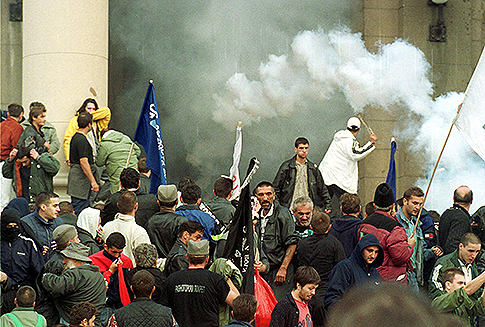
to the great election theft that the Federal Election Commission carried out on the orders of Slobodan Milošević. The DOS ultimately demanded that Slobodan Milošević, by Thursday, October 5, at 15 p.m., recognize the electoral will of the citizens expressed in the federal, presidential and local elections held on September 24, 2000. (...) The supporters of the DOS came to Belgrade from early morning , organized from several directions, from all over Serbia, and led by the leaders of DOS. The police managed to disperse a considerable number of people from the plateau in front of the Assembly of the FRY with a large amount of tear gas. Dozens of citizens entered the Federal Assembly around 16 p.m., while the policemen who had been guarding the building until then withdrew. Thick, black smoke was billowing from the right wing of the Assembly, and almost all the windows in the building were broken. During the conflict between the police and the demonstrators, gunshots were also heard. Around 17:18 p.m., the commander of the Belgrade police requested a meeting with representatives of the DOS. Around 17:XNUMX p.m., members of the police station in Mother Jevrosime Street laid down their weapons and joined the protesters. Dozens of citizens with minor and serious injuries were admitted to the Emergency Center. The police also threw tear gas in the vicinity of the Serbian Radio Television building, while the excavator started to make its way to the entrance. The RTS building in Takovska Street was then set on fire, and the regular RTS program stopped being broadcast after XNUMX p.m. The newly elected president of the FRY, Vojislav Koštunica, addressed the citizens in the evening from the terrace of the Belgrade City Assembly, and then through RTS. During the evening, the constitutive session of the new composition of the Assembly of the City of Belgrade was held. Hundreds of thousands of people were in the center of Belgrade throughout the night, celebrating the victory, but also fearing the possible intervention of the Army and other security formations of the former regime. The Democratic Opposition of Serbia formed a crisis headquarters for key functions in the country in coordination with the new president, and DOS representatives talked during the night with the leaders of state and public security. A large number of people greeted the morning in front of the City Assembly. It was the first morning without a dictator in power."
In this overview of the events of October 5, it is missing that Jasmina Jovanović, a DSS activist from Miloševac near Velika Plana, was killed by falling under the wheels of a truck. Momčilo Stakić from Krupnje also died, who suffered a heart attack, and later it was recorded that another 65 people were injured.
PROTESTS AGAINST THE VUCICE REGIME
Between October 5 and these last protests, the "Protest against dictatorship" in 2017 should also be mentioned. After the elections, on April 3, 2017, student and citizen protests against the dictatorship of Aleksandar Vučić began, walks on the streets of Belgrade, Novi Sad, Niš and Smederevo , Čačka, Kragujevac. Although the government did not believe in it, we could find out that they organized spontaneously through Facebook. Thus, the list of demands of the demonstrators was long, and spontaneity stood in front of them as a more serious obstacle, protests against the dictatorship marked the year 2017 because precisely their flaws - a long list of demands and spontaneity - were at the same time their main virtues. It has been a long time since the spark of a general rebellion that was felt in these protests happened in Serbia, and that is their biggest capital, which was largely preserved in the protests of 2018/19.
Comparisons with the protests and counter-rallies of the nineties are ungrateful, you can't step into the same river twice, nothing can be the same, and the fact that many participants in today's protests publish their photos "then and now" December 1996 - December 2018, proud of the fact that have always been on the "same, right side", it is rather a kind of collective therapy than pride in the fact that they are then and now - on the same side. It is poor pride, we are falling into the trap that for almost three decades one and the same battle is being fought on the streets of Serbian cities. It is not good, if for no other reason, than because, for the sake of some kind of collective health, we should insist on the fact that for a whole decade there was no need to fight for fair and democratic elections and free media with protests. And that, you will admit, is not small. For the sake of collective health.