Od permanent correspondent "political" iz Ljubljana
Speculations surrounding the Serbian-Russian takeover of Slovenia's commercial pride (Merkator) caused quite a stir in Slovenia. In the last fifteen years, the local public has become accustomed to the takeover of Slovenian economic trusts by Italian, German, Austrian and, in general, Western capital, but for the local dika Mercator to fall into Serbian hands - that was too much. The intention of Milan Bek (FPP Balkan limited) and Miroslav Mišković (Delta holding) to "with the help of anonymous Russian investors" through Igor Bavčar (Istrabenc) and Boško Šrot (Pivara Laško) carry out a "raid on the flagship of Slovenian stores" ran into the media's odium, so it didn't take long for the avalanche of denials to start. It seems that ownership in Mercator is a matter of being or not being, so the first man from Istraban has been swearing for two days in a row that he is not selling his "strategic stake and long-term interest" in Mercator. Question - What happens under the grain? – still hanging in the air.
According to information from well-informed circles, the engine of the Mercator affair is the fact that two important interests coincided. The interest of large Serbian companies to penetrate the European Union market in an organized manner and the interest of Igor Bavčar to realize his manager's dream - the purchase of Istrabenac. More precisely, to privatize Istrabenc according to the model that succeeded the president of the management of Autokomerc Herman Rigelnik and the president of the management of the profitable construction company SCT Ivan Zidar. In such a sensitive operation, Bavčar allegedly counted on the support of Serbian and Croatian capital, i.e. Miroslav Mišković's Delta and Ivica Todorić's Agrokor. It is no wonder that at the beginning of this week, the image and work of Mišković and Bek are on the wallpaper of the Slovenian public, while in Serbia Igor Bavčar is in the spotlight.
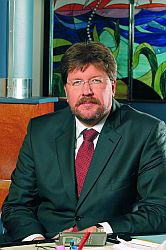
KO JE IGOR BAVČAR? "That's the fighter for human rights who became the minister of the interior." That's how Ljubljana's "Mladina" described Bavčar, a close friend of Janez Janša, accused and convicted before a military court for divulging military secrets in the early 90s of the last century against four". Today, Janša is the head of the Slovenian government. Anything could be said about Bavčar: an angry Marxist who became a staunch capitalist. A fighter for the secession of Slovenia from the SFRY, who today uses capital to unite what was "disunited" during the breakup of ex-Yugoslavia. He came to the attention of the general public as the president of the Committee for Human Rights. It was a plagiarism of the Belgrade Committee for the Defense of Freedom of Thought and Expression, created in the grip of socialism (at the end of the 80s) as a sign of resistance to the process directed by the JNA in the Military Court in Ljubljana. The trial was a consequence of the possession of a not very important document, and it was conducted against JNA officer Ivan Borštner and three civilians, columnists and editors of the weekly "Mladina" (Janez Janša, David Tasić, Franci Zavrl). The effort of Bavčar and a group of Slovenian writers soon bore fruit - tens of thousands of citizens chanted in front of the court. This is considered the beginning of political pluralism, which led to the victory of the democratic opposition of Slovenia (Demos) in the first multi-party elections and - the independence of Slovenia.
Bavčar, whose height and voice resemble Hogar, attracted attention in 1988 with the assessment that "the time is not far when Slovenia will have to think about its national currency" and that "the question of Slovenia's independence is only a matter of generations". Three years later, Slovenia was independent and recognized. As a minister in Demos's government, he occupies a key position - the chair of the Minister of Internal Affairs. He was involved in all the activities of "acquiring" weapons for the Slovenian Territorial Defense and the latter police, and witnesses say that, like his colleague Janša, he particularly enjoyed negotiations with federal officials, primarily Anto Marković and JNA officers during the so-called ten-day war in June and July 1991. As the Minister of Police, he won over the media when he opened to the public the previously strictly guarded Broz underground bunkers in the wooded Kočevska Reka in the south of Slovenia. In the meantime, he runs a bit down the political street, apparently quarrels and breaks up with comrade Janša and ends up in the party and in the government of Janez Drnovšek, winning the prestigious position of Minister for European Integration. He reached the political bottom a few years ago, when the Liberal Democracy of Slovenia (LDS) was in full force and in power - Bavčar suddenly left the party and went into the economy. He comes to the head of the management of Istrabenec, one of the largest Slovenian companies, which he has made even bigger in the meantime.

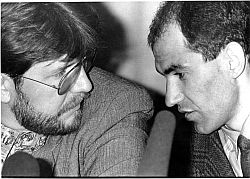
FRIENDSHIP, CRAFT THE OLDEST: Bavčar and Janša, young and thin...
KAD I GDE: He was born on November 28, 1955 in Postojna. His father was a JNA officer, so they soon moved to the other side of Slovenia, to Novo Mesto. Igor finishes high school and enters the school for policemen in Tacno near Ljubljana. He was one of the best in the class. A corpulent policeman patrols the alleys for two months, and then replaces the street dust with an office. The son of an officer joined the Party (Union of Communists of Slovenia) at the age of eighteen, and then at the beginning of the 70s at the current Faculty of Social Sciences (then FSPN, known in the bazaar as Vilayet Stanet Dolanc) he met some of the most promising Slovenian left-wing thinkers, such as Bojan Korsika and the environmentalist Lea Sugar. He also cooperates with the student newspaper "Tribune", in which in 1977, with the cry "LONG LIVE THE PROLETER REVOLUTION!" and quotes from Edvard Kardelj, he heartily attacks petty-bourgeois philistines, bureaucrats, technocrats and Spomenka Hribar (later she was his mentor from the right).
A decade later, he reveals self-criticism, sprinkles himself with ashes and admits: "We were so naive at the time that we thought that those in power did not read the theories they were advocating accurately enough." Much later, we realized that they simply didn't read anything at all." In the early 80's, he was employed as a personnel officer in a Slovenian youth organization and headed the Center for Information and Propaganda and then the Marxist Center. He became the editor-in-chief of the publishing house Krt (1981), in which the responsible editor is the sociologist Tomaž Mastnak, today the head of the "Alliance of Civilizations" office that Kofi Annan founded within the OUN.
At that time, Bavčar became close to Janez Janša, whom he met while preparing materials for a conference that dealt with the "socialization" of the concept of national defense and social self-protection. Both of them were later criticized (party reprimands were also issued) by France Popit, then head of the Slovenian Communists, because they emphasized too much the "class and not enough national character" of the aforementioned socialist defense system. After completing his studies (1984) at FSPN, he got his first serious job in the Socialist Union of Slovenia (SSRN). So young and already a passionate fisherman, which, as he says, is a "primordial drive" for him. Soon, in the office of SSRN President Jože Smole, the idea of a special role for this organization was born, the "poster affair" took place (the controversial poster of Noja sloveniše kunsta for Youth Day), there was a cult of personality, a relay of youth... Dabome, Bavčar left the Party. He meets Stanet Kavčič, the "cleansed" leader of Slovenian liberals among the communists. Together with Janša, on the basis of Kavčič's documents, he published a book of Stane Kavčič's diary entries in the period 1972–1987. The book becomes a hit - it reveals unknown events from the Slovenian political past. During the tour where they were promoting the book, Janša and Bavčar are inseparable, so they stop by home guard and hotelier Vinko Levstik, on the other side of the border, in Gorica, Italy. Reason enough for the then SDB (Slovenian branch) to start wiretapping the premises of Mikro Ada, where Janša works.
Bavcar's mandate at SSRN expires on May 31, 1988, the day when the Slovenian police arrested Janez Janša and searched the premises of the computer company Mikro Ada. A secret JNA document was found on how to act in case of demonstrations in front of the barracks. The document was brought to "Mladin" by JNA ensign Ivan Borštner, and the responsible editor of "Mladin" Franci Zavrl, through journalist David Tasić, sent it for "analysis" to the then columnist and expert on military issues - Janez Janša. In Mikro Ada, the Committee for the Protection of the Rights of Janez Janša was established on June 3, 1988, later renamed the Committee for the Protection of Human Rights. There were many in the presidency of the Committee who later broke with Janša completely politically (Pavle Gantar, Rastko Močnik, Mile Šetinc). Bavčar sovereignly assumed the role of chairman of the Committee, fiercely criticizing the federal government in Belgrade, the JNA and the leadership of the Slovenian party and state in over 100 statements. The board has more than 100.000 individual and about 1000 collective members. Bavčar (unsuccessfully) ran for president of the Republic, cooperated in writing the Slovenian constitution and election laws, and together with Dimitrije Rupel, Janša and others became a central figure of the Slovenian Democratic Alliance (SDZ). After the victory of Demos (1990) in Loyze Peterle's government, he became the Minister of Police. He immediately "cleansed" the top of the police and SDB of old personnel. By function, he becomes the key man for the implementation of the decisions on the secession of Slovenia, which were the result of the plebiscite at the end of December 1990.
…and what do you do for a living?
'DI SU MONEY?: The following year, within the framework of factional struggles, he left SDZ and founded a new Democratic Party. Launches the slogan "The difference is obvious" (on the SLO sticker with YU), but the marketing is not successful, so Bavčar's Democrats join forces with Drnovšek's LDS (1994). In recent Slovenian history, the name of Igor Bavčar is most often mentioned in connection with the "Brnik affair", behind which is hidden the resale of domestic and imported military equipment in the direction of Croatia and Bosnia, where war operations are simmering. Bavčar's role has not been fully clarified to this day, although it is known that no weapon transport from Slovenia - for which then, like all other parts of the former SFRY, the UN Security Council embargo on the sale of arms was valid - could not travel without a permit Minister of Internal Affairs Bavčar.
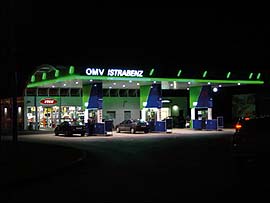
He adds the position of vice president of Drnovšek's LDS to his career. The cooling-off with Janša began in 1994, during the "Depala vas" affair, when a group of Janša's military intelligence agents dragged Milan Smolnikar, a former member of the elite Morris brigade of the Slovenian army, out of his car on a local road and beat him, who was investigating criminal weapons smuggling on the orders of the Bavčar police. and the pressure of Janša's trobans from the army on the media. It was a fateful moment for Slovenia, and Bavčar stood by Janez Drnovšek, who, despite street pressure and demonstrations in front of the parliament, dismissed Janša from the position of Minister of Defense. As a reward, he remains in the government, becomes the minister for European integration and coordinates Slovenia's negotiations on joining the EU at a time of constant pressure from Austria and Italy. When Slovenia's entry into the EU became a foregone conclusion (2002), Bavčar left politics for a company that owns a chain of gas stations.
Although he seemed to have gone into the shadows, he became a gray eminence of the Slovenian economy and economy. First, he never - despite the political split - completely cut off contacts with Janez Janša. Secondly, the two of them formed a tandem at a time when both wore uniforms in the first Slovenian government - Bavčar of the police, Janša of the army. In his place, Bavčar "opened" Slovenian borders for prohibited shipments of weapons that ended up on the battlefields south of Kupa through the Ministry of Defense (Janša). Despite ten years of research by various commissions, the money from those "jobs" was never found in the Slovenian budget. In addition, in the early nineties, Bavčar and Janša found themselves on the same "front" against "suspicious" inhabitants of Slovenia, mostly officers of the former JNA or simply people from other ex-Southern republics who were on the "undesirable" lists. Precisely - deleted. Slovenian officials later confirmed that these lists were either arbitrarily compiled (in the case of JNA officers) or unconstitutional (ordinary mortals, non-Slovenes). In 2004, the Slovenian media revealed that it was Bavčar who, with his signature on some documents, was directly responsible for the beginning of the ordeal of the erased, an affair that has not been resolved even to this day.
Despite this, Bavčar never hid that the economy is only a part of what interests him in life and that he does not give up on returning to the political stage one day. But with more capital and experience.
THE BOSS U SERBIA: That relations with Janša are getting better became clear in September of last year, when information leaked to the public that an agreement was reached at a secret meeting in the seat of the Slovenian government between Prime Minister Janez Janša, Igor Bavčar (Istrabenc), Tone Turnško (Pivara Laško) and Matjaž Gantar (investment giant KD Group) about the transaction of Mercator's shares, which enabled Janša to stage a coup in Ljubljana's "Del". The script? Two parastatal funds (Kad and Sod) and Janša close Gantar (KD Group) sold their shares in Mercator to Pivara Laško and Istrabenac. It is expected that Laško Brewery will soon sell its share in "Del", most likely to KD Group, which would then sell them to the state-owned Triglav Insurance Company. And here is an elegant way to control the "Work". Complicated? Difficult? No. In the meantime, the scenario has almost completely unfolded, and the attempt of the opposition (LDS) to put the dubious sale of Mercator shares under the scrutiny of the parliamentary committee has been thwarted in the first place. Janša's government even abolished the anti-corruption commission headed by a person who was not to the taste of the prime minister.
Bavčar is happy to reject speculations about relations with Janša. "I know Janez, I know that he is really ready to subjugate some of the levers of the state in order to use them sovereignly," he said recently in "Del", demonstrating a critical distance towards the prime minister. In the speculations surrounding Mercator's transactions, he remained secretive, casual, 'cold as a syringe', not revealing his cards: "Slovenian space is so narrow that the media are faced with a shortage of news." That is why they misinterpret certain encounters or even portray them as tectonic shifts in the country. There are seven or eight political parties in our country. When two politicians meet somewhere - a government crisis or the forging of new political conspiracies is already in the repertoire. My relations with Drnovšek's, Rop's and now Janša's government are necessary - we have to solve important issues for Istrabenc."
Bavčar, there is no doubt, has big plans to expand the Istraban network and buy companies both at home and outside the borders of Slovenia. This time, however, he tripped over the nationally colored odium of public opinion, which was also profiled by his former politics. It will take a lot of effort to overcome this obstacle. Or, as a journalist from one of the Ljubljana newspapers wrote - Bavčar realized during the maneuvers around Mercator that "his knowledge of how to deceive small shareholders in Slovenia is not nearly enough to become the main 'boss' in Serbia".