The world is criticizing the conviction of the members of the punk group "Pussy Riot" by the court in Moscow, after they performed a protest performance in the Moscow Church of Christ the Savior. Washington believes that the case is politically motivated, and the verdict is criticized by the EU and numerous human rights groups. Amnesty International requested the annulment of the court verdict.
The trial has divided the Russian public, Putin's opponents call this trial a move to stifle their movement.
A court in Moscow on Friday found Maria Alyokina, Nadezhda Tolokonikova and Ekaterina Samutsevich guilty of hooliganism motivated by religious hatred, for breaking into the Church of Christ the Savior and playing a song about President Vladimir Putin, and sentenced them to two years in prison.
Disrespect for society
Judge Marina Sirova, reading the verdict, said that the defendants' actions "grossly violated the social order."
"Tolokonikova, Samutsevich and Alyokina committed an act of hooliganism and grossly violated public order by showing obvious disrespect for society," said judge Sirova.
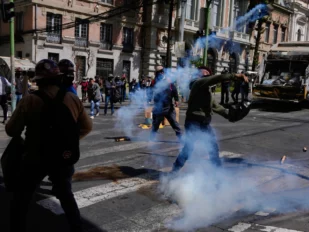
Demonstrations took place in front of the court in Moscow during and after the reading of the verdict on Friday, and the police arrested the leader of the Left Front, Sergei Odaltsov, who tried to enter the court building.
Former chess champion and opposition leader Garry Kasparov is among the 30 persons arrested on Friday in front of a court in Moscow.
Reactions in the world
RSE reports that a huge number of people protested the punishment for Pussy Riot members in twenty cities outside of Russia, including Barcelona, Berlin, Brussels, Copenhagen, London, Paris, Sofia, Sydney, Riga and Tbilisi. At some protests there were only a few people, and at others up to 200.
The members of the band "Pussy Riot" have been in prison for more than five months, for performing a "punk prayer" in an Orthodox church.
The members of the band claim that their invasion of the Temple of Christ the Savior on February 21 of this year was a protest against the strong ties between the state and the Church and the Church's very clear support for Vladimir Putin.
State Department spokeswoman Victoria Nuland she said the verdict could have a negative impact on freedom of expression in Russia.
EU High Representative for Foreign Policy Catherine Ashton found that the conditions in the prison are questionable, which calls into question the respect for the "fair, transparent and independent legal process".
German Chancellor Angela Merkel said that the verdict was "excessively harsh" and called into question Russia's determination to protect fundamental rights and freedoms.
The Ministry of Foreign Affairs of Russia says that "Criminal acts directed against religion and religious beliefs, including hooliganism in places of prayer, are punishable by up to three years in prison or a fine."