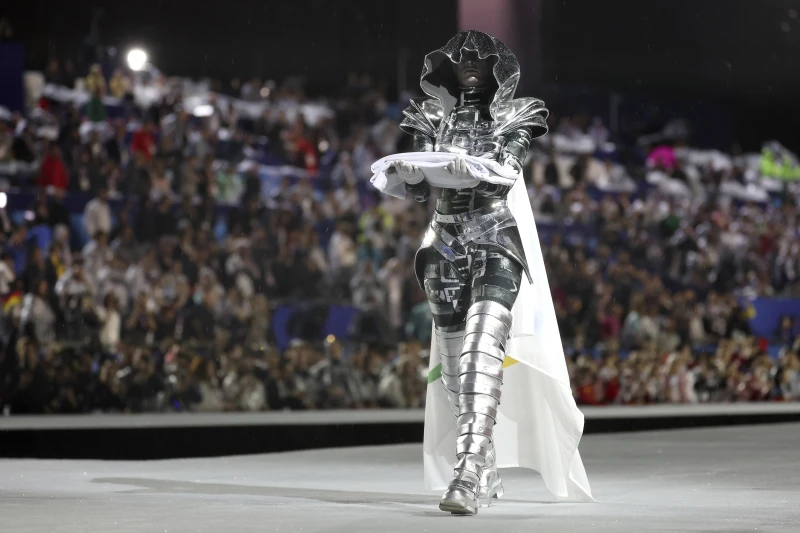
Russian state officials and religious leaders criticized the opening ceremony of the 2024 Paris Olympics, making anti-LGBT comments after Friday's opening ceremony where more than 10.000 athletes from more than 200 countries and territories paraded down the Seine.
"Cultural and historical suicide is taking place in one of the former Christian capitals of European civilization," said Vakhtang Kipshidze, a Moscow-based spokesman for the Russian Orthodox Church.
Russian President Vladimir Putin has placed the disparagement of the LGBT community at the center of calls to preserve "traditional" aspects of Russian society.
Last year, Russia's Supreme Court declared the LGBT "movement" extremist, paving the way for harsh punishments for offenders.
Foreign Ministry spokeswoman Maria Zakharova on Saturday criticized the camp scene from the ceremony in Paris, which some linked to Leonardo da Vinci's "Last Supper," saying it was "a mockery of the holy story for Christians."
She accused the organizers of the ceremony of portraying Christ's apostles "as transvestites."
"Apparently in Paris they decided that if the Olympic rings are multi-colored, you can turn it all into one huge gay parade," said Zakharova.
Zakharova said the event was "a ridiculous outdoor ceremony that forced guests to sit for hours in the rain."
The French are proud of the opening ceremony
French President Emmanuel Macron said on Saturday that the French were "extremely proud" of the logistically complex and visually stunning opening ceremony.
The still-unsolved sabotage of rail networks across France has caused delays and tarnished the start and second day of the Olympics. No one has yet claimed responsibility for the coordinated nighttime attacks on the railroad.
Under the onslaught of what experts said was a Russian disinformation campaign against the Paris Olympics, French authorities this week announced the detention of a 40-year-old Russian chef who they say was involved in a "large-scale" plot to disrupt the Games.
Ban due to doping
Last year, after banning Russian athletes for systematic doping, the International Olympic Committee (IOC) suspended Russia due to its invasion of Ukraine and Moscow's claim that it annexed four Ukrainian regions.
The World Anti-Doping Agency (WADA) concluded in 2016 that more than 1000 people participated in an elaborate and lengthy doping scheme between 2011 and 2014 that was aided by the Russian state.
Russian athletes were only allowed to enter as individuals to compete at the 2018 Winter Olympics in Pyongyang, South Korea, but the Russian national team and national symbols were banned.
WADA subsequently banned Russian athletes and officials from the 2020 Summer Olympics in Tokyo and the 2022 Winter Games in Beijing for mishandling doping data.
"Individual Neutral Athletes"
In total, more than 10.500 athletes from around 200 countries are participating in the Olympics in Paris. Among them are only 15 Russian athletes and they will be officially presented as "neutral" under the designation AIN, which in French means individual neutral athlete - athlete individual neuter. For neutral athletes, there is no anthem, flag and colors of the national team.
The International Olympic Committee invited 36 Russian athletes to participate in the Olympics after passing qualifications for their sports and a vetting process designed to block anyone who publicly supported the war and had anything to do with the military. The check was passed and 15 of them responded.
By comparison, at the Olympics in Tokyo, the Olympic Committee of Russia sent 335 competitors.
Belarus is in a similar position, with 17 athletes coming to the Olympics in Paris, while there were 101 in Tokyo.
This is the fourth Olympic Games in a row in which Russian athletes compete under the label of neutral athletes. The last time Russian athletes competed under the national flag was in 2016 in Rio de Janeiro, RSE writes.
Source: RSE