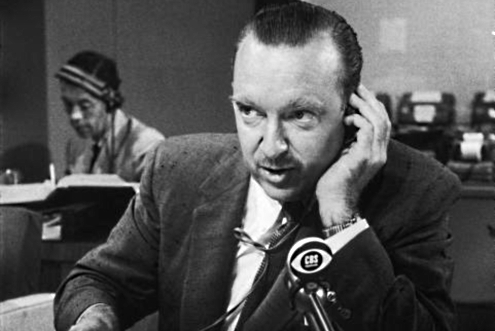
Walter Cronkite, an icon of television journalism in the seventies of the last century, actually a living history of television, has died. He lived to the age of 92 (1916-2009), active in journalism until the end of his life. He died on Friday July 17 from vascular disease, they say in dementia.
Between 1962 and 1981, Cronkite was something of a national institution in America and No. 1 in world TV journalism. Generations of journalists were raised on his example. They called him the most trusted man in America. He was also called Uncle Walter. He saw himself as an old-fashioned newsman. The news that American President John Kennedy was killed was announced through tears, taking off his glasses, and it is still a cult scene today that shows American feelings at that moment. It was a personal gesture of a journalist who was reluctant to show emotions. He criticized himself for running out of words during the TV broadcast of the moon landing, the moment the Eagle lunar module touched down on the lunar surface. Then he uttered the famous "Oh boy!", more restrained than Mladen Delic's famous "My people, is it possible". NASA later gave him a moon rock, which he donated to a Texas university. He spoke of himself as a news anchorman, an old term that they say was invented to describe his role (today it is called a presenter), an editor, not a commentator or analyst. He studied political science, economics and journalism, and in his work he did not feel compelled to show scholarship, but when he announced a grade, his influence was great.
When he went to Vietnam in 1968 and made a special program about the war, he called for an end to the conflict and for peace negotiations to begin. American President Lyndon Johnson, who watched that program, uttered the famous sentence, which our politicians should also learn: "If I lost Cronkite, I lost middle America."
Deep in Years (2006), he attacked Bush's war in Iraq in his columns and said he felt the same way he did when he was reporting from Vietnam. He knew what war was. In World War II, he was one of eight American journalists selected to be in the Flying Fortresses, B52s during the bombing of Germany.
He knew what readers, listeners, and viewers were like, and how they relate to new and stale news, which he probably learned when he started working as a newspaper vendor while also working as a rookie reporter at the Houston Post. In Kansas City, on KCMO radio, he broadcast sports games - which he did not attend, but was informed about the progress of the game by telegrams in the studio.
He was not a slave to the doctrine that news could last no more than two minutes: his report on the Watergate affair, for example, lasted 14 TV minutes.
His patent was also reporting on historical events as if they were happening now, he made documentaries such as the Battle of the Alamo and the 1937 disaster in which the Hindenburg passenger air balloon burned and killed 36 passengers. The show was called "You Are There".
"You are there" is his journalistic philosophy. The speed with which the news was reported at some moments could not be separated from the live broadcast. He announced the news of the death of American President Johnson, just by pressing the mute button on the telephone, while the secretary of the deceased president was still giving him the details, the news went on the air, Cronkite let the secretary finish, and immediately gave a summary of Johnson's life, announcing a wider story about it. He knew the essence of television better than others, because he was "present at its birth". At the Chicago World's Fair in 1933, he was on the team that demonstrated an experimental version of television, and he was happy to tell his colleagues that he had been on television long before them. The signatory of this text likes Cronkite's sentence the most: "The literacy of television journalists sometimes even reaches the end of the second paragraph!"
People trusted him more than the politicians he reported on. Do today's generations of journalists aspire to that?