On its own initiative and for humane reasons, due to the deterioration of the accused's health condition, "taking into account the new circumstances and in order to avoid the worst", on November 6, 2014, the judicial panel ordered the temporary release of Vojislav Šešelj in order to enable medical care in the surrounding area which is most appropriate.
The panel concluded that, given the circumstances, the accused's consent was not necessary.
"In order for the accused to be given the opportunity to undergo medical treatment, the Chamber indicated two conditions: first, that the accused does not come into contact with the victims and witnesses, and second, that he will return to the International Court when the Chamber so orders."
The decision was made by vote, Judge Niang, who is still familiarizing himself with the case has singled out an opinion that he will attach later.
DOCUMENT: Order for the provisional release of the accused proprio motu
1T-03-67-T 5/61508TER
NOVEMBER 07, 2014.
UNITED NATIONS
Case No. 1Т-03-67-Т
Date: November 6, 2014.
Original: FRENCH
International Tribunal for the Criminal Prosecution of Persons Responsible for Serious Violations of International Humanitarian Law Committed on the Territory of the Former Yugoslavia Since 1993
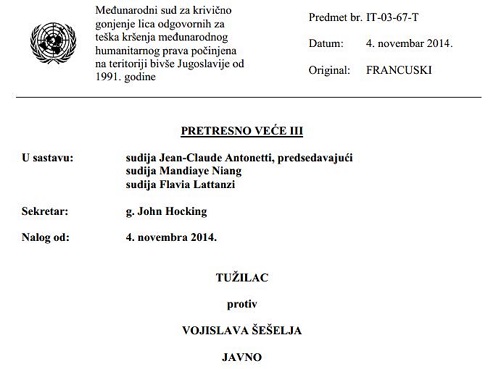
TRIAL CHAMBER Ш
Consisting of:
Judge Jean-Claude Antometti, President
Judge Mandiaye Niang Judge Flavia Lattamzi
Secretary: Mr. Johsi Hocking
Order dated: November 6, 2014.
PROSECUTOR against
VOJISLAV SESELJ
PUBLIC WITH CONFIDENTIAL ADDITION
ORDER FOR TEMPORARY RELEASE OF THE ACCUSED
PROPRIO MOTU
Prosecution:
Mr. Serge Brammertz Mr. Mathias Marcussen
The accused:
Mr. Vojislav Seselj
4/61508 TER
Translation
TRIAL CHAMBER III of the International Tribunal for the Criminal Prosecution of Persons Responsible for Serious Violations of International Humanitarian Law Committed on the Territory of the Former Yugoslavia Since 1991 (hereinafter: the Chamber, i.e. the International Court),
Proprio motu
BEARING IN MIND that the Chamber is the guarantor of the rights of Vojislav Šešelj (hereinafter referred to as: the Accused), that the Chamber is particularly concerned about the condition of the Accused while waiting for the verdict, specifically because of the extension of the proceedings that occurred due to the change of the judge, and that it takes care to keep the Accused in custody The accused shall not be detained longer than the procedure requires,
BEARING IN MIND that the Chamber recently considered the possibility of temporarily releasing the Accused due to the deterioration of his health condition proprio motu, but had to stop that procedure because the conditions set by the Chamber were not met,
BEARING IN MIND that in the meantime the Chamber has received additional information, which was submitted as confidential but the essence of which has been disclosed to the public, which indicates that the health condition of the accused has deteriorated,
BEARING IN MIND that any decision on temporary release must be based on the specific circumstances of the individual accused at the time of making the decision, that the duration of custody of an accused is a factor that should be taken into account when considering temporary release; and finally, that the occasion
3/61508 TER
Translation
Provisional release considerations may take into account humanitarian considerations, including the health of the accused,
BEARING IN MIND that, in view of this development and in order to avoid the worst, the Chamber is considering the possibility of temporarily releasing the accused proprio motu in order to provide him with care in the best possible environment, while ensuring the safety of witnesses and the integrity of the proceedings ,
BEARING IN MIND that in accordance with the provisions of Rule 65 of the Rulebook on Procedure and Evidence (hereinafter: Rulebook), the accused may be provisionally released if the Chamber is satisfied that, in the event of release. will not pose a danger to any victim, witness or any other person, and that he will return to the International Tribunal when the Chamber so orders, and after giving the host country and the country to which the accused requests his release an opportunity to make their case,
BEARING IN MIND that the Chamber considers that the positions previously submitted by the prosecution are still current and that therefore the new communication from the prosecution is redundant,
CONSIDERING that, applying Rule 65(B) of the Rulebook, the Chamber obtained the opinion of the Government of the Republic of Serbia, which gave consent for the Accused to be released to its territory, on the condition that he complies with the conditions set by the Chamber,
BEARING IN MIND that the authorities of the host country have informed the Chamber that they will not oppose the possible temporary release of the Accused,
3
November 6, 2014
Case No. 1Т-03-67-Т
BEARING IN MIND that the Chamber reminds that the Republic of Serbia gave guarantees on the condition that the Accused confirms that he will accept them and that he will comply with all the conditions determined by the Chamber,
2/61508 TER
Translation
BEARING IN MIND that the Chamber, since it orders the release of the Accused on a strictly humanitarian basis, will determine as a condition only that the Accused does not influence the witnesses or the victims, and that he approach the Chamber as soon as the Chamber so orders,
CONSIDERING that the Chamber, considering the current circumstances, is convinced that the Accused will comply with the above conditions,
CONSIDERING that, in view of this, it is not necessary to obtain the consent of the Accused in this sense,
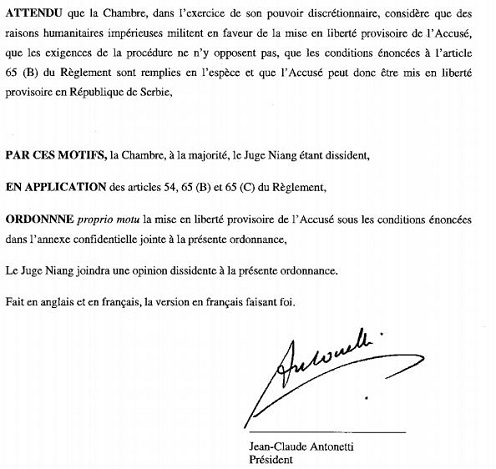
HAVING IN VI 1)1 that the Chamber, applying its discretionary powers, considers that credible humanitarian reasons favor the temporary release of the Accused, that this does not conflict with the needs of the procedure, that the conditions from Rule 65(B) of the Rulebook in this case fulfilled, and that therefore the Accused can be temporarily released to the Republic of Serbia,
FOR THESE REASONS, the majority of the Chamber, with Judge Niang dissenting, PURSUANT to Rules 54, 65(B) and 65(C) of the Rules,
ORDERS proprio motu the provisional release of the Accused, subject to the conditions set forth in the confidential appendix attached to this order.
Judge Niang will attach a dissenting opinion to this order.
Done in English and French, the French version being authoritative.
/signature/
Jean-Claude Antonetti, Chairman
Dated November 6, 2014. The Hague (Netherlands)
[seal of the International Tribunal]
4
November 6, 2014
Case No. 1Т-03-67-Т
Link to:
The Chamber proprio molu initiated a consultation procedure, which included the parties to the proceedings, the Republic of Serbia and the Kingdom of the Netherlands, with the aim of the eventual temporary release of the Accused, in June 2014, v. specifically, the Order inviting the host country and the country receiving the Accused to express an opinion on the guarantees in connection with the eventual release of the Accused on his own motion, June 13, 2014, public; Order inviting the Accused to make a statement on undertaking to comply with guarantees in connection with a possible temporary release proprio motu, July 3, 2014, public.
Order inviting the host country and the country receiving the Accused to express their opinion on the possibility of provisionally releasing the Accused proprio motu, 4 November 2014, public. s Submission of the Prosecution on the provisional release of the Accused proprio motu by the Trial Chamber, public, June 20, 2014.
See Article 20(1) of the Statute of the International Tribunal (hereinafter: the Statute) and the Chamber's note in this regard in the Decision on the continuation of the proceedings, December 13, 2013, rar. 56, public.
Specifically in terms of the principle of presumption of innocence of the Accused, Article 21(3) of the Statute.
Order ending the procedure for the temporary release of the Accused on his own motion, July 10, 2014.
Prosecutor against Popović and others, case no. JT-05-88-AR65.4, Decision on the Consolidated Appeal on the Decision on Borovčan's Request for Supervised Visitation and on the Decisions on Gvera's and Miletić's Request for Temporary Release During a Break in the Court Proceedings, May 15, 2008, para 5- 6, public.
Prosecutor against Šainović and others, case no. IT-05-87-A, Decision on Sretcn Lukić's Request for Temporary Release, March 30, 20, p. 2, publicly, Prosecutor against Prlilć and others, case no. IT-2-04-AR74-65. Decision on the Appeal against the Decision on the temporary release of Jadranko Prlić, December 26, 15, rar. 2011, public.
Letter from the Ministry of Foreign Affairs of the Kingdom of the Netherlands, confidential, 5 November 2014.
Source: ICTY Trial Chamber Šešelj (IT-03-67): Order for the provisional release of the accused proprio motu November 6, 2014.
Šešelj (FR, 06/11/2014) Ordonnance relative à la mise en liberté provisoire de l'Accusé proprio motu
First appearance of the accused before the Court - Šešelj (ICTY Part 1/4) - February 26, 2003.
Hague Court: Order inviting the host country and the country receiving the accused to express an opinion on the possibility of provisionally releasing the accused proprio motu
IT-03-67-T 3/61493 TER
D3 – 1/61493 TER
UNITED NATIONS
November 05, 2014. AJ
International Tribunal for the Criminal Prosecution of Persons Responsible for Serious Violations of International Humanitarian Law Committed on the Territory of the Former Yugoslavia Since 1991
Case No. IT-03-67-T
Date: November 4, 2014.
Original: FRENCH
TRIAL CHAMBER III
Consisting of:
Secretary: Order from:
PROSECUTOR against
The accused:
Mr. Vojislav Seselj
VOJISLAV SESELJ PUBLICLY
ORDER INVITING THE HOST COUNTRY AND THE RECEIVING STATE OF THE ACCUSED TO OPINION ON THE POSSIBILITY OF THE ACCUSED'S PROPRIO MOTUS PROVISIONAL RELEASE
Prosecution:
Mr. Mathias Marcussen
Judge Jean-Claude Antonetti, Presiding Judge Mandiaye Niang Judge Flavia Lattanzi
Mr. John Hocking
November 4, 2014
Government of the Kingdom of the Netherlands Government of the Republic of Serbia
Translation
TRIAL CHAMBER III (hereinafter: the Chamber) of the International Tribunal for the Criminal Prosecution of Persons Responsible for Serious Violations of International Humanitarian Law Committed on the Territory of the Former Yugoslavia Since 1991 (hereinafter: the Chamber, i.e. the International Court),
Proprio motu
BEARING IN MIND that the Chamber recently considered the possibility of temporarily releasing Vojislav Šešelj (hereinafter: the accused) due to the deterioration of his health condition proprio motu, but had to stop that procedure due to the lack of cooperation of the accused,
BEARING IN MIND that in the meantime the Chamber has received additional information, which was submitted as confidential but the essence of which has been disclosed to the public, which indicates that the health condition of the accused has deteriorated,
BEARING IN MIND that, in view of this development and in order to avoid the worst, the Chamber is considering the possibility of temporarily releasing the accused in order to provide him with care in the best possible environment, while ensuring the safety of witnesses and the integrity of the proceedings,
BEARING IN MIND that, for this purpose, the Chamber wishes to obtain the opinion of the Dutch and Serbian authorities on the possibility of temporarily releasing the accused proprio motu, subject to the conditions set out in Article 65 of the Rulebook on Procedure and Evidence (hereinafter: the Rulebook),
FOR THESE REASONS
ON THE BASIS of rules 54 and 65 of the Rules,
INVITES the Government of the Kingdom of the Netherlands to submit an opinion on the possibility of temporarily releasing the accused propio motu by 18.00:5 p.m. on November 2014, XNUMX at the latest,
Translation
INVITES the Government of the Republic of Serbia to submit an opinion on the possibility of the accused propio motu being temporarily released on the territory of Serbia by 18.00:5 on November 2014, XNUMX at the latest and to confirm that he will be able to guarantee that the accused will not come into contact with witnesses or victims and that he will return to the supervision of the International Tribunal as soon as the Chamber so orders.
Done in English and French, the French version being authoritative.
/signature on the original/
Jean-Claude Antonetti, Chairman
Dated November 4, 2014. The Hague (Netherlands)
[seal of the International Tribunal]
Order inviting the host country and the country receiving the accused to express their opinion on the possibility of temporarily releasing the accused on their own motion, November 4, 2014
ICTY case (IT-03-67) Vojislav Šešelj: Completion of preliminary proceedings for provisional release
UNITED NATIONS
3/61475 TER AJ
IT-03-67-T D3 -1/61475 TER
11 July 2014
International Tribunal for the Criminal Prosecution of Persons Responsible for Serious Violations of International Humanitarian Law Committed on the Territory of the Former Yugoslavia Since 1991
Case No. IT-03-67-T
Date: July 10, 2014. Original: FRENCH
TRIAL CHAMBER III
Judge Jean-Claude Antonetti, Presiding Judge Mandiaye Niang Judge Flavia Lattanzi
Mr. John Hocking
July 10, 2014
PROSECUTOR against
VOJISLAV SESELJ
ORDER TERMINATING THE PROCEEDINGS OF THE PROPRIO MOTUS ACCUSED'S TEMPORARY RELEASE
Prosecution:
Mr. Serge Brammertz Mr. Mathias Marcussen
The accused:
Mr. Vojislav Seselj
TRIAL CHAMBER III of the International Tribunal for the Criminal Prosecution of Persons Responsible for Serious Violations of International Humanitarian Law Committed on the Territory of the Former Yugoslavia Since 1991 (hereinafter: the Chamber, i.e., the International Tribunal),
BEARING IN MIND that the Panel proprio motu initiated a consultation procedure that included the parties to the proceedings, the Republic of Serbia and the Kingdom of the Netherlands, with the aim of the possible temporary release of the accused; that this measure, the adoption of which was considered in view of the extension of the proceedings after the replacement of one judge, requires certain restrictions in order to ensure that the accused returns to the Court, as well as to ensure the integrity of the proceedings, in accordance with the provisions of Rule 65 of the Rules of Procedure and evidence (hereinafter: Rulebook),
Order inviting the parties to present their opinion on the possibility of provisionally releasing the accused proprio motu, 13 June 2014 (public); Order inviting the accused to make a statement on undertaking to comply with guarantees in connection with a possible temporary release proprio motu, July 3, 2014 (public).
Order inviting the host country and the receiving country of the accused to express an opinion on guarantees regarding the possible provisional release of the accused proprio motu, 24 June 2014 (public).
Letter from the state regarding the temporary release of Mr. Seselja to freedom, submitted by state representatives on July 2, 2014, July 2, 2014 (confidential).
BEARING IN MIND that the Government of the Republic of Serbia, although it has stated that it is ready to guarantee compliance with the measures prescribed by the Chamber in connection with a possible temporary release, requests as a condition for its cooperation that the accused officially and unequivocally undertake to comply with the prescribed conditions,
BEARING IN MIND that the accused did not want to undertake to comply with conditions other than restrictions on freedom of movement within the borders of the Republic of Serbia; that because of this, there is a reason to terminate the proceedings initiated by the Chamber with the aim of the possible temporary release of the accused,
FOR THESE REASONS, The Chamber
PURSUANT to rules 54, 65(B) and 65(C) of the Rules,
DECIDES to terminate the provisional release proceeding initiated proprio motu, and REQUESTS the Secretary to inform the Government of the Republic of Serbia and the Government of the Kingdom of the Netherlands about this order.
Done in English and French, the French version being authoritative.
/signature on the original/
Jean-Claude Antonetti, presiding judge
Dated 10 July 2014 The Hague (Netherlands)
[seal of the International Tribunal]
ICTY (IT-03-67) Vojislav Šešelj: Order ending the procedure for the provisional release of the accused proprio motu, July 10, 2014.
See more Order regarding medical reports May 13, 2009.
Order regarding medical reports May 13, 2009.
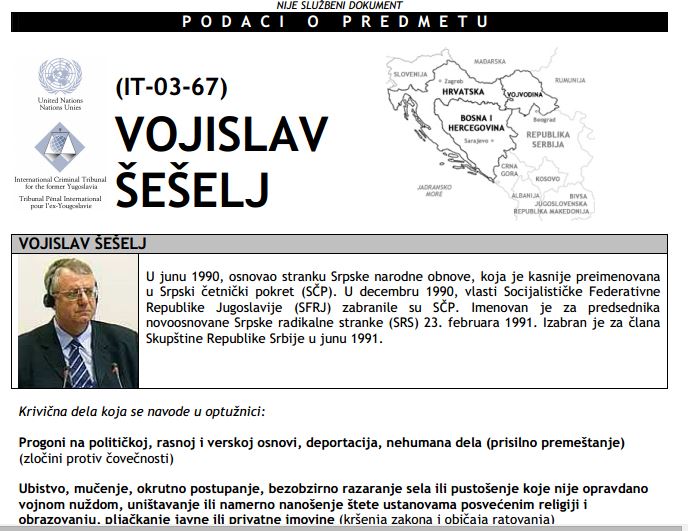
In June 1990, he founded the Serbian People's Renewal Party, which was later renamed the Serbian Chetnik Movement (SČP). In December 1990, the authorities of the Socialist Federal Republic of Yugoslavia (SFRJ) banned SČP. He was appointed president of the newly founded Serbian Radical Party (SRS) on February 23, 1991. He was elected as a member of the Assembly of the Republic of Serbia in June 1991.
Criminal offenses listed in the indictment:
Persecution on political, racial and religious grounds, deportation, inhumane acts (forcible transfer)
(crimes against humanity)
Murder, torture, cruel treatment, wanton destruction of villages or devastation not justified by military necessity, destruction or intentional damage to institutions dedicated to religion and education, looting of public or private property (violations of the laws and customs of war)
From or around August 1, 1991 until at least September 1993, Vojislav Šešelj, acting individually or in concert with other known and unknown participants in a joint criminal enterprise (JEC), planned, ordered, incited, committed or otherwise assisted and supported the planning, preparation or execution, or physically committed acts of persecution against the Croat, Muslim and other non-Serb population in the territory that the Serbian authorities called the "Serbian Autonomous Oblast (SAO) Slavonija, Baranja and Zapadni Srem", and in the municipalities of Zvornik, in the "wider area of Sarajevo" (the municipalities of Ilijaš, Vogošća, Novo Sarajevo, Ilidža and Rajlovac), and in the municipalities of Mostar and Nevesinje in Bosnia and Herzegovina, as well as in parts of Vojvodina in Serbia. These persecutions were committed on political, racial and religious grounds and included:
The killing of many Croat, Muslim and other non-Serb civilians, including women and the elderly, in the municipality of Vukovar in Croatia, as well as in the municipalities of Zvornik, in the "wider area of Sarajevo", and the municipalities of Mostar and Nevesinje;
Prolonged and routine imprisonment and detention of Croatian, Muslim and other non-Serb civilians in detention facilities in Croatia and Bosnia and Herzegovina, including prison camps in Vukovar, Zvornik, in the "wider area of Sarajevo", in Mostar and Nevesinje;
Establishing and maintaining inhumane living conditions for Croatian, Muslim and other non-Serb civilians in the aforementioned detention facilities;
Killing and constant torture and beating of detained civilians of Croatian, Muslim and other non-Serb nationalities in detention facilities;
Long-term and frequent forced labor of Croatian, Muslim and other non-Serb civilians detained in detention facilities or kept under house arrest in their homes in Vukovar, Zvornik, in the "wider area of Sarajevo", and in Mostar. Forced labor included digging graves, loading ammunition for Serbian forces, digging trenches, as well as other types of physical labor at the front;
Sexual abuse of Croatian, Muslim and other non-Serb civilians by Serbian soldiers during capture and in detention facilities;
The introduction of restrictive and discriminatory measures directed against the Croatian, Muslim and other non-Serb civilian population, including persons in Zvornik, in the "wider area of Sarajevo", Mostar and Nevesinje, but also in parts of Vojvodina in Serbia (namely in Hrtkovci, Nikinci, Ruma, Šid and others places bordering Croatia), such as restricting freedom of movement; removal from positions of authority in local institutions of state government and in the police; dismissal from work; denial of the right to health care and arbitrary house searches;
Torture, beating and robbery of Croatian, Muslim and other non-Serb civilians;
Deportation or forced relocation of tens of thousands of Croatian, Muslim and other non-Serb civilians from the above-mentioned territories;
Deliberate destruction of homes and other public and private property, cultural institutions, historical monuments and religious buildings of the Croatian, Muslim and other non-Serb civilian population in the municipality of Vukovar, and in the municipalities of Zvornik, in the "wider area of Sarajevo" and in the municipalities of Mostar and Nevesinje;
Direct and public disparagement of the Croatian, Muslim and other non-Serb population in Vukovar, Zvornik and Hrtkovci, through hate speech, based on their national affiliation.
| Date of birth
| October 11, 1954 in Sarajevo, Bosnia and Herzegovina |
| Indictment
| Original: February 14, 2003; modified: May 27, 2005; modified amended: July 15, 2005; Abbreviated Modified Amended: November 8, 2006 Third Amended Indictment: January 9, 2008 |
| Submission date
| February 23, 2003. |
| Transferred to the ICTY
| February 24, 2003. |
| First appearance and further appearances before the Court
| February 26, 2003, pleaded not guilty; On March 25, 2003, he pleaded not guilty to all charges |
STATISTICAL DATA
| Number of court days
| 175 |
| Number of prosecution witnesses
| 71 |
| Number of exhibits of the prosecution
| 1348 |
| Number of defense exhibits
| 6 |
| Number of witnesses called by the Chamber
| 10 |
| Number of Chamber exhibits
| 26 |
THE TRIAL
| Start of trial
| November 7, 2007 |
| Final words
| March 5 – 20, 2012. |
Trial Chamber III: Judge Jean-Claude Anttonetti (Presiding), Judge Frederick Harhoff (replaced by Judge Mandiaye Niang on 31 October 2013) and Judge Flavia Lattanzi
Prosecution: Mathias Marcussen, Ulrich Mussemeyer, Lisa Biersay, Rachel Hochhauser, Vega lodice, Arthur Traldi
Defense: representing himself
RELATED SUBJECTS
BABIC (IT-03-72)
DOKMANOVIĆ (IT-95-13A) "VUKOVAR HOSPITAL"
GALIC (IT-98-29) "SARAJEVO"
HADZIC (IT-04-75)
KARADŽIĆ (IT-95-5/18) "BOSNIA AND HERZEGOVINA" AND "SREBRENICA"
KRAJIŠNIK (IT-00-39 AND 40) "BOSNIA AND HERZEGOVINA"
MARTIC (IT-95-11) "RSK"
MILOSEVIC (IT-02-54) "KOSOVO, CROATIA AND BOSNIA"
MLADIĆ (IT-09-92) "BOSNIA AND HERZEGOVINA" AND "SREBRENICA"
MRKŠIĆ and others (IT-95-13/1) "VUKOVAR HOSPITAL"
NALETILIĆ AND MARTINOVIĆ (IT-98-34) "TUTA AND STELA"
PERIŠIĆ (IT-04-81)
PLAVŠIĆ (IT-00-39 I 40/1) "BOSNIA AND HERZEGOVINA"
PRLIC et al. (IT-04-74)
SIMIĆ and others (IT-95-9) "BOSANSKI ŠAMAC"
SIMIĆ MILAN (IT-95-9/2) "BOSANSKI ŠAMAC"
STANIŠIĆ AND SIMATOVIĆ (IT-03-69)
STANISIC MIĆO (IT-04-79)
TODOROVIĆ (IT-95-9/1) "BOSNIAN SHAMAC"
INDICTMENT AND CHARGES
The original indictment against Vojislav Šešelj was confirmed by Judge O-Gon Kwon on February 14, 2003. On November 1, 2004, the prosecution submitted a proposal for an amended indictment, which the Trial Chamber confirmed in a decision dated May 27, 2005. On the same day, the Trial Chamber ordered the prosecution to submit a corrigendum to the amended indictment. The Prosecution filed a corrigendum on July 7, 2005. On July 8, 2005, the Trial Chamber partially approved the corrigendum and ordered the Prosecution to file a modified amended indictment, which it did on July 15, 2005.
On August 31, 2006, the Trial Chamber invited the prosecution, pursuant to Rule 73bis(D) of the Rules, to suggest ways to reduce the scope of the modified amended indictment by at least one third. After initially rejecting the invitation, on September 21, 2006, the prosecution submitted a proposal that included dropping some counts of the indictment, and listed several crime scenes in Croatia and Bosnia and Herzegovina for which evidence will not be presented. On November 8, 2006, the Trial Chamber ordered, among other things, that counts 2, 3, 5, 6 and 7 be removed from the indictment. On March 30, 2007, the Prosecution filed a redacted version of the abbreviated modified amended indictment.
On November 27, 2007, the Trial Chamber ordered the prosecution to file an amended indictment, which was supposed to further modify the second amended indictment that the prosecution filed on September 28, 2007, but which was never confirmed. The third amended indictment was filed on December 7, 2007, and confirmed as a valid indictment in the case on January 9, 2008.
The indictment states that in June 1990, Vojislav Šešelj founded the Serbian People's Renewal Party, which was later renamed the Serbian Chetnik Movement (SČP). After the elections in December 1990, the authorities of the Socialist Federal Republic of Yugoslavia (SFRJ) banned the Serbian Chetnik movement. On February 23, 1991, Vojislav Šešelj was appointed president of the newly founded Serbian Radical Party (SRS). In June 1991, he was elected a member of the Assembly of the Republic of Serbia. At almost daily rallies and during the election campaign, he called for the unity of the Serbs and for war against the "historical enemies" of Serbia, that is, against the population of Croatian, Muslim and Albanian nationality in the territory of the former Yugoslavia.
The indictment alleges that Šešelj participated in a joint criminal enterprise (JCEU), the purpose of which was to permanently remove, by committing crimes, the majority of Croats, Muslims and other residents of non-Serb nationality from approximately one third of the territory of the Republic of Croatia and large parts of Bosnia and Herzegovina, as well as from some parts of Vojvodina, in order for those areas to become part of the new state dominated by the Serbs. In Croatia, these areas included the areas that the Serbian authorities called "SAO Krajina" (that is, the Serbian Autonomous Region of Krajina), "SAO Zapadna Slavonia" and "SAO Slavonia, Baranja and Zapadni Srem" (after December 19, 1991, "SAO Krajina" appeared under the name RSK (Republika Srpska Krajina), and on February 26, 1992, SAO Zapadna Slavonija and SAO Slavonia, Baranja and Zapadni Srem became part of RSK), as well as the "Republic of Dubrovnik". In Bosnia and Herzegovina, these areas included Bosanski Šamac, Zvornik, five municipalities known as the "wider area of Sarajevo" (Ilijaš, Vogošća, Novo Sarajevo, Ilidža and Rajlovac), Bijeljina, Mostar, Nevesinje and Brčko.
The JCE was created before August 1, 1991 and lasted at least until December 1995. Seselj participated in this JCE until September 1993, when he came into conflict with Slobodan Milošević. Each participant in the JCE played their role or several roles that significantly contributed to the achievement of the goal of this endeavor. Among the other participants who took part in this JCE were Milošević, Veljko Kadijević, Blagoje Adžić, Ratko Mladić, Radmilo Bogdanović, Jovica Stanišić, Franko Simatović aka "Frenki", Radovan Stojičić aka "Badža", Milan Martić, Goran Hadžić, Milan Babić, Radovan Karadžić, Momčilo Krajišnik, Biljana Plavšić, Zeljko Raznjatović aka "Arkan" and other political figures from S(F)RJ, Republic of Serbia, of the Republic of Montenegro and the leadership of the Bosnian and Croatian Serbs. Among the participants in the JCE were also "Serbian forces", collectively defined as members of the Yugoslav People's Army (JNA), later the Army of Yugoslavia (VJ), the newly formed Serbian Territorial Defense (TO) in Croatia and Bosnia and Herzegovina, the army of the Republic of Serbian Krajina (SVK), the Army of the Republika Srpska (VRS), the TO of Serbia and Montenegro, the forces of the local Serbian police and the police forces of the Republic of Serbia and the Republic of Srpska (MUP forces), including the State Security (DB) of the Ministry of Internal Affairs of the Republic of Serbia and special the Serbian police force in SAO Krajina and in the RSK, which were usually called "Martić's police", "Martićevci", "SAO Krajina Police" or "SAO Krajina Militia", and members of paramilitary forces from Serbia and Montenegro, paramilitary forces of Bosnian Serbs and Croats Serbs and volunteer units such as "Chetniks" or "Seseljevci".
Seselj, as the president of the Serbian Radical Party (SRS), was a prominent political figure in SFRY/FRY during the period to which this indictment refers. It is said that he advocated the policy of uniting "all Serbian countries" into a homogeneous Serbian state. He marked the so-called Karlobag-Ogulin-Karlovac-Virovitica line as the western border of that new Serbian state, which he referred to as "Greater Serbia" and which included Serbia, Montenegro, Macedonia and significant parts of Croatia and Bosnia and Herzegovina.
It is alleged that Šešelj, acting alone and in agreement with other JCE participants, participated in the recruitment, establishment, financing, supply, support and management of Serbian volunteers associated with the SRS, and/or SČP through and/or with the help of the Crisis Staff of the SRS , and then the SRS War Headquarters. He made inflammatory speeches in the media, at public appearances and during his visits to volunteer units and other Serbian forces in Croatia and Bosnia and Herzegovina, encouraging those forces to commit crimes. He advocated and encouraged the creation of a homogeneous "Greater Serbia" by force, and thus participated in spreading war propaganda and inciting hatred towards the non-Serb population. In public speeches, he called for the expulsion of Croatian civilians from parts of the province of Vojvodina in Serbia and thus encouraged his followers and local authorities to participate in the campaign of persecution of the local Croatian population. He participated in planning and preparations for the takeover of power in towns and villages in two Serbian autonomous regions in Croatia and in the municipalities of Bosanski Šamac, Zvornik, in the "wider area of Sarajevo", and in the municipalities of Bijeljina, Mostar, Nevesinje and Brčko in Bosnia and Herzegovina, as and for the subsequent forced removal of the majority of the non-Serb population from those areas. He participated in providing the financial, material, logistical and political support needed for such a takeover. He secured that support, with the help of Slobodan Milošević, from the Serbian authorities and Serbs from abroad, where he collected funds to support the achievement of the goal of the JCE. He recruited Serbian volunteers associated with the SRS and indoctrinated them with his extreme nationalist rhetoric to participate in the forcible removal of the non-Serb population from the target areas by committing the crimes in this indictment in a particularly violent and brutal manner.
Sešelj was charged on the basis of individual criminal responsibility (Article 7(1) of the Statute) for:
Persecution on political, racial and religious grounds, deportation, inhumane acts (forcible transfer) (crimes against humanity, Article 5) and
Murder, torture, cruel treatment, wanton destruction of villages, or devastation not justified by military necessity, destruction or intentional damage to institutions dedicated to religion and education, looting of public or private property (violations of the laws and customs of war, Article 3).
THE TRIAL
The trial began on November 27, 2006, without the presence of Vojislav Šešelj, who had been on hunger strike since November 10 and refused to appear before the court.
In view of such a situation, the Trial Chamber issued an order on November 27, 2006, terminating the accused's self-representation and reassigning him a defense attorney to lead his defense.
The prosecution presented its opening statement on November 27 and 28, 2006.
On December 1, 2006, in light of the accused's health condition, the Trial Chamber ordered that the trial be postponed until further notice.
On 6 December 2006, the Trial Chamber ordered the Dutch authorities to provide medical services to protect the health and well-being of the accused and to avoid loss of life.
On December 7, 2006, Šešelj filed an appeal against the decision on the imposed defense counsel, and on December 8, 2006, the Appeals Chamber issued a decision that "cancelled the beginning of the trial procedure in this case and ordered the resumption of the trial" when Vojislav Šešelj is "in a condition to fully participate in the proceedings as an accused representing himself."
The trial resumed on November 7, 2007, with the opening statements of the prosecution. Presentation of defense evidence began on December 11, 2007.
On February 11, 2009, the Trial Chamber made a decision by majority vote (with Judge Antonetti dissenting) accepting the prosecution's request to postpone the proceedings due to the alleged intimidation of a large number of prosecution witnesses.
On November 24, 2009, the Chamber granted the defendant's request for reconsideration of the adjournment decision and ordered the trial to continue on January 12, 2010.
The prosecution finished presenting its evidence on January 13, 2010. The defense did not present evidence. The parties to the proceedings presented their closing arguments from March 5 to 20, 2012.
DECISION BASED ON RULE 98b/s
Upon completion of the presentation of the prosecution's evidence, the trial panel can decide whether there are grounds for conviction. If the panel finds that the prosecution has not presented sufficient evidence for a particular charge or charges, the panel may dismiss those charges and issue an acquittal on those charges prior to the commencement of the defense's presentation of evidence.
On May 4, 2011, the Trial Chamber rendered an oral decision pursuant to Rule 98bis and denied the Accused's motion for acquittal. Judge Antonetti dissented.
ICTY (IT-03-67) Vojislav Šešelj: Information on the case
See also:
ICTY: Indictment
ICTY (IT-03-67) Vojislav Šešelj: Selection of documents
ICTY (IT-03-67) Vojislav Šešelj: Decision on continuation of proceedings
ICTY (IT-03-67) Vojislav Šešelj: Press releases
After being released on temporary freedom from the Hague Tribunal, where he spent more than 11 and a half years in custody, Vojislav Šešelj, on November 12, 2014 at 12:56 a.m. on Airbus A319 flight JU 361 KL 2824 from Amsterdam to Belgrade Airport "Nikola Tesla". The leader of the Serbian Radical Party was welcomed by his sons and wife, supporters and leadership of the Serbian Radical Party Nemanja Šarović, Milorad Mirčić, Nataša Jovanović, Vjerica Radeta. From Šešelj Airport, he went to the rostrum of the Serbian Radical Party in the Magistrate's building in Zemun, where he was greeted by trumpeters on public speakers and supporters, who greeted him with shouts of "Vojo, Serbs!"...
He addressed his supporters from the terrace of the party's headquarters, saying that the Hague Tribunal, whom he called a "wounded globalist beast that continues to destroy the lives of Serbian political and military leaders," "brutally kicked him out" from custody because they wanted to "get rid of him as soon as possible", that he promised to break up the tribunal, that the fight lasted longer than he expected, but that victory is not to be taken for granted.
"They said that they are releasing me on temporary freedom, and that will last temporarily only until we overthrow Tomislav Nikolić and Aleksandar Vučić, our renegades and traitors who renounced the ideology of Serbian nationalism and became servants of the Western powers..." Seselj told supporters , gathered in front of the Magistrate. The day after returning to Belgrade Seselj announced that he will not voluntarily return to The Hague and that he will start a political struggle against the "pro-Western treacherous regime in Serbia"...
The Trial Chamber is on Friday (December 13, 2013, ed.) issued a decision on the continuation of the proceedings in the case against Vojislav Seselj, after the disqualification of Judge Frederik Harhoff and the appointment of Judge Mandiaye Niang to the Judicial Chamber.
The panel unanimously ordered that the proceedings continue from the stage after the presentation of the closing arguments and move to the deliberation stage as soon as Judge Niang is familiar with the file in question. The Trial Chamber will issue its judgment after this process is completed.
The panel agreed that the new judge was able to review witness testimony in his absence through other means, including video recordings. Consequently, the Chamber concluded that Judge Niang will therefore be able to assess the reliability of the witnesses who were heard during the proceedings in the Seselj case and to familiarize himself with the file in question to a satisfactory extent.
Judges Antonetti and Niang attached concurring separate opinions to the Trial Chamber's Decision.
The decision made on Friday followed the Chamber's invitation to the parties to the proceedings to submit their views on the continuation of the proceedings by November 13. In his submission, Vojislav Šešelj claimed that after the disqualification of Judge Harhoff, the proceedings cannot be continued, that he should be released immediately and that he should be paid monetary compensation. The Prosecution considered that the proceedings should continue from the deliberation stage, after Judge Niang familiarized himself with the existing case file. The Prosecution argued that such a decision would not be unprecedented in the practice of the International Court, pointing to the trial of Slobodan Milosevic, where Judge Bonomy replaced Judge May.
On July 9, 2013, Vojislav Šešelj submitted a motion requesting the removal of Judge Harhoff from the Trial Chamber, based on a June 6 letter written by that judge. On August 28, the specially appointed Commission disqualified Judge Harhoff from the Seselj case after finding by a majority vote that the judge had shown an unacceptable impression of bias in favor of passing guilty verdicts. On October 7, the commission, by majority vote, with Judge Liu dissenting, rejected the Prosecution's request to review this decision.
On October 31, the Acting President of the International Tribunal appointed Judge Niang in place of Judge Harhoff to the Trial Chamber in the Šešelj case.
Seselj's trial will continue after Judge Niang gets acquainted with the file in question Press release MS/PR1592t, The Hague, 16 December 2013.
See also: Decision on Defense Motion to Disqualify Judge Frederik Harhoff and Report to the Vice President, August 28, 2013.
From October 29 to 31, a team of doctors from Serbia visited Vojislav Šešelj and Goran Hadžić in the United Nations Detention Unit, at the request of the accused and the Government of the Republic of Serbia, and in accordance with Rule 31 of the Rulebook on Detention.
The medical staff of the Detention Unit fully cooperated with the doctors from Serbia, after they received consent from these two detainees to share all the available documentation and to answer all the questions of the doctors from Serbia.
It is important to note that this visit was requested in a very short period of time and that the International Court made extraordinary efforts to make medical personnel and equipment available and to prepare the requested documentation in this very short period. The International Court also undertook to deliver all additional materials, such as the results of additional diagnostic tests that may be relevant, to the doctors from Serbia as soon as they are available.
The doctors were informed that the Detention Unit implements a very competent health care system based on Dutch standards regarding the frequency, types and methods of diagnostics and medical treatment. In addition, ICTY detainees enjoy expedited access to medical and diagnostic tests, which is not available to ordinary Dutch citizens.
Furthermore, in connection with the case against Vojislav Seselj, the Chamber today issued an order calling on the governments of the Kingdom of the Netherlands and the Republic of Serbia to submit opinions on the possible temporary release of Vojislav Seselj. In addition, the Government of the Republic of Serbia is invited to confirm that it can ensure that the accused will not come into contact with witnesses or victims and that they will return to the International Court as soon as the Chamber so orders. The panel asked both governments to submit their opinions by 18:00 today.
ICTY weekly press conference, November 5
***
The Vice-President of the Government of the Republic of Serbia and the President of the National Council for Cooperation with the Hague Tribunal, Rasim Ljajić, responded to the letter he received from the Chairman of the Trial Chamber at the trial of Vojislav Šešelj, Jean-Claude Antonetti, in which the Government of Serbia is asked for an opinion on the possible release of Vojislav Šešelj on temporary freedom. .
In his reply to Judge Antoneti, Ljajić stated that the position of the Government of Serbia regarding the eventual release of the accused Vojislav Šešelj remains the same as in the case of the previous decision of the judicial panel of the Hague Tribunal, which requested guarantees from the Government of Serbia, about which the Government informed the Tribunal on July 1 of this year. year.
He pointed out that the Government of the Republic of Serbia is concerned about new developments regarding the health condition of the accused Vojislav Šešelj, and that in this sense it is ready to provide guarantees for his temporary release.
The condition for this is that the accused Vojislav Šešelj declares that he will comply with all the conditions set by the competent judicial panel of the Hague Tribunal, as well as that he accepts the guarantees of the Government of the Republic of Serbia, bearing in mind that he has refused them so far, according to the announcement of the Office of the Deputy Prime Minister.
Source: The government gives guarantees for the temporary release of Vojislav Šešelj, website of the Government of Serbia, November 5, 2014.
On November 5, the spokeswoman of the Hague Tribunal, Magdalena Spalinska, confirmed that the Government of Serbia submitted an answer to the Hague Tribunal regarding the possible release of Hague indictee Vojislav Šešelj. "As far as the Government of the Netherlands is concerned, there is no public submission," she said, explaining that if the accused Vojislav Šešelj refuses guarantees from the Government of Serbia for his temporary release, the Trial Chamber of the Tribunal will make a decision on further steps.
"That is a question that will have to be considered by the judges of the Trial Chamber." They have received, or will receive, answers that they will familiarize themselves with and then they will decide for themselves what the next steps must be," Spalinska said in a telephone statement. Tanjug .
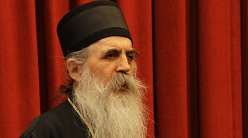
Bishop of Bačka Dr. Irinej on the Seselj case: For God's and human justice, not for Hague justice
The fact that in the 21st century someone spends twelve years in a remand prison of any civilized country is scandalous and monstrous in itself. But the fact that someone has been in the pre-trial detention center of the Tribunal established by the United Nations for twelve years speaks volumes about the state of Western civilization in general, and the most vocal advocates of human rights in the modern world in particular.
Previously, on March 24, 1999, on the example of the Serbian people and the Serbian state, the new world order showed what the rights of nations and states are, what international law means and the value of the United Nations Charter.
Since we know that ten Serbs have already died in the Hague Tribunal, in the case of Dr. Vojislav Šešelj, it is of little value for us to refer to the Provisions of the European Convention on Human Rights, the International Covenant on Civil and Political Rights, the Charter of Fundamental Rights in the European Union and other provisions of international law that guarantees a trial within a reasonable time, not to mention the right to treatment by those he trusts as people and doctors.
We, who in the case of Dr. Šešelj, as in every other judicial process, are not guided by party, ideological, or any worldly motives and goals, but solely stand for justice and legality, remain to admonish ourselves first of all, and then the Hague judges and those powerful ones who are above them, that one day we will all stand before the face of the only absolutely just Judge, no matter how much the mentioned Hague judges and their actual mentors and masters have little or nothing to do with it believed. Then we will hear the words spoken by God Himself through the prophet Moses: Behold, I have set before you life and death... Whether we will then inherit eternal life or eternal death, we all decide every moment of our lives, each one for himself, completely freely and independently from the Hague justice. We are deciding on that now, deciding for justice or injustice in the case of the tragically endangered Hague slave, Dr. Vojislav Šešelj.
Source: Bishop of Bačka Dr. Irinej: For God's and human justice, not for Hague justice, website of the Serbian Orthodox Church, Diocese of Bačka, November 7, 2014.
The day after his return to Belgrade, Šešelj held a press conference at the headquarters of the Serbian Radical Party on November 13, where he said, among other things, that he would not voluntarily return to the Hague Tribunal, about which he repeated his earlier statements ("I went to The Hague, because I promised the Serbian people at a large number of meetings, when I go to The Hague, that I will destroy the Hague Tribunal and the NATO Pact and the European Union and the Dutch Queen..."):
"So, I will not respond, and then when they issue an order to the Government of the Republic of Serbia, then Tomislav Nikolić and Aleksandar Vučić will decide what to do with that order. I will not run away anywhere. If they decide to arrest me, Tomislav Nikolić and Aleksandar Vučić, they can arrest me. They can arrest me now. In that case, if they arrest me, they will have to carry out the formal court proceedings that last for about two weeks, and also order those judges who are their henchmen to make a decision to extradite me. And you know, that would be a historical paradox, perhaps in a sense historical justice. Those who were my closest collaborators, and my most direct accomplices in all my war crimes and crimes against humanity, Tomislav Nikolić and Aleksandar Vučić, to deliver me to the Hague Tribunal. So do you think that I would miss this opportunity that presented itself to me? So there is no voluntary return from me. If the regime arrests me and delivers me, that's another matter. In that case, we will not oppose the regime with weapons in hand. There will be demonstrations, there will be public protests, but there will be no bloodshed, as there has never been at the meetings of the Serbian Radical Party, except for the one organized by Vučić, where he agreed with some groups to attack the police, then caused bloodshed, and continuously promised that will investigate the case of the murdered Ranko Panić..."
During the conference, Šešelj spared no words in denigrating Tomislav Nikolić and Aleksandar Vučić.
"As far as my health is concerned, there have never been any secrets. I had big problems with my heart, with tachycardia and arrhythmia, and after some time it was cured. As far as I'm concerned, I'm functioning normally. They operated on my colon and metastases appeared. They removed them from the lymph nodes, recently they appeared on the liver, in two places. So I got two cancers. You know what I called those cancers? Those two cancers on my liver bear the names of Tomislav Nikolić and Aleksandar Vučić. According to the medical documentation that I have so far, it is possible to operate, and I hope to operate on it soon, while I finish all the other checks and tests..."
"And we have a president of the Republic who obtained a university degree without taking a single exam. He doesn't even know where his faculty is, he doesn't even know which department he was enrolled in. And everything stands. It was not mentioned much in the media, now it is covered up, no one is even allowed to ask him that question. Well, he can't, he shouldn't be talked about anymore. He must leave that position. He must leave as soon as possible, because it is a shame for Serbia. I also have to express my regret that those people who are at the head of today's regime came from our Serbian Radical Party, that they were our first collaborators for many years, that in a certain sense they were also the support of the Serbian Radical Party, but their betrayal, their turning the turkey upside down shows how strong are the forces that conspired against the Serbian Radical Party. They approached their personality with a scientific method, finding weak points, promising, bribing, threatening and using all other ways of waging a special psychological war..."
He announced the mobilization of the membership of the Serbian Radical Party and, as he said, "and all Serbian patriots on the plan of opposing the current pro-Western treacherous regime in Serbia, on the plan of opposing all attempts to include Serbia in the European Union or the NATO pact.":
"We will start our activity at an accelerated pace, as today, in all places in Serbia, in all municipalities, in all local communities, and this action will gain in intensity as much as we are able to mobilize our members...
In addition to very harsh words against his former colleagues, now Prime Minister and President Aleksandar Vučić and Tomislav Nikolić, Sešelj in his introductory speech put special emphasis, not on national issues (although he said that he remains an advocate of the idea of Greater Serbia), but on economic issues:
"This regime is not able to fulfill its election promises. This regime has no conception of economic policy. This regime lives from today to tomorrow, they constantly bombard us with new promises, constant hints of some of their activities, but in fact there is nothing there. Various Gusenbauers and the like are paraded here, some are constantly brought in promising investments, and when you look at it, it would be much better for us if many of those investors never came, so that the state does not have to give money from its own budget for their work. Instead of them financing the state from their profits, the situation is reversed - now the state gives money so that they can do something here and take their profits outside the territory of Serbia..."
The second point was the anti-European attitude:
"Joining the European Union would be a disaster for Serbia and for the entire Serbian people. There is no place for us there. In vain, Aleksandar Vučić shouts at the Albanian Prime Minister. And why didn't he stand in that way towards those from the West, who also recognized Kosovo and who constantly claim that it is a fait accompli? It's easy to blame one poor person from a small country, but you have to oppose the big powers that lead a policy against Serbia, and even lead the politics of today's Albania in an anti-Serbian direction. That is the essence. What would be the basic guidelines of that new economic policy? First of all, we must implement strict customs control and break the import lobby in Serbia. We have no economic recovery while everyone living can import whatever comes to mind, and our domestic production is without any protection. This is the secret of the recovery of the economy, and not now that Russia is closed to Poland or the Netherlands, for their agricultural products, suddenly a huge amount of these goods from Poland and the Netherlands is coming to Serbia, and we Serbs are being threatened that we must not increase our exports to Russia and to compensate what Russia exported from other countries..."
Source: Vojislav Šešelj: The current regime lives on media manipulation, website of the Serbian Radical Party, November 13, 2014.
Updated on November 13
EUROPEAN PARLIAMENT 2014 - 2019
Plenary session document
26.11.2014 B8 0292/2014 }
B8 0294/2014 }
B8 0296/2014 }
B8 0300/2014 }
B8 0304/2014 }
B8 0306/2014 }
B8 0307/2014 } RC1
JOINT PROPOSAL FOR A RESOLUTION
filed in accordance with Article 135, paragraph 5 and Article 123, paragraph 4 of the Rules of Procedure,
which replaces the proposed resolutions of the following clubs:
EFDD (B8 0292/2014)
ECR (B8 0294/2014)
Greens/EFA (B8 0296/2014)
S&D (B8 0300/2014)
ALDE (B8 0304/2014)
GUE/NGL (B8 0306/2014)
EPP (B8 0307/2014)
on Serbia: the case of accused war criminal Seselj
(2014/2970 (RSP))
Cristian Dan Preda, Andrej Plenković, David McAllister, Elmar Brok, Dubravka Šuica, Davor Ivo Stier, Jaromír Štětina, Giovanni La Via, Joachim Zeller, Tunne Kelam, Lorenzo Cesa, Franck Proust, Petri Sarvamaa, Bogdan Brunon Wenta, Monica Macovei, Jeroen Lenaers, Seán Kelly, Jiří Pospíšil, Gabrielius Landsbergis, Marijana Petir, Tomáš Zdechovsklj, Lara Comi, László Tőkés, Ivana Maletić, Tadeusz Zwiefka
on behalf of the EPP Group
Josef Weidenholzer, Goffredo Maria Bettini, Liisa Jaakonsaari, Lidia Joanna Geringer de Oedenberg, Victor Boştinaru, Richard Howitt, Tonino Picula, Marc Tarabella, Nicola Caputo, Biljana Borzan, Doru-Claudian Frunzulică, Miroslav Poche, Elena Valenciano Martínez-Orozco
on behalf of the S&D Group
Charles Tannock, Ruža Tomašić, Ryszard Czarnecki
on behalf of the ECR Group
Jozo Radoš, Ivo Vajgl, Ivan Jakovčić, Fernando Maura Barandiarán, Pavel Telička, Izaskun Bilbao Barandica, Marietje Schaake, Louis Michel, Marielle de Sarnez, Johannes Cornelis van Baalen, Gérard Deprez, Dita Charanzová, Petras Auštrevičius, Javier Nart, Antanas Guoga, Urmas Paet, Ilhan Kyuchyuk
on behalf of the ALDE Group
Marie-Christine Vergiat
on behalf of the Club of GUE/NGL representatives
Davor Škrlec, Igor Šoltes, Ulrike Lunacek, Tamás Meszerics, Ernest Urtasun, Barbara Lochbihler, Jordi Sebastià, Heidi Hautala, Klaus Buchner
on behalf of the Club of Verts/ALE representatives
Fabio Massimo Castaldo, Ignazio Corrao
on behalf of the EFDD Group
European Parliament,
- taking into account its previous resolutions on Serbia,
- taking into account the Stabilization and Association Agreement between the European Communities and their member states and the Republic of Serbia, which entered into force on September 1, 2013,
- taking into account the report of the Commission on the progress of Serbia for 2014 of October 8, 2014 (SWD(2014)0302),
- taking into account the Statute of the International Tribunal for the Criminal Prosecution of Persons Responsible for Serious Violations of International Humanitarian Law Committed on the Territory of the Former Yugoslavia Since 1991 (hereinafter: ICTY),
- taking into account Article 65 of the Rules of Procedure and Evidence of the ICTY,
- taking into account article 135, paragraph 5 and article 123, paragraph 4 of the Rules of Procedure,
A. whereas Vojislav Šešelj, the president of the Serbian Radical Party, was accused before the ICTY of persecution on political, racial or religious grounds, deportation, inhuman treatment (forcible transfer) (crimes against humanity) and murder, torture, cruel treatment, reckless destruction of villages or devastation not justified by military necessity, destruction or willful damage to institutions intended for religion or education, robbery of public or private property (violation of laws and customs of war) in Croatia, Bosnia and Herzegovina and parts of Vojvodina (Serbia), committed between 1991 and 1993;
B. whereas in 1993 the United Nations established the ICTY to prosecute war crimes committed in the 1990s, which laid the foundations for post-conflict conflict resolution and development in the region;
C. whereas on November 6, 2014, after more than 11 years of detention and while the court proceedings are still ongoing, the Trial Chamber of the ICTY issued a proprio motu order on the temporary release of Seselj due to the deterioration of his health condition, under the following conditions : (i) that Šešelj does not influence witnesses and victims; and (ii) to appear before the Council as soon as it so directs; since Seselj had a hostile attitude towards the ICTY from the beginning of the trial, which he demonstrated by repeated interruptions, interruptions and disavowals during the proceedings, and that he was sentenced three times for contempt of Court for intimidating witnesses;
D. whereas since his return to Serbia, Seselj has held several public speeches in Belgrade in which he emphasized that he will not voluntarily return to the ICTY when he is asked to do so, thereby announcing his intention to violate one of the two conditions under which he was released;
E. Whereas in his public statements, Seselj has repeatedly called for the creation of a "Greater Serbia", by which he publicly expressed his pretensions to neighboring countries, including the European Union member state - Croatia, and incited hatred against the non-Serb population; since in a statement to the media he congratulated the "Serbian Chetniks on the 'liberation' of Vukovar" on the occasion of the 23rd commemoration of the fall of that Croatian city to the hands of Serbian paramilitary forces and the Yugoslav Army in 1991 and the atrocities that followed, thus violating the condition not to affect the victims ; whereas the Serbian peace group "Women in Black" gathered in Belgrade to remember the victims of the siege in a performance entitled "We will never forget the crimes in Vukovar";
1. strongly condemns Šešelj's incitement to war, incitement to hatred and territorial pretensions, and his attempts to divert Serbia from the European path; expresses regret for his provocative public actions and war rhetoric since his temporary release, which reopened the psychological wounds of the victims of the war and atrocities of the early 1990s; stresses that Seselj's recent statements could call into question the progress made in regional cooperation and reconciliation and undermine the efforts made in the past years;
2. reminds the Serbian authorities of their obligations within the framework of cooperation with the ICTY and the obligations of Serbia as a candidate country for membership in the European Union; notes with concern that the absence of an appropriate political reaction and legal response by the Serbian authorities to Seselj's behavior undermines the trust of the victims in the judicial process; urges the Serbian authorities and democratic parties to condemn all public manifestations of hate speech or war rhetoric and to encourage the protection of minorities and cultural rights; asks the Serbian authorities to investigate whether Šešelj violated Serbian laws and to strengthen and fully implement the legislation outlawing hate speech, discrimination and incitement to violence; supports all political parties, non-governmental organizations and individuals in Serbia who fight against hate speech;
3. calls on the ICTY and its Prosecutor's Office to review the existence of conditions for temporary release in new circumstances; notes that the different criteria for the Tribunal's practice regarding temporary release will not contribute to the achievement of the ICTY's goals; urges the ICTY to take decisive steps to restore confidence in the ICTY weakened by Seselj's terrible and inadmissible public statements, which includes taking measures to accelerate the completion of all first-instance and appellate proceedings before it; reminds that bringing perpetrators of war crimes to justice is a necessary condition for a genuine and lasting reconciliation process;
4. instructs its President to forward this Resolution to the Council, the Commission, the governments and parliaments of the member states, the Vice President of the Commission / High Representative of the Union for Foreign Affairs and Security Policy, the President, the Government and the National Assembly of Serbia, the United Nations Security Council and the President of the ICTY.
Resolution of the European Parliament on Serbia: the case of accused war criminal Seselj (2014/2970(RSP)), EP/hr/
***
It is astonishing that the European Parliament allowed Croatia to instrumentalize it for election purposes and passed a Resolution referring to Serbia, without giving Serbia the opportunity to even express its position.
Unfortunately, the European Parliament does not change its attitude towards Serbia even now, when it has recognized that Serbia is a country that has deserved the start of the negotiation process with its reforms.
The European Parliament should know how much effort Serbia has put in to stabilize the very fragile relations with Croatia and to resolve numerous open issues in mutual interest. Deputies remained silent in the face of the destruction of Cyrillic signs in Slavonia, in the face of explicit hate speech against Serbs at rallies on the occasion of the anniversary of the criminal action of Oluja, which have lasted for more than ten years, or in the face of holding public concerts of very popular music in Croatia, whose lyrics openly call for the extermination of Serbs .
He also did not appreciate the fact that Serbia did not prevent Croatia on its European path, although it could have due to numerous problems in the area of the rule of law, human rights and freedoms, as well as the unresolved return and property issues of expelled Serbs. Destabilization of the region is not in the interest of Serbia and the Balkan countries, but it is not in the interest of Europe either.
Although it is undeniable that the situation in Serbia is very difficult and that poverty is rampant, the citizens of Serbia are not filled with hatred towards their neighbors, but are preoccupied with problems and bear a heavy burden of reforms, which aim to create legal certainty, economic progress, and a better future in general.
The fact that I do not agree with the voting of the EP Resolution does not mean that it imposes any obligation on Serbia, it just shows us what we could experience in the future.
As for the Hague Tribunal, the question arises, what is the ultimate goal of their circus show and their mentors and clowns? What do they want to achieve? Change of government? So, in democratic societies, aren't citizens deciding on this in elections? That's why it would be unfair to the citizens to resign. That would probably be easier for most members of the Government.
Who would replace them? Demonstrably worse, I dare say worse people, but very susceptible to manipulation. Serbia would return to hell where they would easily take away even what it swore it would never give to anyone.
Serbia pursues a policy of peace and stability in order to provide its citizens with a better life than their own work. It is dedicated to the achievements of civilization, and any war-mongering rhetoric is inadmissible for it, whether it comes from Serbia, Croatia, Albania, or wherever. We should not be reminded of that by those who did not solve the problem in their own backyard.
Statement by the President of Serbia regarding the resolution of the European Parliament, Information Service of the President of Serbia, November 28.11.2014, XNUMX
Trial Chamber III of the International Criminal Tribunal for the former Yugoslavia (ICTY) today (March 31, 3) acquitted Vojislav Šešelj, Serbian politician, president of the Serbian Radical Party and member of the National Assembly of the Republic of Serbia. Vojislav Šešelj was charged with 2016 counts, of which 9 for crimes against humanity (persecution, deportation and inhuman acts or forced transfer) and 3 for war crimes (murder, torture and cruel treatment, wanton destruction, destruction or damage to institutions dedicated to religion or education, looting of public or private property). He was accused of directly committing, inciting, aiding and abetting the crimes committed by Serbian forces in the period from August 6 to September 1991, or of having participated in their commission through his participation in a joint criminal enterprise.
The majority of members of the Chamber, with the dissenting opinion of Judge Lattanzi, concluded that the prosecutor failed to prove the existence of a criminal objective, which is a legal prerequisite for the existence of a joint criminal enterprise. The majority of the Council members concluded that the goal of creating Greater Serbia was more of a political endeavor than a criminal project. Most members of the Council are aware that Serbian forces committed crimes in that process, but that these crimes are not necessarily connected to the achievement of the goal of creating Greater Serbia.
The majority of the Panel, with Judge Lattanzi dissenting, also found that the recruitment of volunteers, for which Vojislav Šešelj was considered to have participated in a joint criminal enterprise, was a legal activity regulated by the Yugoslav constitution and other relevant laws at the time. In any case, the majority of the members of the Chamber, with the dissenting opinion of Judge Lattanzi, concluded that the volunteers, after being recruited and sent to the battlefield, were not under the authority of Vojislav Šešelj, but under the military command, in accordance with the principle of single leadership outlined in the relevant rules.
The prosecutor also claimed that Vojislav Šešelj directly committed a certain number of crimes, primarily through public and direct disparagement in speeches in which he incited hatred directed against the non-Serb population. For some of those speeches, the majority of the members of the Chamber, with Judge Lattanzi dissenting, could not rule out the reasonable possibility that they were uttered in the context of the conflict and that their aim was to raise the morale of his soldiers, and not to call them to show no mercy to anyone. The other majority of the members of the Chamber, with the dissenting opinion of Judge Antonetti, concluded that the two other speeches represented clear calls for the expulsion and forced relocation of Croats. That conclusion, however, is not sufficient for a conviction, because the majority of the members of the Chamber, with the dissenting opinion of Judge Lattanzi, did not establish that the civilian population was exposed to a widespread and systematic attack during the relevant period, thus ruling out the possibility that crimes against humanity were committed. The majority of the panel also concluded that the prosecutor did not provide convincing evidence on the basis of which the impact of Seselj's speeches could be determined or assessed or linked to crimes committed later or in remote areas.
Vojislav Šešelj was acquitted of all the charges against him, by the decision of the majority of the panel members for 8 charges, and by a unanimous decision for one charge.
The parties to the proceedings have the right to appeal the verdict.
During this trial, which began on November 7, 2007, the Chamber admitted nearly 1.400 exhibits. The Chamber heard 99 witnesses, 90 of whom testified for the Prosecution, and 9 were called by the Chamber itself. The judgment is just over 100 pages long and includes two annexes, a concurring opinion by Judge Antonetti, a statement by Judge Niang and a partial dissenting opinion by Judge Lattanzi.
Since its establishment, the International Court has brought indictments against 161 persons for serious violations of humanitarian law committed on the territory of the former Yugoslavia from 1991 to 2001. Proceedings against 149 persons have been completed. Proceedings against 12 defendants are currently underway.
( The judgment of the Trial Chamber in the case Prosecutor v. Vojislav Šešelj was pronounced on March 31, 2016., International Court | Press release | The Hague | March 31, 2016)