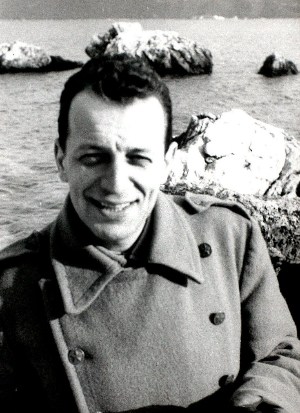
The news about the death of Mica Orlović is one of those that causes a reaction in everyone who hears it. Mića Orlović was one of the most famous faces of TV Belgrade, known to those who did not have the opportunity to watch him as adults, but remembered him as one of their childhood memories. The career of Mica Orlović, journalist, editor and presenter of TV Belgrade (TVB) represents the history of national television. Mića has been with TVB since its inception, and he was the first presenter of "Dnevnik", which was broadcast from the studio at the Belgrade Fair.
Miloje Mića Orlović was born in 1934 in Valjevo. It would be wrong to attribute his perfect speech to the fact that he comes from a region where proper Serbian is spoken. Mića did not hide that his perfect accent and diction were the results of working with SANU linguists, adding that he could never read as fast as Dušanka Kalanj.

Photo: FoNet/Matija Koković
The Second World War found him in Sarajevo, from where his family was expelled. He spent the occupation in Veliki Gradište and, after the end of the Second World War, he returned to Valjevo. In that city, he played sports: table tennis, athletics and basketball, in which he achieved considerable success, because he also played in the "Metalac" club. He believed that he would have become an athlete if he had not entered the media.
His media beginnings were during his military service in Bileća, where he worked on the public address system in the barracks. In Bileća, he served in the army with Stipe Mesić, who was later said to have already shown great organizational skills and with whom he always remained on good terms.
Broadcasting, as the beginning of a media career, may sound strange today, but it was not like that in those days. Mića Orlović continued to work in broadcasting even when he came to study in Belgrade, in the Student town.
After passing the audition, he started working as an announcer at Radio Belgrade. Reading the morning news required getting up early, and this habit remained with him for the rest of his life. From Radio Belgrade, he was sent to television, which was being founded at the time. He was the first announcer in Dnevnik, but he never attached as much importance to it as others did.
"I sound like a parrot to myself when I talk about it," he said in 2010, but at the request of journalists, he still told what it looked like.
"Unlike the radio, I was no longer looking at the technician, who was moving the controls, but I had a cameraman in front of me." Admittedly, that picture was a big help, which I didn't have on the radio. When the first Diary ended, everyone was jumping for joy, because we didn't make a mistake anywhere. I don't know how many people saw me that evening. At that time, there were no televisions in homes, but every better store and restaurant had a television and people watched television there. At first, I didn't have any anxiety, it came later, when I realized how serious it all was."
Mica Orlović's move from Dnevnik to the newsroom of the entertainment program represented a new step, not only in his career, but also in the history of TVB. It came about at the suggestion of Bill Burns, producer of the American television company NBC, who was an advisor at TVB and who thought that Mića was ideal for the host of entertainment programs.
He experienced the transition to the newsroom of the entertainment program as a refresher because, as he said, Dnevnik had become a routine for him.
Mića Orlović was remembered as an unsurpassed host of quizzes, even though he only did it for eight years. The quizzes, in those days, were much more demanding than today's and the contestants often sweated trying to give the correct answer. Mica Orlović's ability to relax the contestants with his kindness, immediacy and naturalness earned him the recognition and respect of the audience. Mica was also the host of a large number of music festivals and he did it with a lot of charm.
In 1978, he moved to the editorial office of the foreign program. From this editorial office, 820 video tapes were released every month, which were sent to the clubs of our emigrants, where they were shown. He worked in this business until 1990, when the satellite program began to be broadcast. Mica believed that switching to broadcasting exclusively via satellite was a mistake, because satellite dishes were expensive at the time and most of our emigrants could not buy them, which contributed to Serbia losing the media war.
At the beginning of the nineties, Mica Orlović was offered to join SPS, JUL or SRS.
"I didn't want to do that." I left the Union of Communists in 1982, by tearing up the party booklet due to irregularities in the distribution of apartments, which was carried out by the housing committee of which I was a member."
He was sent on forced leave with a much lower salary, and Mica's wife, who also worked at TVB, was also punished.
"I don't think they fired me just because I was popular." When I retired in 2000, I was reborn, because I had good coefficients and my pension was good," said Mića about that age.
After the murder of Zoran Djindjic, Mica tried to return to the media.
"I tried, I saw that I couldn't do it and I withdrew."
Speaking in 2010 about what has changed in television from his time to today, Mica said:
"In my time, it was a different world, different attitudes towards that work. When there was general dispersal, it became a profit business. People became Alawis. The goal was to get a place, more money and the ability to manipulate people. Malice and mischief began to spread. Few people resisted it. Those who resisted retreated. Business prevailed at any cost".
By all accounts, the biography of Mica Orlović represents not only the history of TVB, but also the modern history of Serbia.