A legend in Latin it simply means something worth reading. This does not say anything in advance about the truth of what is written. The founders of the great religions of mankind, Moses, Buddha, Jesus Christ and Mohammed, are for all those who are not believers unscathed by doubt, characters from the space between legend and history. The great books of those religions, if we as believers do not understand them as a higher truth, are undoubtedly bestsellers, and it is the subject of endless scientific debate as to what is true and what is legend in them, even if, as in the Old Testament, a large part of the chapters is formally written as the history of the Jewish people.
The founders of Buddhism and Islam, Gautama Siddhartha, born around 563 BC, and Muhammad, born around 570 BC, that is, living in this world a thousand years apart from each other, are undoubtedly historical figures, although most of their works , became a legend through his studies and his life itself. By far the oldest among the mentioned founders of religions, Moses, if we accept the widespread belief of science that he is also a historical figure, belongs to the same category. If we start from the assumption that "his" pharaoh was Ramses II, Moses appeared somewhere between 1250 and 1210 BC, but if it was the reign of Akhenaten, which we will try to deduce based on the indications, much more earlier, in 1350. Since our calculation "before" or "after" the "new era" actually starts from the assumed birth of Jesus Christ, his calendar position in this context should not be guessed.
THE BOOK OF THE PENTEC: Thinking about Moses as a person on the border between legend and history, we must first of all rely on the first five books of the Old Testament, the Pentateuch. The word "pentateuch" actually means five vessels. Five vessels because the scrolls of parchment were stored in vessels, the usual translation of the Pentateuch is not literally correct, but it is in the portable one, because the contents of the scrolls from each such vessel were transferred into one of the "five books of Moses". Those books, of course, were not written by Moses either, they were recorded hundreds of years after his supposed life, originally in the old Hebrew language around 440 BC, while the translation into Greek language, on which theologians rely, was created only around 250 AD, therefore, after Christ, so to speak, at the same time as the Gospels of the New Testament.
Based on the Pentateuch, we assume that Moses was connected to one of the pharaohs and his daughter by his very birth. All pharaohs, that is, dynasties of pharaohs, are known, starting with the so-called first dynasty almost three millennia BC.
In our time, Moses can interest us as the founder and the first and basic prophet of the religion, which in the Serbian language is often called Moses after him. He considers the Jews to be his people, that is, a people chosen by the God whom he only acknowledges. This very people was exposed to persecution for centuries, which reached its modern culmination in the middle of the twentieth century.
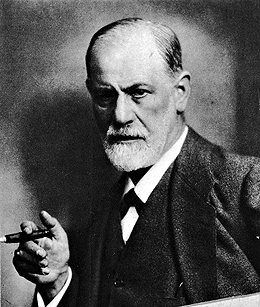
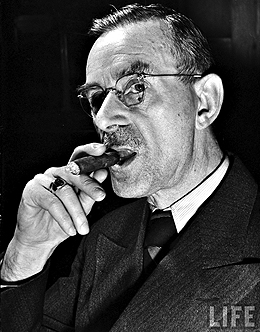
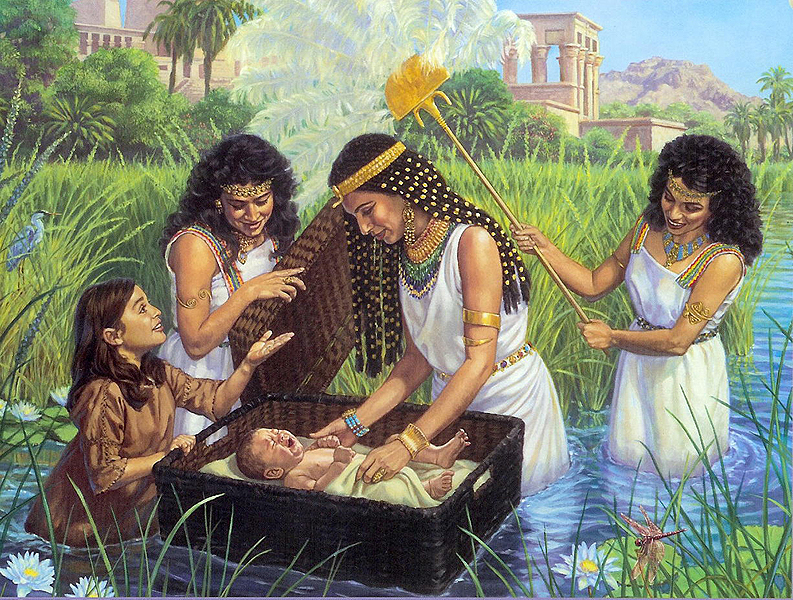
WHO IS MOSES'S GRANDFATHER: Thomas Mann in his novella Law claims that Moses was the grandson of Pharaoh, that Pharaoh's daughter had a capricious, rash relationship with some handsome Jewish slave. When a child was born from that relationship, she made up a story that she pulled him out of the water of the Nile and gave him to a Jewish nanny. Pharaoh knows that Moses is his grandson - Mann writes - and this means that half of his blood belongs to the court and dynasty, but the other half belongs to the people he leads. This nation is multiplying so fast that it is becoming a political problem that must be solved. Mann accepts the widespread but never proven opinion that the pharaoh in question was Ramses II. But Sigmund Freud doesn't think so.

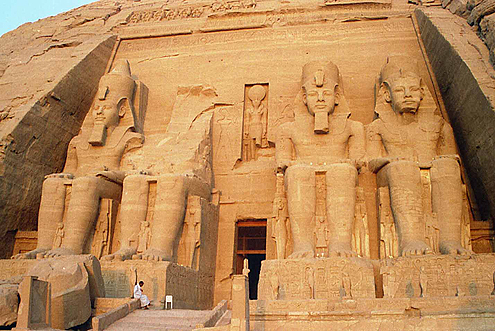
Freud in the book Moses the Man and Monotheistic Religions offers evidence that the first appearance of Moses should be sought somewhere around 1350 BC, which would be immediately after the reign of Pharaoh Akhenaten, who we know advocated belief in only one god. If we connect the stories of Thomas Mann and Sigmund Freud, we come to the assumption that Moses was the grandson of Akhenaten and his wife Nofretita, so beautiful and mysterious that her image still decorates Egyptian cigarette boxes or air transport company brochures. We can certainly establish great similarities between the teachings that Akhenaten preached and tried to impose on the society of his time and the faith that we attribute to Moses.
Amenophis IV - who would later take the name Akhenaton, which might be better pronounced as Ahn-Aton - was crowned king of Egypt - pharaoh - in 1361 BC. We are now on the reliable ground of history. At that time, Egypt in some way, directly or indirectly, ruled the entire then known world. The rulers of other countries, such as Babylon, Hatti, Mitania or Crete, paid tribute to him. Egypt at that time was much larger than today, Palestine, Syria, Nubia all the way to the third cataract of the Nile, Libya, belong to it. Correspondence with the governments of countries that are in a kind of vassal relationship with Egypt testifies to the diplomatic skill of the time, apparently even more valued than the military.
Akhenaten's father, that is, Amenophis IV, was Amenophis III, the first great Egyptian ruler to marry a commoner girl. Her name was Teje. Since even during the reign of her husband, and later her son, people addressed various submissions directly to her, we learn that she had a great, sometimes probably decisive influence on state decisions over two generations.
THE CONFEDERATION OF THE GODS: The names of the pharaohs also denoted to some extent the politics, that is, the principles and views of their bearer, much like in our time the Roman pope, by choosing his new name, signifies the path he intends to lead his church. The name Amenophis means "Amun is Merciful". Amun - or Ammon - was basically the god of the city of Thebes, but also, more broadly, the god of fertility and wind. The fact that Amenophis IV changed his name when he came to power meant a change in politics, in this case an attempt at a major religious and social reform. The name he took, Akhenaton, loosely translates to "That which is useful to Aton." Aten is the god of the sun, as such at the same time abstract and in some way universal. It is not tied to one city, but to all the vastness that the sun shines on.
I suppose that reality in the form of a religion or worldview is usually expressed with some delay. Egyptian polytheism, which reigned during the state's heyday before Akhenaten's accession to power, and after his descent from the historical stage for quite a long time, experiencing its greatest flourishing precisely at the time of Ramses II, is in fact a compromise in relation to the belief in numerous gods in the territory states, gods of enslaved tribes and peoples, denoting a kind of "confederation of gods".
Amun himself is initially a local god from the territory of Libya. Only after the Egyptians will conquer that country will they also take over its god and take him to their Thebes. Under the first dynasties in the state created on the basis of the unification of tribes, each of which has its own gods of a totemic character, mutual recognition of these patrons of groups of people occurs, leading to polytheism. At the time of Akhenaten, the meaning of that compromise was overcome. Egypt is not only united, it is even an extremely imperialist big country.
We start from the assumption that monotheism, which did not exist anywhere until then, could only appear in a very strong state. The realization of a universal god could initially only be imagined in a society that functions under the motto of a single ruler.
Who in the capitals - in Thebes or much later in Rome - could believe the ruler that he was the only god? Certainly not the courtiers of Pharaoh or Augustus, because they knew very well how the crowns got on the heads of their emperors and how they can be taken off together with the heads, i.e. that no gods sit on the throne, but mortals who were afraid of intrigues destructive to their rule and life. Polytheism, with its depictions of the jealous internecine struggle of the gods, corresponded to that outlook. From a certain province, however, that is, from the point of view of a slave or an enslaved and disenfranchised people, it could seem that the world was ruled by a single power. It is only natural that the oppressed could not identify their god - their only hope - with the proven tyrant, otherwise they would not have been able to rebel against him. Neither the Jews in Egypt - Egypt - Pharaoh, nor much later their descendants, the Jews in the Roman Empire - Augustus - could recognize for svg God. Thanks to the ruler and the view of the world, which his very existence imposed on their consciousness, everything was prepared for monotheism.
THE HAMLET TYPE: At the end of the fourth millennium BC, Semitic tribes immigrated to the territory of Egypt. Historical data speak of the struggles of the Egyptians against the Semitic people Hyksos approximately on the territory of today's Israel, but there is no mention in the documents of the covenant of a certain Abraham with the god, whose name is Yahweh, which is taboo. Legends about him were created only after Moses, after all, that's what the writing about him is called The first book of Moses.
It would be an exaggeration to claim that Akhenaten was the first thinker and preacher of a single, universal god. A whole century before him, the thought of a god appears in poetry, to whom the poet addresses with the words: "You are the only one who created everything in the world - the only one who was alone when you formed all beings..." But it can also be interpreted as a poetic figure, flattery one of many gods, to the one who can currently use, whose help is specifically requested at a certain time. Akhenaten goes further, he proclaims Aten as the only god, and in addition orders that the names of other gods be erased from all old writings, reliefs, columns and temple walls, he even leaves Thebes and builds a new capital on the sand "on virgin soil, which is not belonged to no other god or goddess" and calls it Akhet-Aton, "Source of light of Aten". Much later that city will be known as Tel el Amarna.
Akhenaten's court retinue was mostly made up of new people, not representatives of the old nobility, who in all probability remained sulking in Thebes. "I was a Nothing, the son of a Nothing." But I diligently listened to his majesty's teachings, so I built myself up," noted one of the courtiers. This is not at all insignificant for the hypothesis, which we take over from Freud, that, namely, Moses was Akhenaten's courtier, if not even his grandson.
Akhenaten ruled for only seventeen years. Not enough for a major transformation. Busy with his religious reform, he did not pay attention to the Asian areas, which began to separate from Egypt. After his death, everything went back to the way it was. His son Tutankhamun returned to Thebes and changed his name to Tutankhamun. Some Egyptologists call Akhenaten a "Hamlet type", it is claimed that in his time "the idea of God opened its essence to the whole world, it received cosmopolitan features". One of the most beautiful assessments of that pharaoh, in my opinion, was made by Thomas Mann: "He was on the right path, but he was not the right man for the path."
THE MYTH OF THE BIRTH OF A HERO: The real man was Moses. But again we have to ask the question - who is he? The only real piece of information seems to be his name. In the Old Testament it is said: "And when the child grows up, he takes him to Pharaoh's daughter, and she adopts him; and named him Moses, saying: because I took him out of the water." Unfortunately, that is a wrong clue. Moses, that is, the Hebrew variant of that name, Moshe, means nothing at all in the original Aramaic language. After all, why would a pharaoh's daughter give her illegitimate or adopted child a name based on the foreign Aramaic language? We find a logical explanation if we look for the root of the name in the Coptic or Egyptian language. It is in Coptic mv simply "child", and in Egyptian msj "give birth" and thus enters into many famous names. The names of the great pharaohs Ramses (Ra-mose or Ramozis) or Thutmes (Tut-mose or Thutmosis) mean the child of Ra, that is, Tut's child, those pharaohs are named as the children of the gods Ra, that is, Tut. It is strange why no one before Freud came to the conclusion that Moses was Egyptian or that his mother was of Egyptian blood? This would easily explain the biblical legend, the child is simply named Dete, because he has no father, that is, it is not known who his father is, it is an illegitimate child.
Otto Rank in 1909 in a book The myth of the birth of a hero, constructs "an average saga about the birth and life of a mythical hero." A "classy background" is mandatory. The birth takes place with great problems, such as threats to the father or the country, the nation. This is why the newborn is left in the wild or thrown into the water. He is raised by animals or poor people (shepherds). After he grows up consciously or accidentally finds his parents, takes revenge on his father, the prophecy is fulfilled. The first known such story is the supposed autobiography of King Sargon, the founder of Babylon, written in 2800 BC. The same scheme with smaller or larger deviations applies, apart from Moses, also to Romulus and Remus, Oedipus, the Trojan prince Paris, Hercules, Gilgamesh, etc.
The "nobility of descent" in the legend of Moses would be best proved if he proved to be the illegitimate grandson of Pharaoh. Due to a passing remark in the Second Book of Moses "... and the people of Israel built for Pharaoh the cities of Pythias and Ramses", many historians have made the assumption that the "exit from Egypt" and everything related to it happened during the time of Ramses II, which would be around 1235 BC. That half-sentence alone is not proof, even if one starts from the assumption that a part of the Jews still had to stay in Egypt and work on the fortifications even after the successful "exodus". It is much more likely that the vast majority of that enslaved people went to the "promised land" under Moses a full century earlier.
AHNATON'S LEARNING: Religion of the Jews, Law, which we meet in the Pentateuch, is significantly different from almost all the religions known up to that time, but it is in many ways similar to Akhenaten's teaching. The similarity of the names Aten, Syrian Adonis and Jewish Adonai gives serious reason for thinking. Akhenaten ordered to erase the names of all other gods, and they were written in pictures - hieroglyphs. And the Jewish religion strictly forbade all other gods, especially their graphic representation. Akhenaten's hymns to Aten resemble psalms to Adonai. The Jewish faith knows nothing of the afterlife, and Akhenaten abolished that cult so important to his Egyptian compatriots and contemporaries.
The question of the custom of circumcising male children is particularly interesting. We know for sure that before the new era in the wider territory, which we observe between the 14th and 13th centuries before Christ, only the Egyptians circumcised their sons. If we assume that Moses is a Jewish tribune who frees his people from Egyptian slavery, it is hard to believe that he imposed that Egyptian sign of recognition on him. But if Moses was an Egyptian, a follower and like-minded of Akhenaten, perhaps his grandson, if he despairs because after Akhenaten's death, the Egyptian people no longer want to follow the belief in one god, so he, Moses, decides to he chooses his people with which he will maintain that faith, then it is easily possible that tom the chosen people he also gave the symbol of circumcision, because that makes him Egyptian and worthy of the cult of Aten.
After Akhenaten's death, the power in Egypt was shaken. His reform failed. It was only later under Haremhab that the authority of the state would be re-established. It is easy to imagine that precisely in that interregnum, the "exit of the Jews" will succeed without a hard fight against a strong military force. That period lasts approximately from 1359 to 1350 BC. For me, these facts are more indications that the historical exodus could have happened immediately after Akhenaten's death.
Information from Akhenaten's time was found in Amarna, which tells exactly about Canaan and how certain Aramaic tribes conquered oases there. Those tribes are called "Habiru" in those testimonies, which reminds of the name that the followers of Moses later gave themselves, the Hebrews. The description of the Egyptians, given by Herodotus much later, around 450 BC, reminds us of Jewish customs and laws. It's not just about circumcision. Egyptians do not eat pork, they have surprisingly strict rituals for maintaining cleanliness for that time, they do not use cutlery that has already been used by someone else. All this leads to the thought that the origin of the Law of Moses is Egyptian, but that it is not based on Egyptian polytheism, but on Akhenaten's ideas about one god.
HOW YAHUVEH CHOSEN HIS PEOPLE: If we accept the idea that Moses chose his people in this way, we get a new explanation as well as the story as it is God chose a people for himself. The God of the Jews, whose name Yahweh is taboo, so he is addressed only as Lord, with Adonai, is attributed character traits that we can imagine as those of Moses. It is not illogical that the people, to whom Moses preached so much about one god, eventually confused their leader a little with him. At that time, the ruler was always considered "the son of God", that is, immortal. Moses insisted on an abstract, invisible god with no physical form or form. People just couldn't imagine it. Since Moses did not agree to any object of worship, or to any "golden calf", they increasingly considered him personally as a god, at the very least they identified God with him. The Bible describes Moses as an arrogant man, a leader, who gets angry easily, and when, as we would say, "darkness falls on his eyes", he wants to kill. This is probably the character of the old Jewish god.
The duality of the name of the Jewish god is interesting. What does Yahweh mean, and who is Adonai? Before the appearance of Moses, Yahweh (YHVH, Jehovah) is the name of one of the tribal gods of the Midianites, actually a volcanic demon. There are no volcanoes in classical Egypt. The name Yahweh, therefore, could only be created among the Jews after the exodus from Egypt. The Bible says that Moses was "the son-in-law of the priest of Midian." Freud's bold hypothesis: Moses is not one man, in that figure from the myth, two are united. The first Moses is the Egyptian, Pharaoh's grandson devoted to Aten. The Jews killed him. The other is the son-in-law of a Midianite priest, lives about sixty years later, believes in the volcanic Yahweh, which is closer to the popular imagination. And Yahweh is without a human or at least an animal form, but still appears as something visible, like a fire in a burning bush, a pillar of smoke over a hill, spewing flames from which the earth shakes. Later, both gods merge into one, and also both "Moses".
THE TWO MOSES: AS Yahuda in his work The language of the Pentateuch and its relations with Egypt claims that distinctly Egyptian names were found among the Levites for a long time. Freud assumes that the Levites are in fact the descendants of those Egyptians who, because of their faith in Aten, went with the first Moses together with the Semitic tribes from their homeland, outlived their leader, preserved his science about the universal god Aten and thereby enriched the totemic character of the desert Yahweh. Retaining circumcision is a concession to those original "Mosesians", but, of course, even then a modern hygienic necessity. As we have said, Jewish custom forbids speaking the name of Yahweh. It is taboo. It is written, but not read as it is written. In this case, however, the prohibition is not total, the name Yahweh appears in everyday personal names such as Johanan, Yehuda, Yehoshua, in the exclamation hallelujah, which is actually hallelujah, in that last syllable yeah. It is taboo to call God by that name, he must be addressed as Adonai. Doesn't that remind you of Aten?
Freud: "Moses is often described in the Bible as severe, proud, harsh, even savage, and yet it is also claimed that he was the most gentle, the most patient of all people." It is clear that these other qualities would have been of little use to the Egyptian Moses, who had such great and difficult intentions with his people; perhaps these are the characteristics of that other Moses, the Midianite. I think it is justified to separate those two persons and to assume that the Egyptian Moses was never in the oasis of Quadesh near Sinai-Horib and that he never heard of the name of Yahweh, and that the Midianite Moses never set foot on the soil of Egypt and that he knew nothing about Aten. The task of merging those two personalities into one belonged to tradition and the creation of a legend..."
FATHER AND SON QUESTION: If we allow ourselves to start from the assumption that monotheism is the result of a worldview that arose in a political situation in which there is an almost absolute supremacy of one state and its ruler - as in the case of ancient Egypt or, much later, the Roman Empire - so many centuries after the collapse of even of the titular Roman Empire under the German and Frankish crowns, this should also be reflected in the position of the ruling religions today, so there could be no monotheism. So, were we on the wrong track?
If we look carefully at the development, I don't think we are. The pure monotheism from the Old Testament is no longer in Christianity. The problem is clearly expressed by the split into Eastern and Western churches, and continues with the appearance of Protestant denominations and numerous Christian sects. More important and characteristic, however, seems to be the conflict between the Arians and the Athanasians, which arose already at the beginning of the fourth century over the very important issue of the Holy Trinity, and above all the relationship between God the Father and God the Son. Strictly speaking, it is no longer pure monotheism, that is, transferred to human society, to the state and to politics, an expression of firm rule from one place, from one throne. For Constantine the Great, who convened the First Ecumenical Council, the question of father and son was a dynastic question, a question of rulers and heirs to the throne.
IF MOSES HAD A LAPTOP: It is not unimportant how Moses managed to lead the Jewish people past the Egyptian guards. He may have previously been a provincial governor, as Freud surmises, and therefore knew the patrol schedule and the situation on the ground well. Perhaps, fleeing for the first time to Madiam - Mann's variant - he met the salt ponds near today's Suez Canal and correctly assessed that there, where refugees could easily pass on foot, a bulky army, armored cavalry with chariots and war elephants, would simply sink.
The Jews "worshipped" in Moses what he personified, and that is zakon. Adore certainly does not mean only "to love", but also to "fear", and fear can be combined with hatred and the desire to kill. "treasonous phrases" sometimes appear in the vernacular, in Serbian, for example, "to kill the god" in someone.
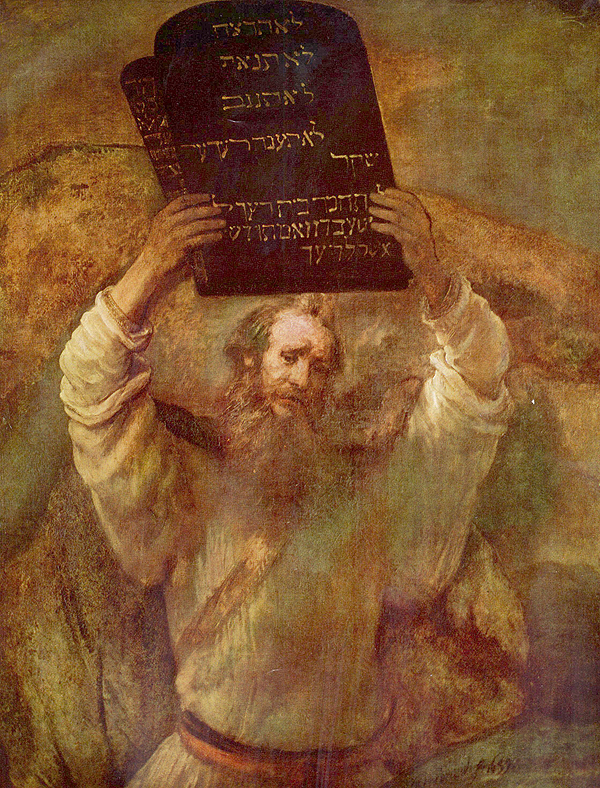
The law both maintained and ruined the Jews, in any case separated them into that lonely, separate, "chosen", repulsive and incomprehensible community, which they represented in the families of peoples of all historically examined centuries. Only with the help of law was it possible to turn the mass, which had just ceased to be a mass of slaves, into the nation, because it is doubtful whether those simple and illiterate people had any understanding of Abraham's agreement with the only God. At the height of the Roman Empire, Josephus Flavius will try to prove that the Jews have an older culture than the Greeks, which in itself is dubious. There is no doubt, however, that to his Roman contemporaries the Jews were barbarians, little better than the Germans or Britons. At the time when Moses chose his people Adonai-Yahweh was certainly still a very young god, who found his first prophet in that man. It is no coincidence that the genius Michelangelo will depict Moses with horns.
"Where justice springs, everyone must get their right, so at first they didn't want to believe that someone could get justice and be judged wrong...", Thomas Mann explains why Moses' contemporaries failed to understand what it's the law. Of course, there were laws before, for example, Hammurabi's code, which according to tradition the king received personally from the sun god. But, the paragraphs established by the Pentateuch are in a way more modern, they already put a kind of "human rights" in the center, they prescribe what is moral until today, which means that society is still organized according to them. The extraordinary effort that had to be made to come up with such laws - commandments - is also shown by the need to invent an appropriate alphabet for them and for them for the first time.
"The Israelites of that primeval time, that is, the scribes of Moses, participated in the invention of the first alphabet," claims Freud. "Moses passionately desired," adds Thomas Mann, "such signs, namely, those that could be quickly, very quickly read from the tablets, that even children like his Jews could learn in a few days, therefore, with the help of God's presence, they could invent and find, because the letter had yet to be invented and found, since it did not even exist yet."
The act by which "God gave Moses the tablets of the commandments" can in any case be identified with the invention of the phonetic alphabet, which is the most ingenious human invention since the construction of the wheel. From myth to history and back really leads Mann's description of Moses sitting on a volcano in the middle of an earthquake, inventing laws, short because he has to write them down, and writing with a hammer and chisel on basalt stone is very hard physical work, and now at the same time he has to creates letters and carves them into boards. "God's wit!" exclaims Mann. "An idea with horns!" If Moses had owned a laptop, if he didn't have to use a hammer and chisel to carve and invent not only words, but even letters, but to put a typewriter on his lap, so that he could write this text like me, the ten commandments of God they would not be so simple, concise and understandable to everyone.
EVERYONE IS A LITTLE MOSES: In the meantime, they made a golden calf down under Sinai. Moses returned from the mountain, where he met with God, got angry, broke the stone tablets and ordered the Levites, his most faithful followers: "Gird your sword to your thigh and kill each one his brother and his friend and his neighbor."
Did they listen? Such a terrible retribution is logical only if the most serious crime happened, if they killed God himself. In all probability - they killed him. They killed Moses himself who was returning with the tablets and tried to oppose the orgy. Again they confused him with the invisible Aten. But Yahweh was the volcano from which the flames rose, the lava boiled. Visible, faceless, but more terrifying than the motionless golden calf. Without that Yahweh's intervention, Aton would also have collapsed. Without the Aten and its universality, Yahweh could not have moved from the terrain of his crater and outlived the forgotten Midianites so long. It is the root of compromise and alliance. That's why those two gods could merge into one, and a very tough one at that. At least that's how I understand the myth of Moses, Freud's hypotheses, Mann's story and historical facts, and I read them all in the way Robert Graves interpreted the mythology.
Every man is a little bit of Moses for himself. He lives his real life, which is marked and bounded by documents, baptism certificate, birth certificate, school certificates, passport with visas, decision on placement, wedding certificate, decisions of tax authorities, characteristics of secret police or personnel administrations, personal correspondence. Death certificate, obituary in the newspaper. A life that can be proven by its traces on paper. But at the same time, everyone tells themselves a legend about themselves, especially at night, before sleep or in their dreams. Therefore, the real truth about man will simultaneously be a list of facts, those milestones on a road, but also the myth itself, which is that road for every human life.
(From an unpublished book of essays Norm and normal. Abbreviations and editing of the text.)
INTERPRETERS: Sigmund Freud...