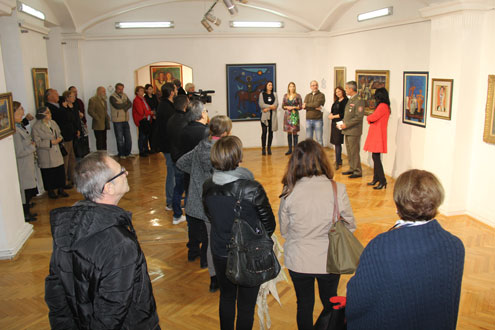
In the Pancevo National Museum, there are two exhibitions in progress - the exhibition of paintings by Robert Hemmerstil "Stories in pictures - in search of identity" and "Poetics and destiny of the 20th century" - from the Art Collection of the Serbian Army House (see box), which was the reason for the story of this museum.
Robert Hemmerstil, better known in the world than in our country, born in Vršča, presented works of a mainly religious character whose models are in Orthodox and Western Christian iconography. He is also known for his paintings, the themes of which are a broken family, camp days, war traumas, family exodus, and the motif of a mother with a child as an unequivocal association with "The Virgin Mary with a Child". All these topics are autobiographical - he grew up in a multinational family, survived the Second World War and a concentration camp, escaped to Austria, but always returned to Vršac. He donated a large number of works to his hometown and the Museum of Vojvodina, and his works are also in the permanent exhibition of the Leopold Museum in Vienna. The second exhibition is a representative selection of artists from the former Yugoslav territories: Vlaho Bukovac, Jovan Bjelić, Ljuba Babić, Lazar Vujaklija, Ljuba Ivanović, Petr Lubarda, Peđa Milosavljević, Krsto Hegedušić, Marko Čelebonović, Sava Šumanović and others.
The Pancevo National Museum is located in the city center in the Magistrate's building, which is itself a historical monument. The building was built in 1838 and until the 70s of the last century was the administrative building of Pancevo. From the terrace of the current museum, Austro-Hungarian generals lined up the army, and from the same building, Dukes Stevan Šupljikac and Stevan Knićanin directed military operations in the uprising of 1848. After the Second World War, it was the seat of the municipality, and the ceremonial halls were painted white. Fortunately, under several layers of white paint, the old appearance was preserved, so the banquet hall was completely reconstructed in 2015. Now it is an exhibition space, and according to the director of the museum, Miroslav Birclin, the people of Pančevci can never get used to the fact that the municipality is no longer at its old address, so it is mandatory to take photos of newlyweds in this hall on weekends. However, apart from the two galleries for occasional exhibitions, a large part of the building is closed to visitors due to moisture problems, and the permanent exhibition is kept to a minimum.
"Due to the humidity, the Museum was without a permanent exhibition from 2006 to 2011," says the director of the museum, Miroslav Birclin. "The moisture has been remedied in the upper parts of the building, but it is still a big problem in the basement rooms, so the walls have been crumbling for years. For this reason, the museum's depots were moved to the upper floors, and only in one part are the most basic objects of the former permanent exhibition displayed. In 2015, the city allocated 10 million dinars for the preparation of project technical documentation for the rehabilitation of the building, but it was returned several times due to changes in regulations. When the project is finished, we will try to find a partner in Romania to apply for IPA projects. It is estimated that around 3,5 million euros are needed for rehabilitation."
However, even in the reduced permanent display, some interesting objects can be seen. There is the target where Emperor Franz Joseph and Hugo Weifert shot. Franz, aiming his rifle, missed everything. When he borrowed a rifle from Hugo Weiffert, he had five or six shots. One of the greatest treasures of the museum is the original flag of the Serbian Voivodeship from the uprising of 1848. The flag is not in very good condition, and it is interesting that it is yellow and black, the colors of the Austro-Hungarian monarchy, and in the middle is the Serbian coat of arms with the Austro-Hungarian black eagle. In this way, the Serbian insurgents wanted to show that they did not want to leave Austria, but autonomy.
A hundred years after the construction of the building, there was a detention center in the basements. During the Austro-Hungarian period, mostly criminals were detained. Before and during the Second World War, communist political prisoners were imprisoned (Mara Mandić, a national hero, was awaiting judgment there), as well as Jews. All this is evidenced by the messages on the walls. However, since the walls are in a bad state, they will hardly be reconstructed, the messages will be preserved only in photographs.
Finally, one interesting thing: the people of Pančević, according to Miroslav Birclin, believe that their museum contains the original version Migrations of Serbs Paje Jovanovic. The painting was commissioned for the Millennium Exhibition in Budapest in 1896 by the Parliamentary Committee in Sremski Karlovci, headed by Patriarch Georgije Branković. The clients were not satisfied that Paja Jovanović painted sheep, a woman with a child, and fleeing people in the painting. They wanted to portray the Serbs as a military force that will defend the borders against the Turks. This is how the larger version of this painting was created, which is located in the Museum of the Serbian Orthodox Church, where instead of a woman with a child, there is a spearman on a horse, behind which are infantry and army. During the Second World War, it was considered that both paintings were destroyed, so Paja Jovanović also painted a third one, which is a mixture of the first two. In 1972, the Pancevo authorities took out a loan and managed to buy the painting, which has been in the Pancevo museum ever since.
The "Odbrana" Media Center Gallery, better known as the Gallery of the Home of the Serbian Army, is one of the reference places of the Belgrade cultural scene - 20 exhibitions were organized this year. The collection of over 1500 works of art also includes paintings by Vlaho Bukovac, Ljubo Ivanović, Sava Šumanović, Milo Milunović, Jovan Bjelić, Kosta Hakman, Petr Lubarda, Milan Konjović, Ljubica Cuca Sokić, Sreten Stojanović and many others. The collection travels around the cities of Serbia as part of four exhibitions: paintings - "Poetics and fate of the 20th century", sculpture - "Mirror of Time", graphics - "Reading the line" and drawings - "Confession of Yugoslav modernity", and in Belgrade it is presented only once a year , in January.
Exhibition activity in the Army House began after the end of the Second World War, at the initiative of Branko Šotra, a painter and graphic artist and one of the founders of the Museum of Applied Art. Although closely related to the propaganda of that time - the national liberation struggle and national defense, in addition to engaging exhibitions, there was also an ear for something different. Thanks to gifts from artists who exhibited here, as well as purchases, the Army House managed to create a representative collection. The catalog is in progress. Since 2010, according to Jelena Knežević, Senior Curator and Head of the Gallery, a special exhibition concept has begun: "Cooperation with cultural institutions, museums, galleries, endowments and legacies has contributed to our two galleries becoming a reference place for promoting art and culture in Belgrade . We are visited by museums and galleries from Serbia and abroad, and we try our best to enable these institutions to present themselves in the best possible way. Mainly for all exhibitions we also organize accompanying programs: lectures, workshops, expert guidance. Entrance to the gallery of the Army House is free, as well as to all programs. It is our desire, and we are trying very hard, to create a permanent exhibition," says Jelena Knežević, adding that one of their priorities is the return of works that were in representative military facilities - such as Marko Čelebonović's painting in Tito's villa on Tara and works Vlaha Bukovac, who was in the embassy in Washington.
And the Military House building itself, the so-called The War Palace has been a cultural monument since 1984, and was built between the two wars with the contributions of reserve officers. Architects Jovan Jovanović and Živko Piperski designed it in a modernist spirit. The terrace used to be a summer cinema, and the idea is to reactivate it for cultural events. There is also an idea to turn the tower with the clock and the original bells from the Soldier's Home into a gallery space where cameras and photographs would be exhibited, i.e. a room dedicated to the Army Home. When asked how they achieve all this, Jelena Knežević says that behind them is the military infrastructure, but also that "you always want more, you always have something new. Someone offers you an interesting exhibition and you just regret not offering it to the audience. When you see that the audience is satisfied, when they have a positive comment in the book of impressions about your programs, exhibitions, it is a satisfaction to move on. It is especially satisfying when artists visit your space and then donate a work to your collection. I don't think there's anything better than that."
The text was created within the project "With museums through exhibitions - Getting to know the museum heritage of Serbia". The project is co-financed from the budget of the Republic of Serbia - Ministry of Culture and Information. The views expressed in the supported media project do not necessarily express the views of the authority that allocated the funds