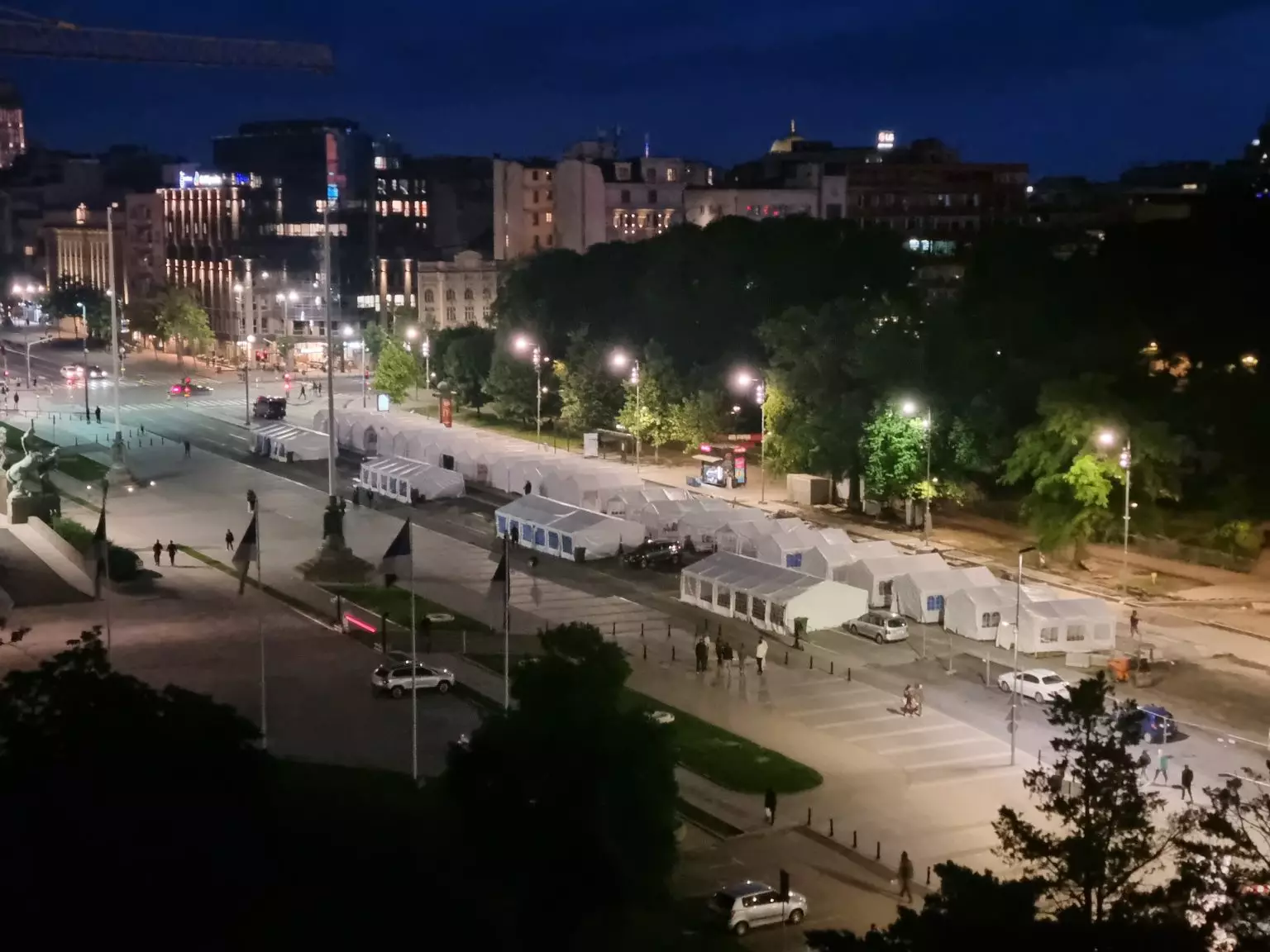
On the night between April 14 and 15, 2025, hooded men placed ten white tents on the plateau in front National Assembly of the Republic of Serbia, "Vreme" previously wrote. There was no official explanation as to why the already existing camp in Pionirski Park known as "Ćaciland" was extended to Bulevar Kralja Aleksandra.
Seven months later, the tents are still in front of the National Assembly. People employed in Belgrade municipalities, but also men with thicker criminal records, stay in them on a daily basis. In the meantime, various meetings and counter-meetings were held on the occupied space under the direction of the regime of Aleksandar Vučić.
The original Ćaciland was created in Pionirski Park as a protest of the so-called Students who want to learn. That countergroup, Students in Blockade, led by Miloš Pavlović, demanded from the authorities to enable them to teach at the faculties. They insisted that, because of the "blockaders", they are not blocking the streets. Faculties have been unblocked for months, classes at all universities began on November 2, but the settlement is still surrounded by a double metal fence and under twenty-four-hour police security.
In recent days, the tents in front of the Assembly have been filled with supporters of the regime, who are harassing Dijana Hrka, the mother of Stefan Hrka, who died in the fall of the canopy at the Railway Station in Novi Sad, who is on hunger strike with loud music. Thousands of people were brought to that place to welcome the Serbs from Kosovo who are allegedly walking to Novi Sad to meet some kind of mass meeting announced by Aleksandar Vučić.
The President of Serbia called Ćaciland "a symbol of the existence of Serbia", the last "oasis of freedom" in Europe.
Revolted lawyer
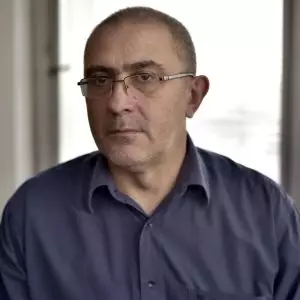
Lawyer Mihailo Pavlović has now decided to sue the Ministry of Internal Affairs of the Republic of Serbia for violating his right to freedom of movement and restricting his right to work. It demands the removal of objects that have been placed on the plateau in front of the National Assembly for seven months.
He also requests that, until the conclusion of that procedure, he be allowed to pass that route unhindered by car and motorcycle.
"I initiated the procedure against the Ministry of the Interior because it decides on applications for blockades. It is the body that is responsible in this particular case for the fact that this blockade has been in place for months," Pavlović told "Vreme".
Lawyer Pavlović's requests
"The first part of the request is related to the lawsuit, where it is requested to determine the violation of freedom of movement and the violation of the right to work, that is, the restriction of the right to work," explained our interlocutor.
The second part refers to the request that the court, until the end of the litigation, issue a temporary measure that will enable him to pass freely by car and motorcycle. The lawsuit is based on restriction of freedom of movement and abuse of freedom of assembly, which are actually related things.
Pavlović further explains that the freedom of assembly in itself is not disputed, it is legal, what's more, the state is obliged to ensure every type of freedom. However, public gatherings in public spaces must be time-limited.
"If I decide today to rebel for any reason, I cannot keep one part of the city blocked indefinitely. That is why it is important that the freedom of assembly has a certain period of time", emphasizes the interlocutor of "Vremen".
If someone reported the blockade of Nikola Pašić Square for an unlimited time, the Ministry of Internal Affairs had to reject such a report.
"It is not allowed to block anything indefinitely, no matter what requests you have. That is a fact," says Pavlović.
He omitted the permanent blockade of Pionirski Park from his lawsuit and focused on removing the tents from the road, demanding that traffic flow smoothly.
No meeting registration information
Since the group "Students who want to learn" is formally behind the blockades, their purpose ceased to exist after the faculties started working normally.
"And we still have that blockade, what's more, new tents have been set up. So, we don't know who reports those gatherings, we don't even know if they report them at all," says our interlocutor.
According to the standards of the European Court of Human Rights, this would be classified as an abuse of rights, Pavlović points out. "In fact, you are now abusing the freedom of assembly, you are not using it for the purpose for which it should exist, but you are using it contrary to what is guaranteed by the Convention for the Protection of Human Rights and Fundamental Freedoms. By doing so, you are limiting other people in other rights, such as freedom of movement."
Personally affected
Pavlović notes that he is prevented from accessing public goods, that this affects his work, because the Assembly of Belgrade, the Bar Association of Serbia, a public garage and so on are located in that part of the city.
"I can't park in that garage, I can only approach public institutions on foot, and now I can't even walk that part next to the Assembly anymore, because the police don't allow passage. I am limited in my right to work, because as a lawyer I communicate with public institutions, I write, I represent some parties, I speak, I go to the Bar Association, I use that route," explains our interlocutor.
Our interlocutor claims that there was a disproportionate interference with his right to freedom of movement, as well as a limitation of his right to work because he has difficulty using that right.
He filed the lawsuit on Thursday. The request for a temporary measure goes to the State Attorney's Office, which has a few days to express its opinion. The court can then schedule a hearing or make a decision about it without a hearing.
In addition to the temporary measure, his request must be discussed to determine whether his right has been violated.
"The main request is to establish that my right to freedom of movement and the right to work have been violated. And the second request is to remove all obstacles from the roadway and enable passage in both directions through the entire Nikola Pašić Square, the entire Dečansko in both directions and Dragoslav Jovanović where the public garage is located. Therefore, to remove everything from the roadway and to enable unimpeded passage," emphasizes Pavlović.
Italian practice
In 2001, the European Court of Human Rights ruled against Italy when the G8 summit was held in Genoa. Back then, Pavlović recalls, the city was divided into several zones - red, yellow and orange - which citizens could not pass through. That summit lasted five days, and the conditions for passing through the city were strict.
On July 15, 2006, the European Court of Human Rights issued a decision in the case of Bigliazzi and others against Italy, in which it rejected the petition of the applicant due to the violation of freedom of movement from Article 2 of Protocol no. 4 which was filed due to the fact that part of the city of Genoa was blocked.
— Mihailo Pavlović (@MihailoLawBlog) November 6, 2025
"A group of people who lived there initiated proceedings before the European Court, where they stated that for five days they could not get to their houses, they could not pass through the city, nothing. However, the European Court rejected their petition, but also said several important things," explains Pavlović.
First, that it is a meeting of the G8, a group of the most powerful leaders, and that the risk of terrorist attacks is certain, so it is logical to fence off the locations where they are located. Second, that blockade lasted only five days, so it can be said that the violation of one's freedom of movement was nevertheless proportionate.
"Here we have neither the G8 group, nor world leaders, nor anything, and the initial demands for which the blockades were lifted have been met," concluded the "Vremena" interlocutor.