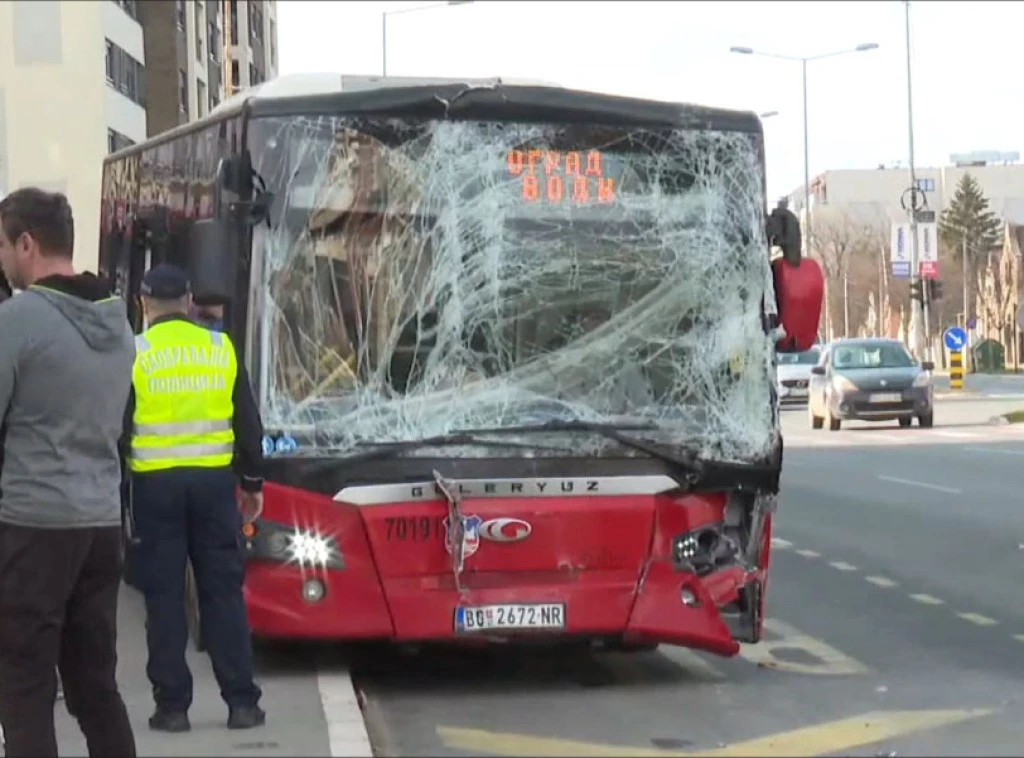
Collision between two buses city transport on Tuesday (January 28) at the bus stop in Zemun caused special public attention not only because of the large number of injured, 18 of them, but also because the drivers of both vehicles were Sri Lankan citizens, which revived the question under what conditions foreign citizens are hired to transport citizens.
Those conditions, "Vreme" learns, are very poor.
"The only condition for people from abroad to start driving public transport buses is that they have a driver's license from their country, and unfortunately there are no special trainings, selections or controls for them, because it is all left to the carriers themselves and their conscience or rather unconscionability," traffic engineer and president of the Trade Union Center GSP Belgrade Ivan Banković told "Vremena".
Attractive Serbian driver's license
He pointed out that Serbia has ratified agreements with other countries, so anyone who passed the driving test in Sri Lanka or Nepal is recognized in Serbia.
"Then, based on that driver's license, our driver's license is issued to them, which makes Serbia a very attractive country for the citizens of those countries, because the Serbian driver's license is recognized everywhere in the European Union." A driver coming from Sri Lanka would not be able to directly go and drive in the EU, but if he comes to Serbia and gets a license here, then he can drive with it in the EU," says Banković.
The collision on Tuesday involved the buses of the "Strela" carrier on lines 45 and 601, and Banković stated that the practice of private carriers is for drivers from abroad to be introduced to the lines they will be driving by a driver who already works for that carrier, "mostly their compatriot because of knowing the language".
"Of course, that is not enough. It is especially important that knowledge of the Serbian language is not a condition for getting a job. Many of our drivers work in EU countries, including in passenger transport, but the basic requirement is that they know the language of that country. They take exams, it's not just about a few basic sentences, or they bring certificates from certified language schools. "Unfortunately, our drivers from abroad do not know Serbian, or even English, and that is a big problem," said Banković.
Hunting in the dark
He emphasized that it is not enough for drivers from abroad to have training of only a few days and to familiarize themselves with only a few lines, but that it must be training with a plan and program.
"They would have to go through everything that will actually await them when they get behind the wheel of a bus." However, we do not have that for now, it is not worthwhile for a private individual to 'waste time' on it, but it is important for him that the driver from abroad starts driving as soon as possible, because every lost day is a potential loss of several thousand euros. Because of all this, it has become a hunt in the dark," said Banković.
He pointed out that "those drivers are not to blame for that."
"No one came here because they live very well in their own country and travel long distances to come to Serbia." They are absolutely not responsible, they came with a belly for bread and do as much as they know how. This is not about their failures," said Banković.
They drive for 10 or 12 hours.
In addition to all that, Banković emphasized, the driver's working hours are also a problem.
He stated that some private carriers lack at least 20 percent of the planned number of drivers.
"It is compensated by one driver working 10 or 12 hours a day." Instead of the bus operating in three shifts, from four in the morning until midnight, having three drivers, the private carrier has two drivers. What happened is not an isolated case, we warned about it and unfortunately there will be more such situations. Are we waiting for someone to be seriously injured or killed before the system starts?", asked Banković.
He pointed out that the Traffic Police administration is most responsible for such a situation, which should carry out detailed daily control and must inform the public about the results of the control of the driver's working hours.
"The Secretariat for Public Transport should not pretend that all this is not happening in Belgrade either, because they are obliged to carry out supervision according to the decision on the city administration, as well as according to the contracts they have with private carriers. They cannot say that it is enough that the private carrier contractually undertakes to comply with the law and that is enough for them, without checking whether it actually complies with the law. "We are talking about the citizens of Belgrade, almost a million people use public transport, so there is no room for improvisations, and public transport, especially in the past year, has become a training ground for corruption and improvisation," Banković concluded.