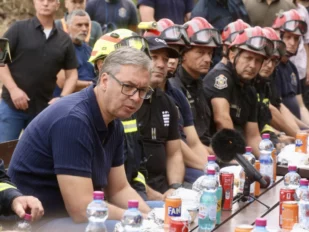
When Ukrainian President Volodymyr Zelensky lands in Belgrade on Saturday (August 8), he and his host, Serbian President Aleksandar Vučić, are in for a trip into a political minefield. writes Deutsche Welle.
In the European press, Serbia is followed by the rumor that it is "pro-Russian oriented", which is why, according to the media, there is a current in Kiev that fiercely resisted the visit. On the other hand, all research indicates that Vučić's hard-line electorate is really in favor of Russia and against joining the European Union.
It's possible that's why meeting in Belgrade postponed several times, even though there were newspapers. Two years ago, the first lady Olena Zelenska came, and the two presidents met several times on the sidelines of world summits.
Just in case, Vučić sent a message before the visit as if to say that it was a routine meeting. "We have several important topics, one is the European path of Ukraine and Serbia, the other issue is our bilateral and energy cooperation," he said.
Walking on eggs is also due to the possible upcoming elections in which, according to polls, Vučić has a real chance to fall from power after fourteen years.
However, both presidents clearly believe that they need a meeting right now. "Zelensky needs everything that acts as a kind of slap to Putin. The same applies to the European Union, which certainly assisted in the meeting," says political analyst Đorđe Vukadinović.
"Vučić, on the other hand, has the tactic of simulating maximum cooperation towards the EU, especially after the elections in Hungary when he saw the fate of Viktor Orbán. In this part of the Balkans, Brussels still has enough sticks and carrots, and Vučić does not need their sticks before the next elections," adds the editor of New Serbian Political Thought (NSPM).
Grenades as hard currency
Zelenski, the wartime president for an indefinite period, has more tangible reasons for coming to Belgrade.
Serbia, although it did not join the sanctions against Russia, very early after the start of the war played with hard currency by supplying Ukraine with artillery shells and other things through intermediaries. The Financial Times calculated as early as 2024 that the value of that war equipment had reached almost one billion euros.
That public secret has now received official confirmation. Christopher Hill, an American diplomat of high caliber who recently finished his career as ambassador in Belgrade, openly told how he connected the Ukrainian army and the Serbian special industry.
"The United States began to support the purchase of significant amounts of Serbian ammunition, which we knew Ukraine urgently needed," he told the Frankfurter Allgemeine Zeitung. Weapons were officially purchased by countries such as the Czech Republic and Poland, passing them on to Ukraine.
According to that newspaper, behind the scenes there is even talk of building a joint drone factory - Ukrainian know-how, Serbian workers, and capital from the United Emirates. Allegedly, President Zelenski's people were already visiting possible locations in secret.
"Ukraine seeks to preserve and expand the circle of partners in Europe, including countries that have not imposed sanctions on Russia," says Srđan Majstorović from the Belgrade Center for European Policies. "At the same time, Serbia has a defense industry whose products are of concrete importance to the Ukrainian war effort."
Vučić is neither here nor there.
Although rhetorically, the narrative of "Orthodox brotherhood" with Russia persists in Serbia, the Kremlin has long since openly begun to express its dissatisfaction with Vučić.
This can be seen in the powerful leverage that Russia has - the supply of gas. Recently, Serbia has only received short-term supply contracts, which raises economic uncertainty and shakes Vučić's economic model of attracting foreign investments with cheap labor and energy prices.
That is why some consider Vučić's meandering between Moscow and the EU, Serbia's most important trade partner, as extortion.
Vukadinović doesn't think so: "Superficial observers in Serbia, and by God also outside, put Vučić's moves in the basket 'for the EU' or 'for Russia'. But both are equally dishonest - he only sees where he faces greater dangers and where benefits come from, with the aim of staying in power forever."
And now it has become hot for Vučić. According to the NSPM survey, the student list, which is taking shape, has a slight advantage over the government. According to the Crata survey, the difference is as much as ten percent, while researchers closer to the authorities say that Vučić is still the favorite. Either way, it's clearly going to be tight.
That is why Vučić's critics are afraid of severe election manipulation. Vučić is heavily involved in the campaign, which takes place under tents, with public rejoicing in live broadcast. Gifts are distributed to voters, pressure is on public sector employees, and the election day itself, critics say, could be marked by the "import" of voters from Republika Srpska, Bulgarian trains and others.
A trump card in Brussels?
Criticism of Vučić from Brussels has been restrained and divided so far. For example, the European Commission recently recommended the opening of new negotiation chapters, but some member states blocked it.
"It is not excluded that Zelenskiy's visit and Serbian cooperation with Kyiv will be used by some of the EU member states and the European Commission in an effort to deepen negotiations with Serbia, especially at a time when geopolitical reasons unjustifiably suppress the criteria in the area of the rule of law," says Majstorović.
According to Vukadinović, the government's media firepower will alleviate any grumbling in his electorate due to Zelenski's visit. And opting for the EU or Russia, although important in Serbia, is now on the back burner.
"Vučić pacified both his voters and most of the political scene in relation to that issue," says Vukadinović. "Vučić's voters are mainly Russophiles, but it is lukewarm, just like their commitment to the preservation of Kosovo or their nationalism is weak. They are an obedient army of admirers of the character and deeds of Aleksandar Vučić - that was the essence of his propaganda operations."
Faintly or not, the previous meetings between Vučić and Zelenski also included a mandatory reminder that even Ukraine did not recognize the independence of Kosovo. And that is always convenient to mention in Serbia.