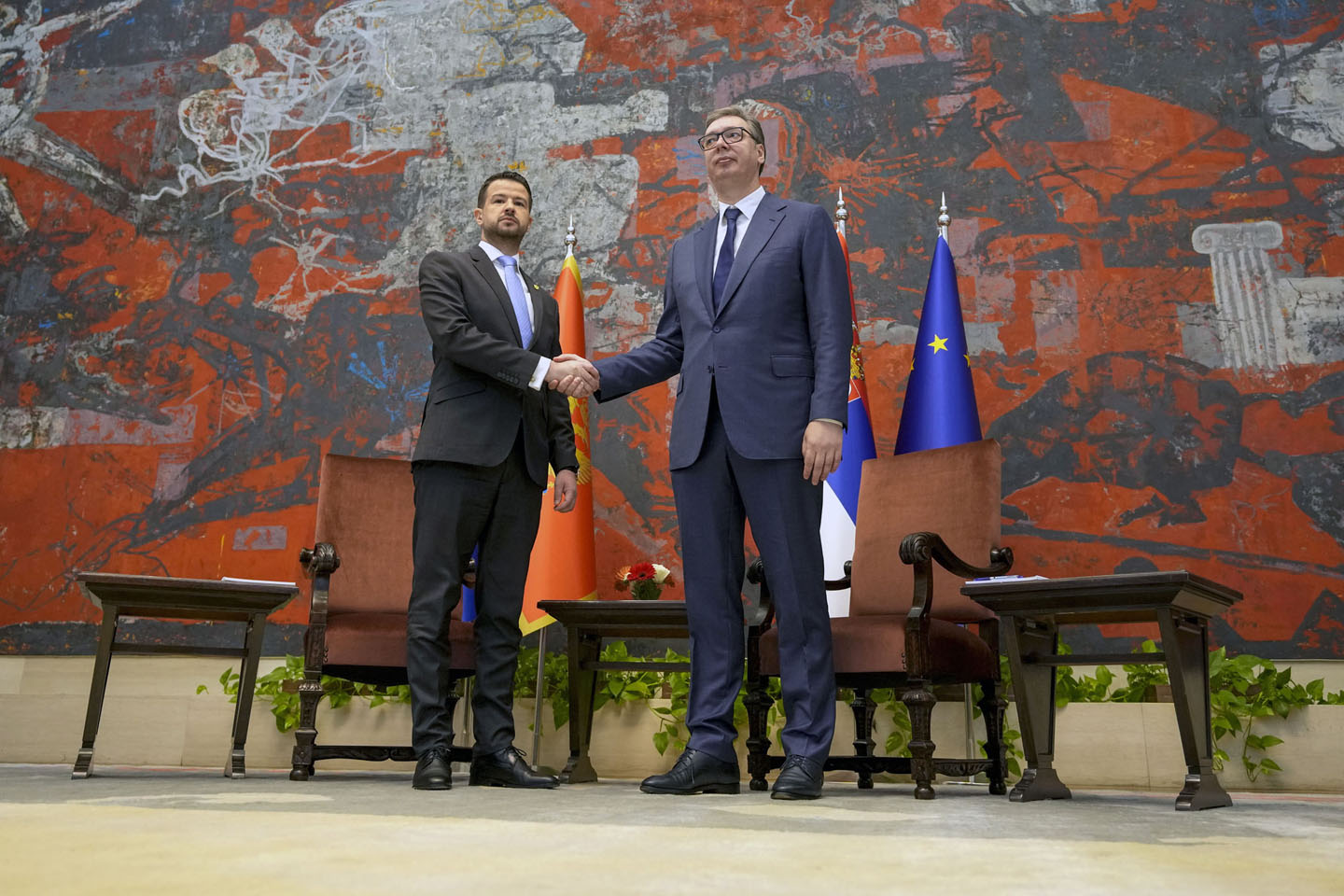
Two decades after the split of the state union in 2006, Serbia i Montenegro they developed two quite different models of society.
Serbia remained a much larger economy, an industrially and geopolitically more important country, but with more pronounced problems of centralization of power, media pressures and political polarization.
Montenegro is smaller, dependent on tourism and foreign capital, but it ranks much better in most international democratic and institutional indices.
Economy
Serbia, with a nominal GDP of about 82 billion dollars, has a much larger total economic mass, more industry, IT sector, agriculture and exports than Montenegro, whose nominal GDP is about nine billion dollars. However, Montenegro has a larger one BDP per capita and higher average earnings, but this partly stems from a small population and an economy based on tourism and services.
The average salary in Serbia is between about 1.000 euros, and in Montenegro between 1.025 euros.
GDP per inhabitant in Serbia is between 12.000 and 13.000 dollars, and in Montenegro it is around 15.000 dollars.
At the same time, life in Montenegro is more expensive, especially on the coast, so rent and food often eat up the difference in wages between Montenegro and Serbia.
In addition, Serbia has a more developed production, logistics and infrastructural potential, while Montenegro is significantly more vulnerable due to the uncertainty brought by the tourist season, but also external crises and credit debt.
In an economic sense, Serbia has an advantage because it has more jobs, a more developed IT and industrial sector, larger cities that offer more opportunities and lower costs outside of Belgrade and Novi Sad. What significantly degrades Serbia is the enormous economic centralization of Belgrade and the fact that salaries outside the big cities are actually miserably low, but also the fact that the regime Aleksandar Vučić on represents a growth "on paper" that is significantly higher than what citizens actually feel.
The advantages of Montenegro are higher average wages, the euro as a currency brings stability and a smaller administrative apparatus and a smaller market facilitate some processes.
However, a big disadvantage of the Montenegrin economy is that it depends a lot on tourism, which dominates seasonally, the fact that there are significant differences in the standard between the coast and the north of the country and that there is a small number of significant industrial sectors.
Therefore, Serbia is an economy with more potential and greater depth, while Montenegro currently provides a slightly higher average standard for part of the population, but on a much more fragile basis.
Democracy
In Serbia, there is an extremely strong concentration of power and the dominant role of one political center, actually one man, while institutional resistance is weak, and the influence of the state on the media is devastating. In addition, the regime of Aleksandar Vučić is in a constant political campaign and a permanent, polarizing mobilization of society. Today, Serbia functions more stably than in the nineties of the last century, but with a visible trend of complete personalization of politics.
In Montenegro, after the fall of the long-term government of the Democratic Party of Socialists and Milo Đukanović in 2020, the political system became more unstable, but with much more pluralism. At the same time, the change of government has become a reality, and the media space is more open, unlike in Serbia.
Freedom of the media
When it comes to media freedom, and according to the 2026 Reporters Without Borders report, the differences between Montenegro (41st place) and Serbia (104th place) are huge.
Serbia cannot possibly "start breathing" in the media due to harsh tabloidization, the dominance of pro-regime television stations, pressure on investigative journalists, aggressive political rhetoric and insurmountable media polarization. Quality independent media are under constant pressure.
The situation in Montenegro is not ideal either, but the media scene is more diverse, less centralized, and critical media have a more visible space. There are political and business pressures there as well, but international indexes rate Montenegro significantly better.
Corruption
According to Transparency International's corruption perception index for 2024, both countries have serious problems, but Serbia has stagnated or regressed in recent years, while Montenegro has a somewhat better perception of institutional control.
In Serbia, corruption is linked to public procurement, infrastructure, party employment and the combination of politics and business, while in Montenegro the biggest problems are the construction and tourism lobby, smuggling affairs from earlier decades and a small circle of political and business elites.
In essence, in both countries there is a sense that institutions are often subordinated to political centers of power.
EU integration
In terms of European integration, Montenegro has advanced farthest in the region in negotiations with the EU, and it is also a member of NATO, which means that it is much more clearly tied to the West in foreign policy.
Serbia leads a policy of sitting on multiple chairs and balances between the EU, Russia and China, formally negotiates with the EU, but progresses more slowly due to the issues of Kosovo, democracy and foreign policy. In addition, the citizens of Serbia are not nearly as committed to EU membership as the citizens of Montenegro.
Real journalism costs money, and we will not be bought by tycoons and corporations. Support us with a one-time or monthly donation. The time for it is now!