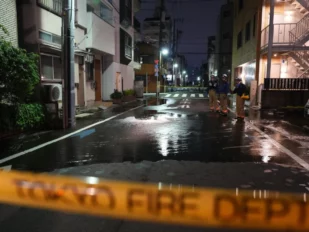
The storm, accompanied by strong southerly winds and high sea waves, caused floods, landslides and landslides in numerous resorts in Greece and Montenegro, which are favorites among Serbians tourists.
The coastal areas of northern Greece, particularly popular among Serbs, such as Paralia, Olympic Beach, parts of Halkidiki and Thessaloniki, were the most affected, writes the portal Grčkainfo.
Greek civil protection authorities declared a "red alert" in the regions of the Peloponnese, Western Greece, the Ionian Islands and Epirus.
An unprecedented phenomenon was recorded in Thessaloniki, in the area of Kalamaria, where residents and visitors were stunned when the sea level rose sharply, and water covered roads along the coast, business premises and parking lots.
Due to heavy rainfall and rising sea levels, the water has swallowed the beaches, buried the sand cars, so the streets turned into water channels in just a few minutes, and traffic was suspended in many parts of Greece, such as the Olympic region, in Halkidiki and in the area of Nikita.
The strong storm that hit Halkidiki left behind serious consequences, and although the weather has stabilized, the situation is still difficult, and in some places it is risky to move.
Greeks worried about the upcoming season
According to the information of the competent services, traffic was suspended in several sections due to the drift of water, mud and stones, and roadway damage caused by heavy rainfall and flash floods.
Landslides occurred in some places, while the torrents dumped a large amount of material on the roads.
Beaches were turned into trenches, numerous houses and roads were damaged or totally destroyed.
One of the hardest hit areas is Nikiti, where the coastal part of the town was significantly damaged.
Strong winds and high waves pushed the sea onto the boardwalk and road, carrying sand and rocks with it. In several places, the banks have been eroded, the road and sidewalks damaged.
Local restaurateurs and tourism workers are appealing to the authorities to urgently start work on the rehabilitation of damaged buildings and roads in order to bring everything back to normal before Easter holidays, when the more intensive arrival of guests and preparations for the summer season begin.
Historically rainy winter
Greek meteorologists draw attention to the large amount of water expected to fall on already saturated soils. They point out that this winter is "historic rainy" and explain that the problem is not only meteorological, but also geological and hydrological and that it requires great attention, because even moderate rain can lead to landslides.
A strong cyclone from the Adriatic, which moved over our area further to the northeast towards the east of Europe, brought pronounced southerly currents and stormy southerly winds, and in combination with low air pressure, all of this led to a rise in the level of the Aegean Sea and flooding of the coasts in the wider area of Thessaloniki.
The cause of sea overflow is usually a strong storm wind that "pushes" water towards the coast, and the consequences are often flooded streets in coastal areas and material damage to buildings.
Flood in Dalmatia, Herzegovina and Montenegro
At the same time as the storm in Greece, a strong cyclone from the Adriatic caused a flood on the coast.
In the south of Dalmatia and Herzegovina, more than 100 liters of rain fell per square meter, and on Montenegrin on the coast and twice as much, causing floods and torrents.
The worst situation is in Kotor, where the tidal wave has made the main gate of the city inaccessible, and as you can see from the videos on social networks, the water is so much that people and vehicles are practically swimming around the city.
Local media reports that Kotor's Old Town is under water. Numerous buildings were flooded, and traffic is very difficult.
Although the weather will stabilize in the middle of this week. new, frequent precipitation is expected next week.