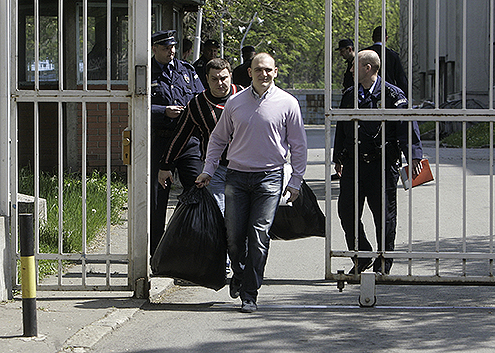
Luka Bojović (9) was arrested in Spain on Thursday, February 17 at around 37 pm. At the same time, four more Serbian citizens were arrested.

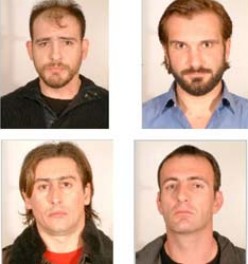
ARRESTED IN VALENCIA WITH LITHUANIAN PASSPORTS: Luka Bojović, Vladimir Milisavljević, Siniša Petrić, Vladimir Mijanović
In addition to Bojović, the Spanish police also arrested Vlada Milisavljević, known as Vlad the Fool, (who was sentenced in absentia to 40 years in prison for the crimes of the Zemun clan, and another 35 years for his participation in the murder of Serbian Prime Minister Zoran Đinđić), then Siniša Petrić, called Zenica (former member of Arkan's "Serbian Volunteer Guard" and member of Marinko Magda's group, sentenced to death in the 1999s, who, according to according to one version, he escaped from prison in Sremska Mitrovica, and according to another, JSO took him out of "Dubrava" prison near East in Kosovo in 9) and Bojović's godfather Vladimir Mijanović, known as Zuba. This was stated by police director Milorad Veljović on Friday morning. Police Minister Ivica Dačić then told reporters that Luka Bojović, Vladimir Milisavljević, Siniša Petrić and Vladimir Mijanović had Lithuanian passports when they were arrested on February XNUMX in a restaurant in Valencia and that their identities were officially confirmed by the Spanish police.
The police found a large amount of weapons in Luka Bojović's apartment - pistols, three "scorpion" automatic pistols, a shortened "bokerica" hunting rifle, bulletproof vests, silencers, ammunition; then over half a million euros in cash, wristwatches, several laptops and tablet computers, identity cards, two fake passports of Luka Bojović and one fake Croatian passport of Vladimir Milisavljević, in the name of Marijan Barišić, issued on December 31, 2008.
In the MUP of Serbia, Tanjug was told that a joint operation by the criminal police of Serbia and Spain arrested a person matching the description of Bojović, and his identity was officially confirmed after exchanging information with the Serbian police.
It is believed that Luka Bojović is one of the leaders of the Zemun clan, which he became after the murder of Dušan Spasojević and Mile Luković in March 2003, when a state of emergency was imposed after the assassination of Prime Minister Zoran Đinđić.
In fact, it is believed that Bojović is currently the most prominent active leader of the criminal group in the region.
Bojović is accused of several murders and attempted murders. He is being tried in absentia for the attempted liquidation of Andrija Drašković in 2004. He is also accused of organizing the murder of Branko Jeftović Jorge in 2004, the attempted murder of Andrija Drašković and Zoran Nedović, when their bodyguards Dejan Živančević and Milutin Jovičić were killed.
Bojović was arrested in the fall of 2007 together with Veljko Banović, while Ilija Novović subsequently surrendered. He spent about a year in prison. Novović and Cvetko Simić, his closest "associates" were killed, the rest were either arrested or on the run.
In September 2010, an international arrest warrant was issued for Bojović. However, he was lost a few months earlier. On Friday, February 10, more details about the arrest of not only Bojović were published. The Spanish Ministry of the Interior announced, reports Tanjug, that Luka Bojović, Vladimir Milisavljević and Siniša Perić were arrested in a restaurant in the center of Valencia, after a long follow-up in the investigation that the Spanish police in cooperation with the Serbian and Dutch police conducted for more than 20 months about persons of Balkan origin suspected of murders, robberies of jewelers, possession of stolen goods, drug trafficking and money laundering. The Spanish El Pais writes that the investigation into the connection of this group with murders in Serbia, Spain and the Netherlands, as well as with various robberies and drug trafficking, was conducted in Switzerland, Romania, the Netherlands and the United States of America. The Spanish police obtained information that persons from Bojović's closest environment - his wife, children, brothers, mother, and even his deputy - were located in different locations in Alicante and Las Palmas in the Canary Islands. The police followed Milisavljević, who came from Las Palmas to a meeting in the Valencian restaurant where Bojović, Perić and Milisavljević gathered, and decided to arrest them in that restaurant.
Read more about Luka Bojović in the text from the "Vremena" archive:
Who is Luka Bojović and what made him important
<< TIME | BR 1018 | 8 JULY 2010.
Media assumptions about Luka Bojović being the main contractor in the field of killing pushed this native of Belgrade to first place on the crime scale in the region.
Written by: Slobodan Georgijev
Belgraders and others passing through Vračar, one of the elite parts of Belgrade, rejoiced at the beginning of this decade when the "Bojović" bakery was opened. On the corner of Kneginje Zorka and Njegoševa nikla streets, there is a modern large bakery full of various diakonies, which always had fresh products at all times. A large number of young people gathered there at night, especially to eat something good after going out. From the moment it started working, those from the area knew that it was Luka's bakery, Luka's son Vuk Bojović, manager of the Belgrade Zoo. There were not too many questions about how he got that lucrative job and how he opened such an expensive bakery.
People knew that he was doing other things and that it couldn't have been done on his dad's salary at the Zoo, but no one was concerned with the origin of the property while he smoked burek and hot dogs with yogurt in the early hours.
A few years later, today, pastry is not in the sphere of interest of either clients or owners. Recently, two things could have excited Luka Bojović: the wounded Sretko Kalinić, in a statement given to the Croatian police, allegedly said that Bojović participated in various ways in directing and carrying out a bunch of unsolved murders in the region in recent years, and then the public was flooded with information about that Vojislav Šešelj from The Hague ordered the murder of Tomislav Nikolić by hiring Bojović.
PERSONALITY FROM THE MOVIE: The Croatian media reported that in the statement Kalinić gave to the police, it is stated that Bojović ordered or co-perpetrated 11 murders. Among others, Kalinić allegedly, among other things, accuses him of the murder of some persons who could have been very important witnesses in elucidating political murders in Serbia in the last fifteen years: from Ivan Delic, important for elucidating the murder of the former Minister of the Army of the FRY, Pavle Bulatović, through Zoran Vukojević Vuk to Kuja Kriještorac, who was supposed to be an important witness in the proceedings against the murderers of Zoran Đinđić. As a rule, the others who were mentioned represent characters from the underworld who in some way "resent" Bojović and they are mostly associates of Andrija Drašković and Sreten Jocić.
These two things are connected in one characteristic that goes with the "character and deed" of the thirty-seven-year-old owner of a bakery from Vračar in Belgrade: Bojović is currently the most prominent active leader of a criminal group in the region, who after the attack on Darko Šarić's clan and the earlier arrest and trial of Sreten Jocić is trying to is installed in the place of the first underground don.
We have yet to find out how this happened and how it is possible for such a dangerous man to never be charged with a more serious crime than illegal possession of a weapon and forging an identity card. Until everything about the assumptions is cleared up in the investigations conducted on various sides, Bojović looks like a person from mafia movies: a local craftsman / merchant who only deals with service entrepreneurship, and behind the counter where there are rolls, burek and rolls -plans are being prepared to take over the crime scene and kill unfit politicians. These events started anew the story of Vojislav Šešelj's involvement in various controversial events in Serbia over the past two decades, which as a rule ended with a murder. In addition, the mentioned connections of Bojović with almost all major and unsolved murders show the deadly link between crime and the authorities that was established in the early nineties in Serbia and has not been completely severed to this day. All actors mentioned in relation to the activities of Luka Bojović have something to do with political life in Serbia - either through direct contacts with persons like Vojislav Šešelj, or through connections with the former state security. His relationship with Seselj allegedly dates back to the 1990s, when Seselj was in power: he influenced the young Bojović to have some criminal acts erased.
DISCRETE APPEARANCE: The presence of Luka Bojović in various events described on the pages of the "black chronicle" and in the internal investigative documents of the Serbian police is long-lasting. He was mentioned for the first time more than fifteen years ago when, allegedly, as a young guy, one of the team of Željko Ražnatović Arkan, he was involved in the shooting in which Mihajlo Divac was shot dead. During the years of the war, he was a member of the Serbian Volunteer Guard, and after that he devoted himself to various jobs in the criminal milieu. The start and growth with Commander Arkan will forever mark his career. After the liquidation of the mentor, it seems that Bojović strongly tried to take revenge on some people who could have been guilty of that murder, but also that he continued to work on those jobs that Arkan established. His name is associated with murders, kidnappings and drug deals. He was active in the "west" for several years. Some reports indicate that he worked with major criminal enterprises in Europe in drug trafficking, prostitution, kidnapping. The Dutch police issued an international warrant for him on suspicion of having organized the liquidation of Srđan Miranović in Podgorica on January 12, 2006. William Wim Holleder, 48, a well-known Dutch mobster of world reputation, who "became famous" for the kidnapping of multimillionaire Freddie Heineken in 1983, was mentioned as a possible customer. In addition to this, it is interesting that he was "wanted" by the American police for illegal animal trafficking.
Although it was previously said that his group is currently one of the most powerful and influential, there is no information on how many people work in that circle. For his team, it is claimed that he hires associates "on contract", "per job" and that he only has a small number of loyal associates around him. Apart from having a bakery in Belgrade, Bojović did not particularly stand out in "public life". Unlike other members of various criminal enterprises who liked to walk around the city, to be seen and known, everyone also knows Bojović, but no one saw him often, nor was he present in public through statements to the media. His "discretion" indicates that he took his engagement seriously and that his assessment was that any public appearance would be bad for business.
In this context, his famous front-page photograph that accompanies most of the inscriptions can be interpreted: it shows a man with a military haircut, a sharp look, a few-day-old beard surrounded by the high collar of an Italian shirt.
It is a photo from an earlier period: after that we have photos of Bojović after he was released from custody in 2008. He is slightly thicker, balder, but just as elegant. In an interview with "Revia 92", Milan Živanović, who was arrested for breaking into the American embassy during the demonstrations after the declaration of independence of Kosovo in February 2008, says about Bojović:
"I'm going to tattoo him." But I don't want the picture as it was in the newspaper. The boy is not like that at all. He is blue, beautiful as a doll. The guards are afraid of him. Everyone is afraid of him. He is God there. He's not in the mood to be dangerous. He is normal, he is silent."
FORM: Bojović was arrested in the fall of 2007 together with the first associate Veljko Banović, while the third member of the team later surrendered. The then Minister of the Interior, Dragan Jočić, stated that this was a serious group that planned numerous murders in Serbia and that the found arsenal of weapons confirms this. Also, the media reported that Bojović's group was designated as logistical support for the fugitive members of the "Zemun Clan", for whom it provided travel arrangements and meals. Less than three years later, it seems not that Bojović's group was not a logistical support for the "Zemunians", but that the previous members of the clan worked for Luka, which could indicate that he took over the jobs that Dušan Spasojević and Mile Luković managed.
The arrest in the fall of 2007 was marked as a major blow by the Serbian police to the mafia and a realistic prevention of new liquidations. That story has been similar to this one for the past few days: "the security structures have found out", "it points to it", "it can be concluded from this" are just some of the usual phrases that describe the potential danger of the actions of this criminal group, which is so strong that it will simultaneously take over the affairs of the Šarić clan and for Duke Šešelj to "work out" whoever is needed. Bojović is thus presented as a criminal of general practice who works where "it pays well" or where a favor needs to be returned. A country that is traumatized by the murder of the prime minister should be especially careful when it comes to hints that another politician could be killed, but such things could lead to the clarification of the role of some of the political parties in connection with the murder of Zoran Đinđić. , the assassination of Vuk Drašković, the murder of Slavko Ćuruvija, the attempted murder of Dejan Anastasijević and his family, and other severe liquidations.
In addition, we also learned that it is assumed that he managed to escape, even to South America this time when he realized that the announced extradition of Sretko Kalinić, a man with whom he had worked for years, could endanger him and that a new departure to detention unit of the Central Prison in Belgrade could also mean long-term absence from liberty.
Probably, according to the pattern we saw in the case of the Šarić clan, the next story will be related to the property that in some way is owned by Bojović and his close relatives. According to the data of the Agency for Economic Registers, he is the owner of only one company, but a more detailed investigation could show that his assets are much larger when the names of his friends, associates and relatives are crossed. Because of his son's affairs, father vuk Bojović was often "summoned" to make a statement. In one of the last statements he says, with a lot of sense, that Luka is a grown man who is responsible for his actions and if it is proven that he is involved in some criminal activities, he should be responsible for that.
"I didn't deserve to have any shady deeds attributed to me through him," the Belgrade daily "Pres" reported the words of the longtime director of the Zoo after his arrest in 2007.
JOURNALISTS KNOW: Once he was released from custody, it is hard to believe that Luka Bojović will return to it just like that. It is up to the police not only to "call" someone and provide security to the vulnerable, but also to work on gathering evidence that can lead to verdicts with multi-year sentences. The current practice of strong media exploitation of spectacular arrests sends a message that crime does not pay, but if this does not lead to a real reduction in the "crime rate", does not make it difficult for the mafia to trade and distribute drugs, stories about new mafia bosses will be more than interesting media reading. The police of the region have done a lot in recent months with various joint actions to suppress the growth of criminal enterprises, but there is still a doubt that the connection between the mafia and politics has not been severed. That's why actions are sometimes more media than real. As former minister Jočić said the other day.
"Journalists who are familiar with the events on the Serbian criminal scene know the relationships between certain criminals and businessmen and can assume that those weapons were intended for the liquidation of a certain person. The police do not have that information, but it is important that the leaders of one of the more dangerous criminal groups in Serbia were arrested," Večernje Novosti reported his statement.