The paraphrase of Balasevic's verse from the title is the first thing that comes to my mind after the grand opening on the 32nd. Sarajevo Film Festival, not only because it opened with the film "Fatherland" by the Oscar-winning Polish director Pawel Pawlikowski - for me, Sarajevo is always one of those "homelands".
Jakov Milatović, President of Montenegro with his wife, actor Goran Bogdan, actor Branko Đurić Đuro accompanied by his actress wife Tanja Ribič and daughter Ela Đurić, director Pjer Žalica, as well as jury members of the Competition Program, director of the European Film Academy Matthijs Wouter Knol, Macedonian actress Sara Klimoska, English actress Emily Watson and Croatian director Igor Bezinović were seen on the red carpet before the event.
Where are the Serbian actors?
Of the Serbian film workers on the red carpet, only actor Branislav Trifunović and director Miroslav Terzić - the crew of the film "Three weeks later" - were announced, but my colleagues and I did not see them. In earlier years, the audience often saw here Dragan Bjelogrlić, Jasna Đuričić, Boris Isaković, Mirjana Karanović, Milan Marić, Dragan Mićanović...

Photo: Robert ČobanFlags of Palestine at the opening of the SFF
A large number of Sarajians and tourists watched the parade on the red carpet, and I saw several Palestinian flags in the crowd.
The opening ceremony at the National Theatre, and a little later in front of a much larger audience at the Summer Cinema, was led by the young Bosnian actor Kerim Čutuna.
Everyone loves the Sarajevo Film Festival
Around the SFF in the capital of Bosnia and Herzegovina, there is a consensus similar to the one I wrote about when it comes to Oliver Dragojević and the "Trail in the Endless" festival in Croatia - everyone supports it. Both Sarajevo dailies - "Oslobođenje" and "Avaz" publish regular supplements and reports about the festival, billboards and advertisements of companies supporting the SFF are on every corner, the list of institutions, companies, embassies and international organizations that stood behind this cultural event, without a doubt the largest in BiH and one of the most significant in the region - is also impressive.
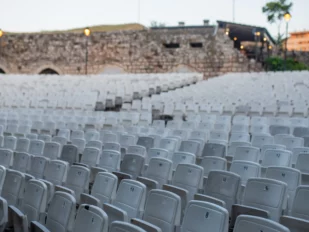
Photo: SFFThe audience at the screening of the film "Ocevinas"
Hotels and restaurants in the city are full, SFF newsletters are available at all reception desks and desks. The mass of people in the center of Sarajevo on the opening night of the SFF cannot be compared to any similar event in the region.
The biggest festival in the region
Two years ago I wrote about the little quiet one Sarajevo Street, which bears the name of historian and academician from the famous Serbian merchant family, Vladislav Skarić (1869-1943), and connects Ferhadija with the Street of the Green Berets, where the festival crowd begins and which resembles Amsterdam. This year, that contrast seems to be even stronger.
Then, in a report for "Vreme" from Sarajevo, I wrote about the challenges that SFF was going through in the past years: in 2023, SFF had problems with part of the Bosnian public due to the broadcast of the trailer for the Serbian film "Heroji Haliarda", in which the Chetniks of Draža Mihailović appear.
A few months later, the 7th of October happened and the attack of Hamas on Israel and what followed in Gaza with all the implications it has on Muslims around the world but also on a large number of Bosniaks in Bosnia and Herzegovina and Sandzak.
Three years later, in the summer during which there was no Exit and Tamburica Fest in Novi Sad for the first time, no Shakespeare Fest in Čortanovci, and the question is what will happen to Belgrade's BITEF, the tenacity and quality of SFF, which has managed to overcome all difficulties since the war in 1995 until today and (p)remain the largest film festival in the region, is certainly something that no one can dispute.
"Fatherland"
With the film "Fatherland", Pavlikovsky completes the Cold War trilogy. "Fatherhood" is a historical drama about the relationship between Nobel laureate Thomas Mann, played by Hanns Zischler, and his daughter Erika, played by Sandra Hüller. Erika is an actress, writer and racing driver. At the height of the Cold War, in the summer of 1949, father and daughter embark on an emotional journey in a black Buick through devastated Germany, from Frankfurt in the American sector to Weimar under Soviet control.
Thomas Mann, who returns home after sixteen years of exile in the USA, faces not only a divided homeland but also a deep split within his family. When asked by the American AP journalist with whom (it is hinted) his daughter Erika will later end up in bed - "Where is the homeland for you?", Thomas Mann has no real answer.
The film's atmosphere, location, historical period and theme remind me of the play "On whose side" I watched 10 days ago in Brioni. It's as if everyone is dealing with that topic at once.
Only in August: Save three thousand dinars on the annual subscription to the digital edition of "Vremena"! Take advantage of the discount here and support independent journalism.