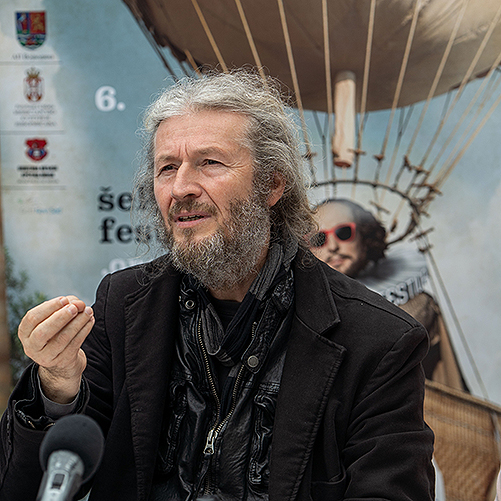
The title of the Shakespeare Festival's new production, My Shakespeare, is also the theme of this project by Nikita Milivojević: the actors who are remembered for the productions of Shakespeare's works on our stages will speak monologues from their roles, and will tell what Shakespeare means to them. It could be said that the personal experience of Shakespeare is also the reason why Nikita Milivojević founded this festival, and because of which the theater and artists from around the world have been coming to Čortanovce for the sixth year, to Villa "Stanković".
Nikita Milivojević is currently preparing another Shakespeare play, How nice of you, for the Nashville Festival, and a dramatization of the novel Travnica Chronicle Ivo Andrić at the Serbian National Theater in Novi Sad.
The new Shakespeare Festival starts tonight, Thursday 27 June. It recently received recognition from the European Association of Festivals, because it is unique in this part of Europe.
"WEATHER": Did this recognition draw the attention of the state to the festival, was it easier to organize and realize it this year than the first time??
NIKITA MILIVOJEVIĆ: Although this year we are doing a little easier than the previous ones in many segments of organizing the festival, I could not say that this recognition is the reason for that. Various other things, (un)circumstances and the like, affect every festival, so it's the same with us.
The recognition of the European Association of Festivals is certainly important, first of all because it is decided by an international jury, because someone there, completely unknown to us, decided that we belong to the family of significant art festivals in Europe. In this sense, it is of course significant that what we do at the Shakespeare Festival is visible to some people in the world. On the other hand, I am glad that we are in the company of Bitef, the Palić Film Festival, the Belgrade Jazz Festival and our other festivals with a much longer tradition, which already have this recognition here, because I think that all those festivals are really what make us the best possible the way it represents in the world. But what I probably like the most is that this recognition is a kind of reward for my Shakespeare team, proof that we have been doing something good and important for these six years.
Once you are asked why, if you've already had time to establish a festival, you have not founded a festival of some domestic classic, responded with the information that in the history of the National Theater in Belgrade, Nušić or Steria were not the most played, but Shakespeare. The project My Shakespeare is a new proof that we have really adopted it.
One easily finds himself and his time and environment in Shakespeare. We are always surrounded by Macbeth, Richard, Hamlet and Henry, melancholy Jacques, Ophelia, Lady Macbeth, Juliet... we just need to see and recognize them. And it has been like that for more than 300 years, which after all was one of the reasons for creating this festival. In the letter that Peter Brook sent us in support two years ago, when we had almost no funds for the festival, he says: "Shakespeare is a phenomenon, like the sun or the moon, and it cannot be explained in words." For us, there is a kind of the opinion that Shakespeare is the most complex acting and directing task. I've been listening to it since I was a student, today my students are listening to it. No actor's biography is complete without Shakespeare in it. That was also the main motive for me to invite some of my friends who have played Shakespeare a lot and let's create something like a "small intimate theater" in which they will talk about some of their experiences about their own experience of Shakespeare on stage. What is particularly beautiful about this entire meeting is the composition of this Shakespeare troupe, because in addition to our actors, there are also their colleagues from Zagreb, Skopje, Ljubljana... My Shakespeare, although it has a certain script, it is completely open, so even we who participate do not know exactly how that story about Shakespeare will look like. It will largely be created that evening, it will be very spontaneous in a way because it is the result of the interaction between the actors and the audience. Each of the actors has prepared some kind of personal confession related to Shakespeare, but we will see how it will really turn out on stage.
One has the impression that classical literature, both dramatic and prose, attracts directors more and more often than contemporary dramatic texts and you are among them. What is so irresistible about classics?? Why is it more interesting for you to look for today's topics in a text from past centuries than to reveal a new text to the audience??
In the great classics, there is the residue of all times, both past, present and future. The story of man's destiny is written in it again and again. Our desire to be current and talk only about our reality is of course understandable to me, but in the theater, unfortunately, it is very often banal. It is not easy to write a great dramatic text, just as it is not easy to make a great play. The fact is that, for example, at the competition of the Sterija Theater for a domestic dramatic text, the number of those who arrive at the competition and those who are shortlisted is in a devastating ratio. A lot is written, but that does not mean that it is written well. Sometimes I get the impression that it is thought that this decades-long general crisis of society has almost no effect on our theater. It is just as sick as many other institutions.
What is modern in How nice of you, the show you are preparing for Nashville? I ask that on the assumption that you have not decided to transfer it to the stage without the present view of the text.
One of the most famous and most often quoted sentences of Shakespeare is in this play: "The whole world is a stage, everyone appears and leaves... and on it we all play many roles in life." For me, that is the basic idea of the play. First of all, it was conceived as a great dedication to the Theatre, the stage. In addition, the reason and some kind of special motive for me to do this play is the fact that this will be the first performance of Shakespeare on the stage of the Kruševac Theater since its foundation, that is, since 1946.
Where will they play? How nice of you when nishville passes? What is the fate of non-repertoire performances? My Shakespeare is the second production of the Shakespeare Festival, what was the fate of the previous one Pericles?
I could only wish for this present fate as well Pericles because so far it has been played more on various tours around the region and beyond than on the home stage in Šabac. In addition, we played it for two years at the Shakespeare Festival, we could certainly have done it longer, but it seemed like a privileged status. Pericles won more than thirty awards at various festivals and is still being played with great success. How nice of you after the premiere in Nishville, it will have two main stages: in Kruševac and Niš, and what will happen afterwards, what kind of life the play will have, you never know.
One of the reasons people go to the theater is because they expect to hear the truth from the stage. Many in Serbia believe that we live in a time of lies and deception. What do you think??
I will tell you a story, more like a little anecdote than a wise answer to your question, but I believe it can be interesting. My son, when he was about five years old, went with us for the first time by car to the sea. We are driving towards Greece, the road is getting longer, the heat is terrible, he is getting more and more nervous and every hour he asks "when will the sea come?", and we lie more and more "it's over there, behind that hill, as soon as we pass this curve", and then he In the meantime, we entertain him with something to distract him, and then we stop somewhere for him to drink juice and take a walk. And, at one point, for the hundredth time, obviously now very angry, he asks "when will the sea come!?", and I try again with "here's another 15 minutes, as soon as we cross this hill". And he says to me: "I've had enough now, I'm getting off here!" To me, this story has become a metaphor for various things we've been going through for the last 30 years. All that cheating, lying, replacing one and the same. The landscapes change, but the essence remains the same – the sea is nowhere in sight. I got tired of all that and said to myself the same as my son: I've had enough, I'm getting off here. It's just that it seems to have taken me a lot longer to figure it out than him.
You live in Belgrade and Athens, so it is possible that you perceive our present with a certain distance. Yet, last year you supported the protests "1 in 5 million". Why?
When I'm not in Serbia, I'm less and less able to follow the news and I don't really have the best insight into various domestic matters, so I wouldn't want to pretend to be someone who is knowledgeable about the events. When, for example, you and I talk about the theater, then you are in my yard, and for that I don't need newspapers or other opinions, after 15 minutes I can tell you what the actors are like, the direction, whether we are watching something interesting in the theater, clever or not. You cannot hide anything on stage, and above all you must not lie because it is immediately visible, in that sense the theater is the most democratic possible institution in the world. In politics, everything is the opposite. You never know whose motives are there. As for the protest, for me, first of all, some of my colleagues from the theater, whom I consider to be serious, smart people, really the best in their work, and they are not members of any parties at all, were quite enough reason to support them and be on their side. .
You said that even the cleaning lady knows what the problem is with the National Theatre, you stated the necessity of separating Drama, Opera and Ballet. At one time you were the director of Drama. Did you try to solve it then?
One of the key feelings that I have had for many years related to our society is - delay! We are constantly falling behind in the race. It has already become frivolous for me to repeat the same story for years, but if I have to, here it is again: the serious work of organizing the National Theater will begin at the moment when Drama, Opera and Ballet are separated and when finally, one day, we all switch to the contracts that we each new job brings to the extent that we deserve it. This would, among other things, introduce responsibility towards what we do. I told this same story, only with more specific suggestions, many years ago to Zoran Đinđić. We had only a few meetings and all of them more or less had the theme of the National Theater. At first it seemed that we really had a great plan and were moving towards its realization, but then, in our last meeting, he told me that, unfortunately, there was nothing to come of it, that many other "more important" things started happening all over sides, so we'll have to move all that to another time. I asked how long it was, and he answered: at least five years. I told him that in that case I would like to return to Athens and continue directing, five years is a long time. The only motive for me to become the Director of Drama was to change the system in the theater. You can't be five years in something you don't believe in. I can't even start a play if I don't believe in it, if I don't care about it, the actors feel it right away. So, not five but almost twenty years have passed since then, and probably another 20 will pass and we will still be telling the same stories, being where we are now, or rather in a much worse situation. My whole adventure, with the position of Drama Director, was less than a year, so I am probably the Director of Drama of the National Theater with the shortest tenure.
Surely you have also heard about the comment that the decision to leave the leading positions in the National Theater was made, and then in Bitef, were good because it is quite possible that otherwise the European scenes would not have discovered you. We are talented to release the potential that we have, to leave it to others. And that in all areas of society.
After all these years, the theater has become, among other things, my way to communicate with the world around me on various topics, to somehow reduce my loneliness. On the subject of the departure of educated, talented people, I have already done two plays, I have made a film. And that was all ten years ago now. Unfortunately, I have the impression that the lack of quality people, in every part of this society, is increasingly taking on the proportions of some kind of domestic ancient tragedy.