The first building of the Railway Station in Novi Sad, the one on Liman, which is no longer there, was a symbol of the progress of Novi Sad. The current building from 1964 was a masterpiece of modern architecture, and then it turned into a ruin. It was reconstructed the first time when Novi Sad became the European Capital of Culture, and the second time because of the "Soko" train. On Saturday, its canopy killed 14 people
It was decided at the Berlin Peace Congress in 1878 that the Budapest-Zemun railway would pass through Novi Sad.
It was built by the Hungarian State Railways. Because of the railway, a tunnel was dug under the Petrovaradin fortress and the Čortanovački tunnel, and two bridges were built, one in Novi Sad over the Danube and one over the Sava between Zemun and Belgrade.
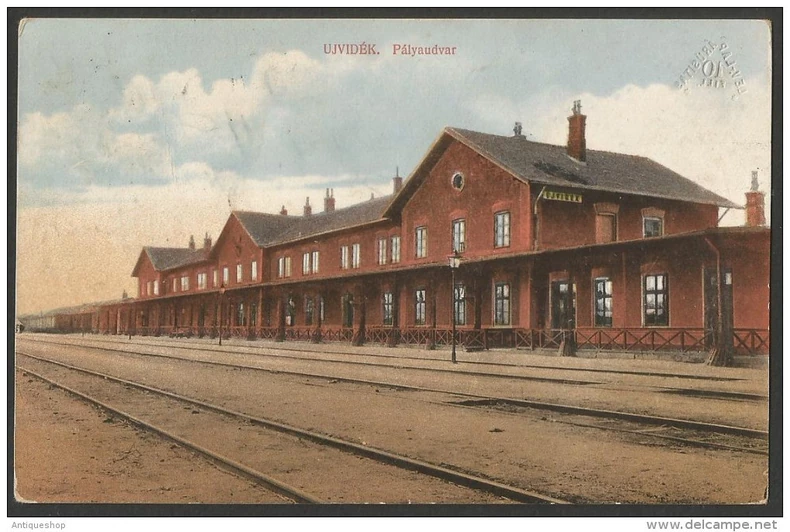
The first building
The first train arrived in Novi Sad on March 5, 1883, around 18:30 p.m. The day was cold, but it was welcomed by the masses of Novi Sad residents and caused general euphoria. Three trains actually arrived that day, the first brought railway officials to certain stations, the second consisted of three locomotives and was used for bridge tests, while the third brought the director of the Hungarian State Railways L. Tolnaj and the head of the construction inspection, ministerial adviser L .
He entered the railway station located on Liman, on the southern outskirts of the city, on the site of today's Liman market. It was the first building of the railway station in Novi Sad.
It was connected to the city by tram, with the lines that connected it to today's Dunavska, Temerinska and Futoška streets. The building consisted of a central hall with cash registers and waiting rooms, as well as official rooms and a restaurant. Next to the main building, there were warehouses and a building for postal traffic and customs, which is the only preserved building to this day and it still serves the needs of the post office.
Chasko to the Vienna Opera
Because of the railway, Novi Sad has made great progress in every aspect. Hundreds of people passed through the Novi Sad station every day, it was lively both day and night. The first morning newspaper and fresh bread could be bought at the train station.
According to the newspapers of the time, the Serbian railway was equipped with the most modern and best cars, and there was also a heating system that "not even the Austrian railways" had.
Photo: Novi Sad ArchivesBuilding on Liman
However, traveling by train was initially only available to the wealthier strata of society, while ordinary people could not afford it. A third-class ticket cost 17 dinars and 10 pairs, which corresponded to the then price of 400 eggs, 25-35 chickens. For example, a teacher's salary was 67 dinars, a lieutenant's salary 126 dinars.
Because of the railway, the Budapest and Vienna operas, as well as their schools and universities, become more accessible to the people of Novi Sad. Train passengers become our famous families and individuals (the Dunđerski family, Laza Kostić, Jovan Jovanović Zmaj, Svetozar Miletić, Isidora Sekulić). Emperors and kings pass through Novi Sad by train.
Also, the famous Orient Express first travels through the Banat from Paris to Istanbul, via Kikinda, and later via the route via Budapest and Novi Sad. Agatha Christie was a regular passenger of this train, and Isidora Sekulić used to say that the Orient Express is a frantic speed.
New building
In the period between the two wars, there was an expansion of traffic at the Novi Sad railway station, and the problem of its capacity also arose. In parallel with the relocation of the entire industry to the northern part of the city, a new concept of railway routes is being created. This was made possible by the construction of a new modern bridge made of prestressed concrete according to the project of engineer Žeželja, after which it got its name.
The new building of the railway passenger station in Novi Sad was opened on May 31, 1964. It was completed in a record time of only 18 months.
At the opening, Stevan Doronjski-Franja, vice president of the Executive Council of the SR of Serbia, cut the red ribbon at the entrance to the marble station building and then the first train left for Belgrade.
As "Dnevnik" wrote the day after that, several thousand fellow citizens found themselves on the plateau in front of the railway station and waited for the ceremony, which began in the early hours of the morning. flags", reads the news of "Dnevnik".
The first train left at 10.32:11 a.m. for Belgrade, while the second train left at XNUMX a.m. for the north of the country, to Subotica.
Architect Farkas
The building was built according to the project of the architect Imre Farkaš and his associates from the project studio "Architekt", while the work is done by the contractor. At the time of its construction, the station building was a masterpiece of modern architecture.
The characteristic saw-shaped roof, which symbolizes the roofs of typical Pannonian houses, is particularly recognizable. The station building itself represents a logical sequence with the then new Boulevard of Liberation. Access to the tracks is achieved through underground passages, in order to achieve maximum passenger safety. It was designed so that about 1000 passengers who get off the trains on the platforms can arrive in front of the station building in just 1 minute.
Photo: WikipediaThe interior of the building
It can be said that the ambience of the station was tailored to the needs of man.
Imre Farkaš was nominated for the October Award. However, some local architects were against it. Completely disappointed by this behavior of his colleagues, Farkas moves to Canada.
Reconstruction on the occasion of EPK
In the period of the 90s and 2000s, the new building was ruined and from its former pride it became a mockery of the city. The restaurant and waiting rooms stopped being used, while cleanliness was at a low level. The clock on the station building had been broken for years.
It was reconstructed, for the first time in its history, on the occasion of the nomination of Novi Sad as the European Capital of Culture in 2022, when in March the presidents of Serbia, Aleksandar Vučić, and Viktor Orban of Hungary, welcomed the Soko train, which, speeding at 200 km per hour, would reach Belgrade in half an hour, announcing that it would by 2025, all of this will become part of the Belgrade-Budapest high-speed railway.
Second reconstruction
The reconstruction was done again in 2023 and 2024 and was officially opened again on July 5, 2024.
The new station vestibule, with a gallery, counters, waiting room and other accompanying rooms, was opened for passengers and service users, in the presence of the Minister of Construction, Transport and Infrastructure Goran Vesić, the President of the Provincial Government Maja Gojković, the General Director of the Railway Infrastructure of Serbia Jelena Tanasković, the Novi Sad Mayor Milan Đurić and other guests.
On November 1, 2024, the station's entrance canopy collapsed, killing 14 people.
What is happening in the country and the world, what is in the newspapers and how to pass the time?
Every Wednesday at noon In between arrives by email. It's a pretty solid newsletter, so sign up!
NUNS demands an urgent investigation due to the threats sent to two Radar journalists who wrote about the Sky correspondence in which Aleksandar Vučić is mentioned. The association states that the threats also mention violence against children of journalists and warns of impunity
Almost a third of the estimated deaths occurred during a particularly intense heatwave between June 17 and July 1, when temperatures averaged 5,3°C above normal
Among fifteen-year-olds in Serbia, 53 percent of students in mathematics, 48 percent in reading and 43 percent in natural sciences are below the threshold of functional literacy.
Aleksandar Vučić commented on bot attacks on social networks and the case of an attack on the account of the weekly "Vreme" in the Albatros news podcast. And lied
There is, literally, no difference between the one who claims it is day in the middle of the night, or the one who claims to be a giraffe, from the claims we read on billboards: that Vučić is working to unify Serbs and that Serbia is doing better and better day by day.
The pre-election arrests due to the alleged "overthrow of the state" testify to the regime's panic. The bad news for them is - they can't arrest the whole people who decided to defend themselves from progressive beatings and election theft
The ring that tightens around Ćaciland Student list is getting narrower. Because there are more and more spoiled people who see the false prophet for what he is: a street obscener who is fighting Serbia
The archive of the weekly Vreme includes all our digital editions, since the very beginning of our work. All issues can be downloaded in PDF format, by purchasing the digital edition, or you can read all available texts from the selected issue.